


(Image Credit: BrianPenny/pixabay)
University College London (UCL) researchers looked into whether LED lights limited spectral range negatively affects vision. They compared LED office lighting with broader-spectrum incandescent lighting, with infrared wavelengths missing from most LEDs. They also discovered that participants experienced an improvement in mitochondrial ATP production in retinal cells when exposed to longer-wavelength red and near-infrared light.
LEDs emit light between 350nm and 650nm, lacking infrared output. Daylight has an even broader spectrum that goes beyond 1500nm. The team says this missing long-wavelength component could impact mitochondrial activity in retinal cells. They suggest the spectral gap could lead to significant implications for office design, occupational health, and lighting engineering practices.
Researchers previously stated that near-infrared and long-wavelength light could boost mitochondrial ATP production via interactions with cytochrome c oxidase. This had the potential to support retinal metabolism and help with vision.
Meanwhile, the team argues that “when shorter wavelength exposure is dominant, as in LED lighting, mitochondrial function declines.” They also say that mitochondrial complex proteins are reduced and there is reduced ATP production.”
To test their theory, the team brought in 22 office workers. While eleven participants worked under standard LED office lighting, the others used incandescent lamps under similar conditions. The incandescent lights generated a wider range, which includes infrared wavelengths that standard LEDs don’t emit. Each participant used the lamps for eight hours per day, spanning two weeks.
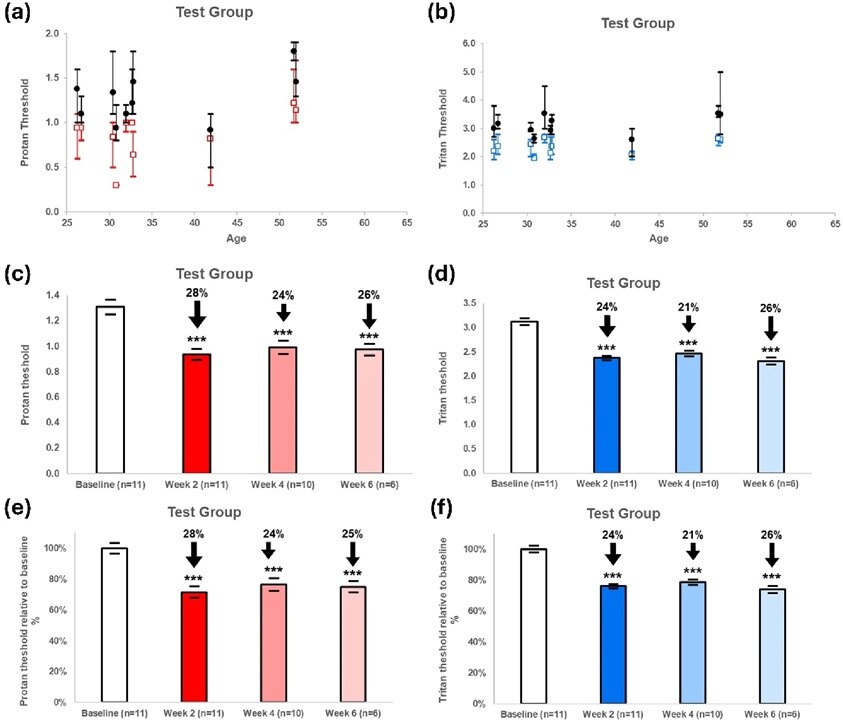
After two weeks of incandescent light exposure, protan and tritan contrast thresholds decreased from baseline. This indicates improved contrast sensitivity that persisted for weeks. (Image Credit: Scientific reports)
The team assessed visual performance via color contrast sensitivity (CCS) testing before exposure. Two weeks and four weeks after the experiment ended, they used CCS again. Specifically, they measure protan and tritan contrast sensitivity that correspond to red-green and blue-yellow visual discrimination pathways.
This measuring method determines how well a participant can detect fine color distinctions to reliably evaluate the retina’s functionality. Participants with the broader spectrum incandescent lighting showed a 25% average increase of protan and tritan in CCS. And those with the LED experienced no significant changes. Improvements remained for at least four weeks after exposure to the incandescent lighting.
However, the results are not definitive. The study had a small sample size and used a narrow set of visual performance metrics rather than ophthalmological testing. Additionally, it focused on CCS without addressing visual acuity and long-term eye health. Further studies will likely be needed before these results drive changes to lighting standards or architectural engineering practices.
Have a story tip? Message me here at element14.