


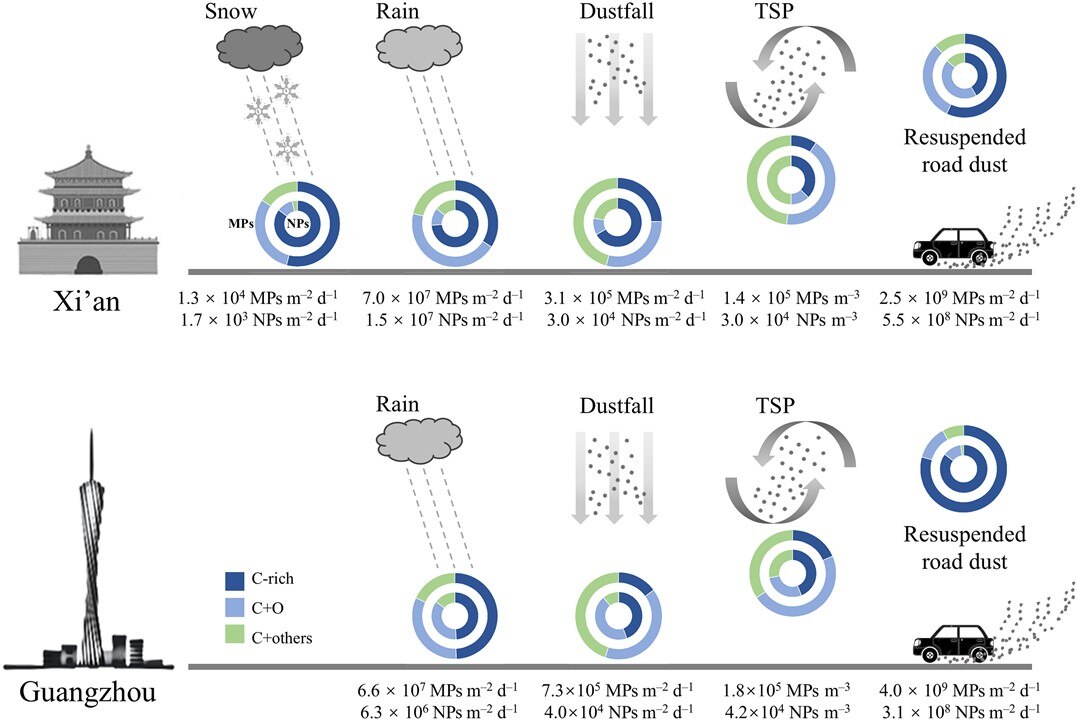
This diagram shows ring slices with polymer composition (C-rich, C+0-rich, C+others fractions) for atmospheric microplastics (outer) and nanoplastics (inner) groups, plastic fluxes from single events, TSP from 5-day composites (d, day). (Image Credit: ScienceAdvances)
Microplastics and nanoplastics are ubiquitous, found in soils, within the bodies of animals and humans, and in the air. China recently discovered two clouds containing plastic particles above Guangzhou and Xi’an. They also noted these plastic particles are small enough to remain airborne for long periods, potentially leading to cloud formation. According to the study, these particles could land somewhere else on Earth during rainy weather.
China’s researchers measured nanoplastics and microplastics in urban air through a multi-stage process involving atmospheric sampling, chemical pretreatment, and high-resolution particle analysis. The team used an all-glass midget impinger with double-distilled ultrapure water to collect airborne particles. The impinger operated at controlled flow rates, achieving size-dependent collection efficiencies down to 300-350 nm, pulling large amounts of ambient air through the liquid to trap the particulate matter.
Rainwater collectors and dry dustfall collectors placed at open-air, elevated positions collected wet deposition and dry fallout. A closed resuspension chamber simulated real-world dust re-entrainment from road dust via standardized airflow and agitation.
Each sample went through a detailed pretreatment protocol that eliminates biological and inorganic particles while preserving polymeric material. Oxidative and mild acid treatments removed organic matter and some inorganic carbonates, applied under controlled conditions to prevent polymer structure changes. All the leftover solids were then vacuum-filtered and prepared for electron microscopy analysis. This step automatically identified carbon-rich particles and applied morphology filtering to exclude soot and fly ash. It also classified the remaining carbon-based particles as plastics while minimizing analytical interference from dust, soot, and natural fibers.
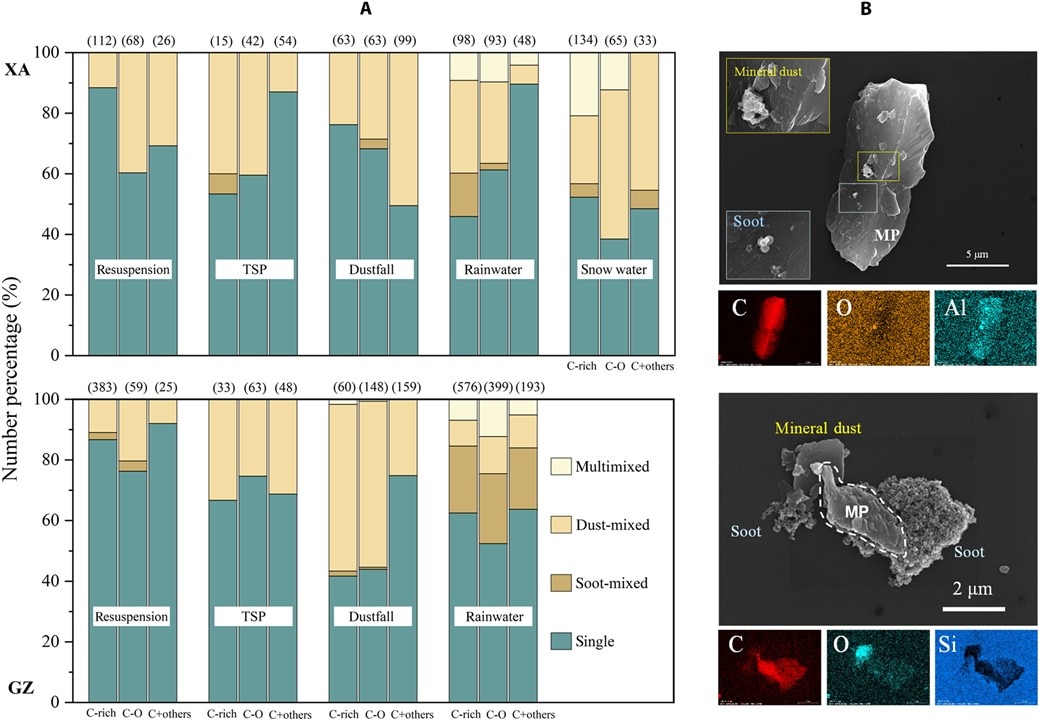
Plastics aggregated with dust/soot. CCSEM-EDX examples from Xi’an show snow water (nanoscale attachments) and rain (microscale interlocked) (Image Credit: ScienceAdvances)
For the detection system, they used a computer-controlled electron scanning microscope (CCSEM) combined with energy-dispersive X-ray spectroscopy (EDX). CCSEM relies on automated stage movement, backscattered-electron (BSE) particle recognition, and batch EDX acquisition for analyzing thousands of particles per run with minimal operator bias. Its field-emission electron source demonstrated high spatial resolution for precise detection (approximately 200nm), allowing the team to measure microplastics and the lower end of nanoplastics. The system collected specific morphological parameters for each particle, including aspect ratio, equivalent circular diameter, surface texture, etc., and captured X-ray spectra. Identifying each particle as plastic was done by applying a compositional threshold of ≥10% carbon by weight. This method follows guidelines for distinguishing carbon-rich polymers from biological residues, soot clusters, or carbonate-containing particles.
According to the paper, the CCSEM-EDX system produced size-resolved concentration data for each sampling technique. Guangzhou’s atmospheric concentrations reached roughly 1.8 x 10⁵ microplastic particles/m3 and roughly 5.0 x 10⁴ nanoplastic particles/m3 (>200 nm). Xi’an aerosols experienced similar levels: ~1.4 x 10⁵ microplastic particles/m3 and 3.2 x 10⁴ nanoplastics particles/m3. Wet deposition fluxes reached 4.0 x 10⁷-8.5 x 10⁷ particles/m2/day. Dry deposition was 2.6 x 10⁷-5.1 x 10⁷ particles/m2/day. Resuspended road dust produced extreme concentrations: up to 108 microplastics/m3, highlighting urban re-entrainment as a major source.
With this method, the team also categorized each plastic into groups, such as hydrocarbon-dominant polymers (PE, PP) and oxygen-rich polymers (PET-like signatures) based on EDX elemental motifs (relative proportions of carbon, oxygen, and minor elements). Size distributions showed 90%+ of particles <10 um, with a strong sub-1 um tail and nanoplastics (<1 um) contributing approximately 70-80% of particle number abundance across samples. Although the system can’t identify specific polymer types, it provides a high-throughput, size-resolved, and chemically informed dataset that is unmatched in atmospheric nanoplastic research.
Have a story tip? Message me here at element14.

