


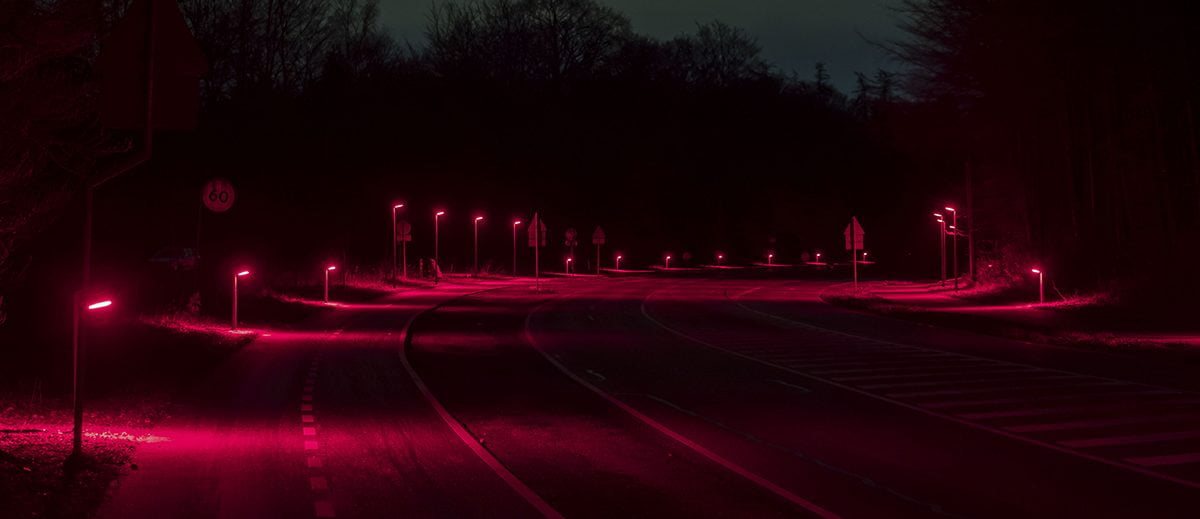
Denmark installed red LEDs in 2022 to help with biodiversity. (Image Credit: Light Bureau)
Engineers design things for interaction, for humans. HMI, GUI, touchscreen, simple buttons and switches. We interpret the world back to us. But, what if we did the same for the rest of the creatures on the planet. Here is one instance I really like.
In April 2022, drivers in Denmark saw unusual lighting while driving along Frederiksborgvej in Gladsaxe, a town on Copenhagen’s outskirts. Red lights replaced the traditional blue and white ones everyone’s used to seeing. As part of a pilot project, the LEDs are placed in suburban neighborhoods that meet dense greenery, signaling a targeted effort rather than a citywide redesign.
These red lights were installed near a bat colony to reduce the impact of artificial lighting on the nighttime ecosystem. They don’t interfere as much as white LEDs that emit blue wavelengths, which scatter through the air and confuse bats or repel insects away from their feeding zones. The pipistrelle and brown long-eared bat can then travel through the dark corridors to reach their roosting and feeding areas. Meanwhile, the red lights provide enough illumination for the drivers to see the road safely.
“Overall, we hope that everyone welcomes the new lighting and that the red light not only has functional value, but also symbolic value. The red light should make passers-by aware that this is a special natural area that we want to protect,” Philip Jelvard, Light Bureau lighting designer, said.
This is a real project and part of an international effort to create smarter, greener cities. Called Lighting Metropolis – Green Mobility, the EU-backed program connects municipalities across Denmark and Sweden to experiment with sustainable street lighting. The red LEDs are a real-world test, showing us how they can impact wildlife and energy use. They yield advantages like energy savings compared to sodium lamps. However, these also have downsides, including reduced color perception for drivers.
Additionally, this connects efforts to sustainable urban living. According to the United Nations World Urbanization Prospects 2025, cities now house 45% of the global population, with two-thirds of population growth to 2050 expected in urban settlements. These initiatives prove how interventions can help cities balance human needs with the environment.
How soon will we see this in a movie?
Have a story tip? Message me here at element14.