


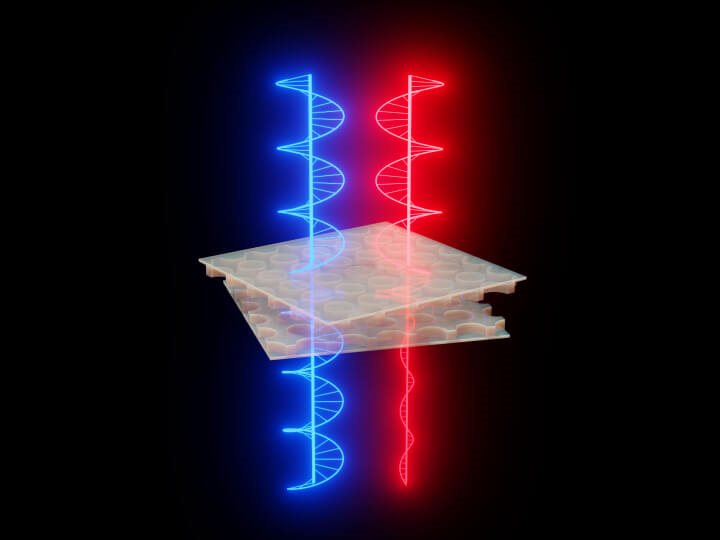
Harvard researchers developed a device that differentiates the left-or-right handedness of light. (Image Credit: Mazur group at Harvard SEAS)
Researchers at Harvard’s John A. Paulson School of Engineering and Applied Sciences (SEAS) recently developed a proof-of-concept chip-sized device that controls light chirality. It works by twisting a pair of specially designed photonic crystals. By using an integrated micro-electromechanical system (MEMS), the team can fine-tune the twisted bilayer photonic crystal (TBPhCs) in real time. The team’s invention could pave the way toward sophisticated chiral sensing, quantum photonics, and optical communication.
“Chirality is very important in many fields of science – from pharma to chemistry, biology, and of course, physics and photonics,” Eric Mazur, the Balkanski Professor of Physics and Applied Physics, said. “By integrating twisted photonic crystals with MEMS, we have a platform that is not only powerful from a physics standpoint but also compatible with the way modern photonics are manufactured.”
The team demonstrated that twisting two photonic crystal layers stacked on top of each other produces a built-in left-right asymmetry. This allows the device to control the handedness of light as it passes through. Their device is also tunable, which means responses to different chiral light types can be adjusted without replacing components.
It leverages the bilayer design to achieve this. Placing the photonic crystals close together and twisting them causes the structure to become uniformly chiral. Doing so enables the detection of chiral light. Left- or right-handed light passes through differently when both layers’ optical modes interact strongly or as light hits the surface.
A MEMS TBPhCs device allowed the team to adjust the twist angle and interlayer spacing. With this method, they adjusted how the device detects various chiral light modes that approached near-perfect selectivity to determine if light is left- or right-handed.
To confirm the optical chirality and response of the MEMS-integrated TBPhCs, the team measured the momentum-resolved transmission spectra with RCP/LCP using a near-infrared camera. A transmission dip appeared at the point associated with the antibonding dipole modes.
The circular dichroism (CD) spectrum featured two nearly placed peaks with opposite handedness. Those peaks matched the resonance dips, and the CD extrema spectral positions may not match the transmission minima due to different definitions.
“Note that although the non-zero CD values are common in the band structure, the majority of them originate from extrinsic optical chirality that relies on oblique incidence. As we focus on the vertical dashed line indicating the point, the non-zero CD only exists at around, revealing the rarity of intrinsic optical chirality,” the team wrote in the paper.
The team believes their device could lead to chiral sensors or light modulators for optical communications that enable on-chip control of light.
Have a story tip? Message me here at element14.