element14 Community
element14 Community
    Register Log In
  • Site
  • Search
  • Log In Register
  • Community Hub
    Community Hub
    • What's New on element14
    • Feedback and Support
    • Benefits of Membership
    • Personal Blogs
    • Members Area
    • Achievement Levels
  • Learn
    Learn
    • Ask an Expert
    • eBooks
    • element14 presents
    • Learning Center
    • Tech Spotlight
    • STEM Academy
    • Webinars, Training and Events
    • Learning Groups
  • Technologies
    Technologies
    • 3D Printing
    • FPGA
    • Industrial Automation
    • Internet of Things
    • Power & Energy
    • Sensors
    • Technology Groups
  • Challenges & Projects
    Challenges & Projects
    • Design Challenges
    • element14 presents Projects
    • Project14
    • Arduino Projects
    • Raspberry Pi Projects
    • Project Groups
  • Products
    Products
    • Arduino
    • Avnet & Tria Boards Community
    • Dev Tools
    • Manufacturers
    • Multicomp Pro
    • Product Groups
    • Raspberry Pi
    • RoadTests & Reviews
  • About Us
    About the element14 Community
  • Store
    Store
    • Visit Your Store
    • Choose another store...
      • Europe
      •  Austria (German)
      •  Belgium (Dutch, French)
      •  Bulgaria (Bulgarian)
      •  Czech Republic (Czech)
      •  Denmark (Danish)
      •  Estonia (Estonian)
      •  Finland (Finnish)
      •  France (French)
      •  Germany (German)
      •  Hungary (Hungarian)
      •  Ireland
      •  Israel
      •  Italy (Italian)
      •  Latvia (Latvian)
      •  
      •  Lithuania (Lithuanian)
      •  Netherlands (Dutch)
      •  Norway (Norwegian)
      •  Poland (Polish)
      •  Portugal (Portuguese)
      •  Romania (Romanian)
      •  Russia (Russian)
      •  Slovakia (Slovak)
      •  Slovenia (Slovenian)
      •  Spain (Spanish)
      •  Sweden (Swedish)
      •  Switzerland(German, French)
      •  Turkey (Turkish)
      •  United Kingdom
      • Asia Pacific
      •  Australia
      •  China
      •  Hong Kong
      •  India
      •  Japan
      •  Korea (Korean)
      •  Malaysia
      •  New Zealand
      •  Philippines
      •  Singapore
      •  Taiwan
      •  Thailand (Thai)
      •  Vietnam
      • Americas
      •  Brazil (Portuguese)
      •  Canada
      •  Mexico (Spanish)
      •  United States
      Can't find the country/region you're looking for? Visit our export site or find a local distributor.
  • Translate
  • Profile
  • Settings
Sensors
  • Technologies
  • More
Sensors
Blog Electronics Engineer Builds a PLFM Open-Source Radar System
  • Blog
  • Forum
  • Documents
  • Quiz
  • Events
  • Polls
  • Members
  • Mentions
  • Sub-Groups
  • Tags
  • More
  • Cancel
  • New
Join Sensors to participate - click to join for free!
  • Share
  • More
  • Cancel
Group Actions
  • Group RSS
  • More
  • Cancel
Engagement
  • Author Author: Catwell
  • Date Created: 22 Apr 2026 8:03 PM Date Created
  • Views 15 views
  • Likes 2 likes
  • Comments 0 comments
  • diy
  • open
  • radar
  • open source
  • sensor
Related
Recommended

Electronics Engineer Builds a PLFM Open-Source Radar System

Catwell
Catwell
22 Apr 2026

image

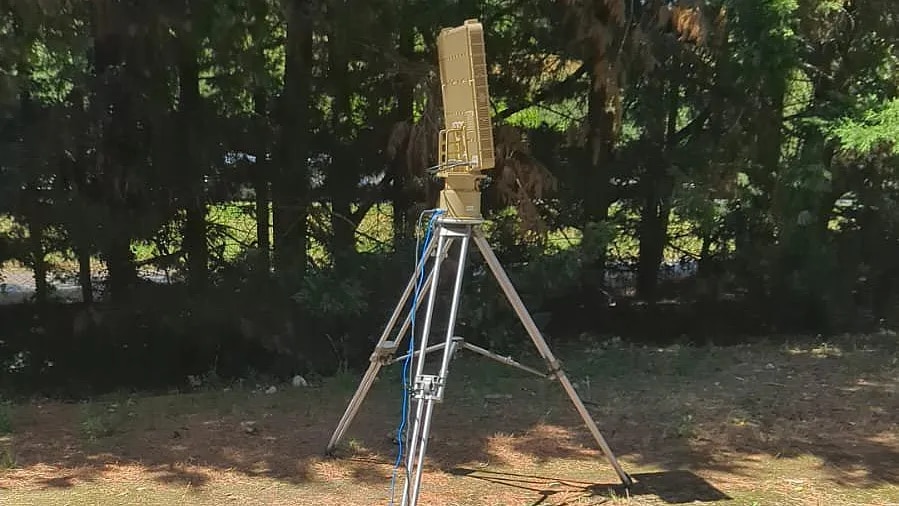
Nawfal built an affordable and accessible radar system that operates at 10.5 GHz. (Image Credit: Nawfal Motii)

Morocco-based electronics engineer Nawfal developed an affordable, open-source AERIS-10 radar system that combines SDR hardware with a programmable architecture. Nawfal made two versions: AERIS-10N (3 km max. range) and the AERIS-10E (20 km max. range). The phased-array operates at a frequency of 10.5 GHz and uses Pulse Linear Frequency Modulation (PLFM). He says this radar is built for researchers, drone developers, and SDR enthusiasts.

So, how does the radar work? It runs through a timed boot and scanning sequence. The STM32 MCU cycles power before waiting for the Oven-Controlled Crystal Oscillator (OCXO) to thermally stabilize and manage voltage sequencing for the AD9523 clock generator. The microcontroller configures the AD9523, establishing a clock distribution network that synchronizes the FPGA and RF components with precise phase alignment.

Afterward, the system initializes the GPS, IMU, barometer, two ADF4382 frequency synthesizers (one to transmit and one to receive), and four ADAR1000 beamforming chips. When an operator presses ‘Start’ in the Python GUI, the interface transmits a handshake packet and radar settings to the STM32 controller. The MCU verifies that the configuration monitors the GPS stream and waits for a lock before sending position data to the GUI. That data is used by the interface to center its map on the radar’s location, providing the operator with spatial context for targets.

While the GPS updates, the STM32 reads the IMU and barometer to calculate the pitch, roll, yaw, and altitude. The yaw data instructs the stepper motor to turn the antenna, enabling the scan to start from a known reference direction. Using this configuration ensures the radar’s angular measurement remains consistent.

Next, the RF chain enters the phase-coherent operation. The microcontroller sets the two ADF4382 synthesizers, executing a system synchronization step to keep the oscillators aligned. Maintaining this coherence is required for Doppler processing and coherent pulse compression, improving target detection and velocity measurement.

The XC7A100T FPGA then handles the fast signal processing. While doing so, it produces chirps, captures echoes, and performs down-conversion (achieve with two LT5552 microwave mixers). Along with that, it applies filtering, pulse compression, Doppler FFT, moving target indication, and CFAR detection before transmitting results to the GUI.  

Those interested in the project can visit the GitHub page and build their own radar system. However, this will require electronic and mechanical knowledge. To make it more accessible, Nawfal reached an agreement with the Crowd Supply platform to reach a Q3 2026 release.

Have a story tip? Message me here at element14.

  • Sign in to reply
element14 Community

element14 is the first online community specifically for engineers. Connect with your peers and get expert answers to your questions.

  • Members
  • Learn
  • Technologies
  • Challenges & Projects
  • Products
  • Store
  • About Us
  • Feedback & Support
  • FAQs
  • Terms of Use
  • Privacy Policy
  • Legal and Copyright Notices
  • Sitemap
  • Cookies

An Avnet Company © 2026 Premier Farnell Limited. All Rights Reserved.

Premier Farnell Ltd, registered in England and Wales (no 00876412), registered office: Farnell House, Forge Lane, Leeds LS12 2NE.

ICP 备案号 10220084.

Follow element14

  • X
  • Facebook
  • linkedin
  • YouTube