element14 Community
element14 Community
    Register Log In
  • Site
  • Search
  • Log In Register
  • Community Hub
    Community Hub
    • What's New on element14
    • Feedback and Support
    • Benefits of Membership
    • Personal Blogs
    • Members Area
    • Achievement Levels
  • Learn
    Learn
    • Ask an Expert
    • eBooks
    • element14 presents
    • Learning Center
    • Tech Spotlight
    • STEM Academy
    • Webinars, Training and Events
    • Learning Groups
  • Technologies
    Technologies
    • 3D Printing
    • FPGA
    • Industrial Automation
    • Internet of Things
    • Power & Energy
    • Sensors
    • Technology Groups
  • Challenges & Projects
    Challenges & Projects
    • Design Challenges
    • element14 presents Projects
    • Project14
    • Arduino Projects
    • Raspberry Pi Projects
    • Project Groups
  • Products
    Products
    • Arduino
    • Avnet & Tria Boards Community
    • Dev Tools
    • Manufacturers
    • Multicomp Pro
    • Product Groups
    • Raspberry Pi
    • RoadTests & Reviews
  • About Us
  • Store
    Store
    • Visit Your Store
    • Choose another store...
      • Europe
      •  Austria (German)
      •  Belgium (Dutch, French)
      •  Bulgaria (Bulgarian)
      •  Czech Republic (Czech)
      •  Denmark (Danish)
      •  Estonia (Estonian)
      •  Finland (Finnish)
      •  France (French)
      •  Germany (German)
      •  Hungary (Hungarian)
      •  Ireland
      •  Israel
      •  Italy (Italian)
      •  Latvia (Latvian)
      •  
      •  Lithuania (Lithuanian)
      •  Netherlands (Dutch)
      •  Norway (Norwegian)
      •  Poland (Polish)
      •  Portugal (Portuguese)
      •  Romania (Romanian)
      •  Russia (Russian)
      •  Slovakia (Slovak)
      •  Slovenia (Slovenian)
      •  Spain (Spanish)
      •  Sweden (Swedish)
      •  Switzerland(German, French)
      •  Turkey (Turkish)
      •  United Kingdom
      • Asia Pacific
      •  Australia
      •  China
      •  Hong Kong
      •  India
      • Japan
      •  Korea (Korean)
      •  Malaysia
      •  New Zealand
      •  Philippines
      •  Singapore
      •  Taiwan
      •  Thailand (Thai)
      • Vietnam
      • Americas
      •  Brazil (Portuguese)
      •  Canada
      •  Mexico (Spanish)
      •  United States
      Can't find the country/region you're looking for? Visit our export site or find a local distributor.
  • Translate
  • Profile
  • Settings
Sensors
  • Technologies
  • More
Sensors
Blog Engineers Develop LED Device to Kill Cancer Cells
  • Blog
  • Forum
  • Documents
  • Quiz
  • Events
  • Polls
  • Members
  • Mentions
  • Sub-Groups
  • Tags
  • More
  • Cancel
  • New
Join Sensors to participate - click to join for free!
  • Share
  • More
  • Cancel
Group Actions
  • Group RSS
  • More
  • Cancel
Engagement
  • Author Author: Catwell
  • Date Created: 17 Jul 2024 6:24 PM Date Created
  • Views 1188 views
  • Likes 5 likes
  • Comments 1 comment
  • on_campus
  • implant
  • led
  • cabeatwell
  • university
  • medical
  • notre_dame
  • sensor
  • innovation
Related
Recommended

Engineers Develop LED Device to Kill Cancer Cells

Catwell
Catwell
17 Jul 2024

image

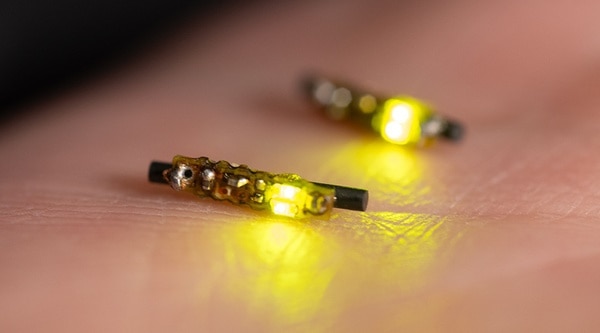
The LED device could help fight deep-seated cancers. (Image Credit: University of Notre Dame)

Cancers near or on the skin can be effectively treated through specific light types. However, deep-seated cancers surrounded by blood, tissue, and bone are too far away for that light treatment therapy. Engineers at the University of Notre Dame developed a tiny, wireless, implantable LED device for deep-seated cancer treatments. It has a light-sensitive dye responsible for killing cancer cells and mobilizing the immune system’s cancer-targeting response.

“Certain colors of light penetrate tissue deeper than other ones,” said Thomas O’Sullivan, associate professor of electrical engineering and co-author of the paper. “It turns out that the kind of light, in this case green, that doesn’t penetrate as deeply, has the capability of producing a more robust response against the cancer cells.”

A dye with light-sensitive molecules is injected into tumor cells. An external antenna turns on the device before the dye absorbs the light and transforms it into energy that turns the cancer cells’ oxygen toxic. This process causes the cells to destroy themselves.

“Working together, biochemistry graduate student, Hailey Sanders, and electrical engineering graduate student, SungHoon Rho, perceptively noted that the treated cells were swelling, which is the hallmark of a kind of cell death, pyroptosis, that’s particularly good at triggering the immune response,” said Bradley Smith, professor of chemistry and biochemistry and co-author on the paper.

He continued, “Our goal is to induce just a little bit of pyroptotic cell death, which will then trigger the immune system to start attacking the cancer.”

The team wants to experiment with this device on mice next. By doing so, they hope to determine if the cancer-killing response in one tumor causes the immune system to identify and attack other cancer cells. This technology could help progress deep-rooted cancer treatments.

Have a story tip? Message me at: http://twitter.com/Cabe_Atwell

  • Sign in to reply
  • kmikemoo
    kmikemoo over 1 year ago

    I hope this works.

    • Cancel
    • Vote Up 0 Vote Down
    • Sign in to reply
    • More
    • Cancel
element14 Community

element14 is the first online community specifically for engineers. Connect with your peers and get expert answers to your questions.

  • Members
  • Learn
  • Technologies
  • Challenges & Projects
  • Products
  • Store
  • About Us
  • Feedback & Support
  • FAQs
  • Terms of Use
  • Privacy Policy
  • Legal and Copyright Notices
  • Sitemap
  • Cookies

An Avnet Company © 2025 Premier Farnell Limited. All Rights Reserved.

Premier Farnell Ltd, registered in England and Wales (no 00876412), registered office: Farnell House, Forge Lane, Leeds LS12 2NE.

ICP 备案号 10220084.

Follow element14

  • X
  • Facebook
  • linkedin
  • YouTube