element14 Community
element14 Community
    Register Log In
  • Site
  • Search
  • Log In Register
  • Community Hub
    Community Hub
    • What's New on element14
    • Feedback and Support
    • Benefits of Membership
    • Personal Blogs
    • Members Area
    • Achievement Levels
  • Learn
    Learn
    • Ask an Expert
    • eBooks
    • element14 presents
    • Learning Center
    • Tech Spotlight
    • STEM Academy
    • Webinars, Training and Events
    • Learning Groups
  • Technologies
    Technologies
    • 3D Printing
    • FPGA
    • Industrial Automation
    • Internet of Things
    • Power & Energy
    • Sensors
    • Technology Groups
  • Challenges & Projects
    Challenges & Projects
    • Design Challenges
    • element14 presents Projects
    • Project14
    • Arduino Projects
    • Raspberry Pi Projects
    • Project Groups
  • Products
    Products
    • Arduino
    • Avnet & Tria Boards Community
    • Dev Tools
    • Manufacturers
    • Multicomp Pro
    • Product Groups
    • Raspberry Pi
    • RoadTests & Reviews
  • About Us
    About the element14 Community
  • Store
    Store
    • Visit Your Store
    • Choose another store...
      • Europe
      •  Austria (German)
      •  Belgium (Dutch, French)
      •  Bulgaria (Bulgarian)
      •  Czech Republic (Czech)
      •  Denmark (Danish)
      •  Estonia (Estonian)
      •  Finland (Finnish)
      •  France (French)
      •  Germany (German)
      •  Hungary (Hungarian)
      •  Ireland
      •  Israel
      •  Italy (Italian)
      •  Latvia (Latvian)
      •  
      •  Lithuania (Lithuanian)
      •  Netherlands (Dutch)
      •  Norway (Norwegian)
      •  Poland (Polish)
      •  Portugal (Portuguese)
      •  Romania (Romanian)
      •  Russia (Russian)
      •  Slovakia (Slovak)
      •  Slovenia (Slovenian)
      •  Spain (Spanish)
      •  Sweden (Swedish)
      •  Switzerland(German, French)
      •  Turkey (Turkish)
      •  United Kingdom
      • Asia Pacific
      •  Australia
      •  China
      •  Hong Kong
      •  India
      •  Japan
      •  Korea (Korean)
      •  Malaysia
      •  New Zealand
      •  Philippines
      •  Singapore
      •  Taiwan
      •  Thailand (Thai)
      •  Vietnam
      • Americas
      •  Brazil (Portuguese)
      •  Canada
      •  Mexico (Spanish)
      •  United States
      Can't find the country/region you're looking for? Visit our export site or find a local distributor.
  • Translate
  • Profile
  • Settings
Sensors
  • Technologies
  • More
Sensors
Blog Engineers Develop Living Circuit Boards Using Bacteria That Work Like Transistors
  • Blog
  • Forum
  • Documents
  • Quiz
  • Events
  • Polls
  • Members
  • Mentions
  • Sub-Groups
  • Tags
  • More
  • Cancel
  • New
Join Sensors to participate - click to join for free!
  • Share
  • More
  • Cancel
Group Actions
  • Group RSS
  • More
  • Cancel
Engagement
  • Author Author: Catwell
  • Date Created: 25 Aug 2026 8:55 PM Date Created
  • Views 13 views
  • Likes 1 like
  • Comments 1 comment
  • research
  • mit
  • on_campus
  • biomimicry
  • organic
  • bio-circuit
  • university
  • innovation
Related
Recommended

Engineers Develop Living Circuit Boards Using Bacteria That Work Like Transistors

Catwell
Catwell
25 Aug 2026

image

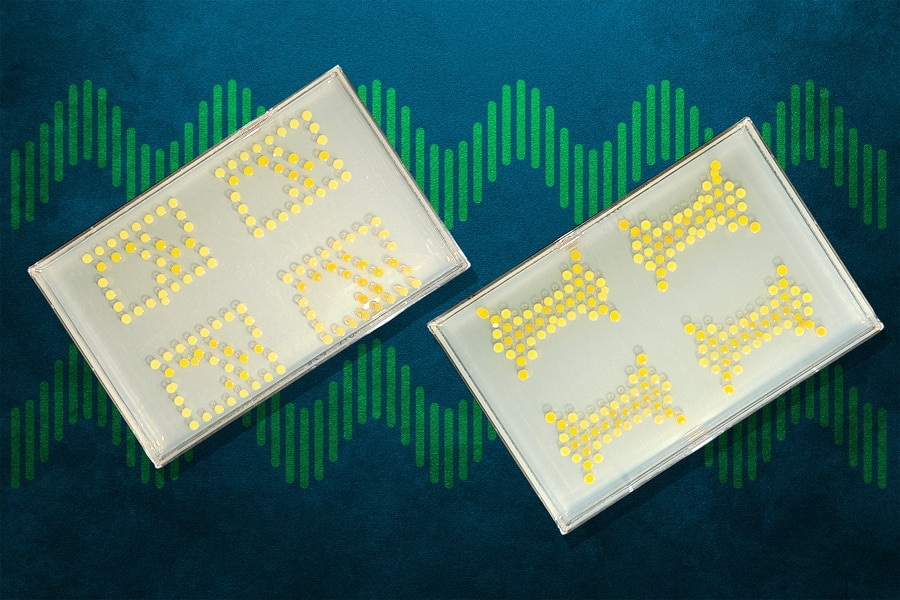
MIT has engineered bacteria to function like transistors for living circuit boards. (Image Credit: MIT)

Transistors are used in circuitry to control electrical signal flow. But now there is a bio-inspired one. MIT engineers modified bacteria that can be integrated into larger circuits and perform switching similar to transistors. With this technique, computational systems could operate in biological environments, where it’s challenging to deploy electronics.    

A bacterium called Pantoea agglomerans, found on surfaces like plants, was used as the groundwork for the team’s system. Instead of loading a computational circuit into one cell, they engineered individual bacterial strains for simple switching functionality. They can then connect those components, forming a more complex biological circuit.

The team printed bacterial colonies onto plates containing agar, spacing each colony 5 mm apart. This spacing limits signal transmission to nearby colonies, ensuring each one passes information to the next and creates a one-way path throughout the circuit.

This system features two types of bacterial transistors along with three additional strains that work like molecular relays (OC-6, OC-12, and OHC-14). These resistors don’t respond to electrical current, but rather chemical signals. The OC-6 molecule acts like the control input, turning the transistor on/off. Meanwhile, OC-12 acts like the signal/input being processed. And finally, OHC-14 is the output signal produced by the transistor.

All the relay strains serve as wiring between each component. These turn the output signal into another molecular signal that makes a downstream transistor active. Controlling which bacterial colonies are set beside each other allows the team to modify how data moves through the circuit. This is achieved without the need to genetically redesign the components.

Their technique solves an issue with synthetic-biology circuits. Placing various functions within the same cell crowds the molecular machinery. At the same time, interacting genetic components may cause interference with each other. Isolating those functions into specialized strains enables the team to assemble more complex architectures from a small set of building blocks.

The researchers showed that the bio circuit performs multiple inputs and several types of logic operations. In addition, they developed a demultiplexer that sends a signal toward one of the outputs, depending on a control input. Transistors were combined into more complex circuits, including one that adds two inputs. The biggest circuit they built connected 24 bacterial colonies.

However, these systems aren’t as fast as electronic processors. It takes approximately eight hours to run a calculation. Even then, the top priority isn’t speed. The team believes the system is more ideal for operating where living systems exist. In the future, bacterial circuits could be placed on plant leaves or roots to detect drought and pests, and trigger a biological response.

Have a story tip? Message me here at element14.

  • Sign in to reply
  • DAB
    DAB 4 hours ago

    Could be an interesting way to send out long range probes into the solar system that will take millennia to complete.

    • Cancel
    • Vote Up 0 Vote Down
    • Sign in to reply
    • More
    • Cancel
element14 Community

element14 is the first online community specifically for engineers. Connect with your peers and get expert answers to your questions.

  • Members
  • Learn
  • Technologies
  • Challenges & Projects
  • Products
  • Store
  • About Us
  • Feedback & Support
  • FAQs
  • Terms of Use
  • Privacy Policy
  • Legal and Copyright Notices
  • Sitemap
  • Cookies

An Avnet Company © 2026 Premier Farnell Limited. All Rights Reserved.

Premier Farnell Ltd, registered in England and Wales (no 00876412), registered office: Farnell House, Forge Lane, Leeds LS12 2NE.

Follow element14

  • X
  • Facebook
  • linkedin
  • YouTube