element14 Community
element14 Community
    Register Log In
  • Site
  • Search
  • Log In Register
  • Community Hub
    Community Hub
    • What's New on element14
    • Feedback and Support
    • Benefits of Membership
    • Personal Blogs
    • Members Area
    • Achievement Levels
  • Learn
    Learn
    • Ask an Expert
    • eBooks
    • element14 presents
    • Learning Center
    • Tech Spotlight
    • STEM Academy
    • Webinars, Training and Events
    • Learning Groups
  • Technologies
    Technologies
    • 3D Printing
    • FPGA
    • Industrial Automation
    • Internet of Things
    • Power & Energy
    • Sensors
    • Technology Groups
  • Challenges & Projects
    Challenges & Projects
    • Design Challenges
    • element14 presents Projects
    • Project14
    • Arduino Projects
    • Raspberry Pi Projects
    • Project Groups
  • Products
    Products
    • Arduino
    • Avnet & Tria Boards Community
    • Dev Tools
    • Manufacturers
    • Multicomp Pro
    • Product Groups
    • Raspberry Pi
    • RoadTests & Reviews
  • About Us
    About the element14 Community
  • Store
    Store
    • Visit Your Store
    • Choose another store...
      • Europe
      •  Austria (German)
      •  Belgium (Dutch, French)
      •  Bulgaria (Bulgarian)
      •  Czech Republic (Czech)
      •  Denmark (Danish)
      •  Estonia (Estonian)
      •  Finland (Finnish)
      •  France (French)
      •  Germany (German)
      •  Hungary (Hungarian)
      •  Ireland
      •  Israel
      •  Italy (Italian)
      •  Latvia (Latvian)
      •  
      •  Lithuania (Lithuanian)
      •  Netherlands (Dutch)
      •  Norway (Norwegian)
      •  Poland (Polish)
      •  Portugal (Portuguese)
      •  Romania (Romanian)
      •  Russia (Russian)
      •  Slovakia (Slovak)
      •  Slovenia (Slovenian)
      •  Spain (Spanish)
      •  Sweden (Swedish)
      •  Switzerland(German, French)
      •  Turkey (Turkish)
      •  United Kingdom
      • Asia Pacific
      •  Australia
      •  China
      •  Hong Kong
      •  India
      •  Japan
      •  Korea (Korean)
      •  Malaysia
      •  New Zealand
      •  Philippines
      •  Singapore
      •  Taiwan
      •  Thailand (Thai)
      •  Vietnam
      • Americas
      •  Brazil (Portuguese)
      •  Canada
      •  Mexico (Spanish)
      •  United States
      Can't find the country/region you're looking for? Visit our export site or find a local distributor.
  • Translate
  • Profile
  • Settings
Sensors
  • Technologies
  • More
Sensors
Blog ETH Zurich Engineers Develop Small Magnets That Achieve 38 and 42 Tesla
  • Blog
  • Forum
  • Documents
  • Quiz
  • Events
  • Polls
  • Members
  • Mentions
  • Sub-Groups
  • Tags
  • More
  • Cancel
  • New
Join Sensors to participate - click to join for free!
  • Share
  • More
  • Cancel
Group Actions
  • Group RSS
  • More
  • Cancel
Engagement
  • Author Author: Catwell
  • Date Created: 25 Mar 2026 7:52 PM Date Created
  • Views 14 views
  • Likes 3 likes
  • Comments 0 comments
  • mod
  • research
  • margnets
  • hmi
  • on_campus
  • university
Related
Recommended

ETH Zurich Engineers Develop Small Magnets That Achieve 38 and 42 Tesla

Catwell
Catwell
25 Mar 2026

image

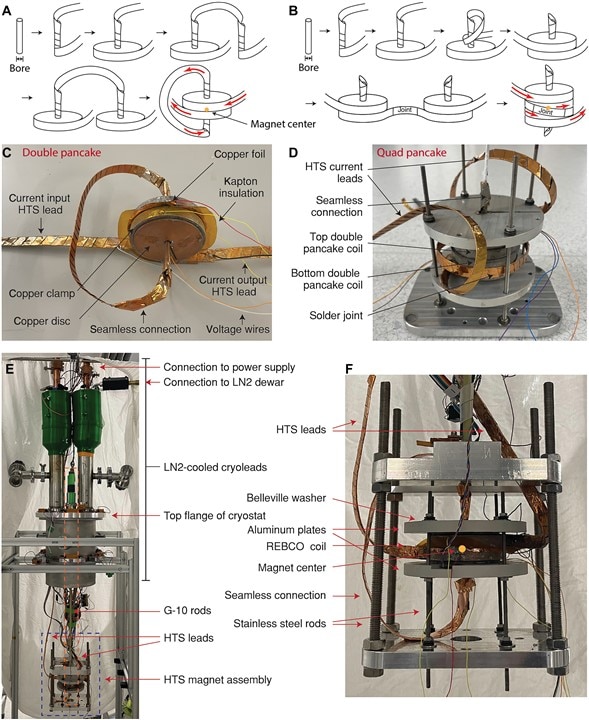
Schematic diagram showing the coils for the magnets. (Image Credit: Science Advances (2026). DOI: 10.1126/sciadv.adz5826.)

High-field magnets, especially those for Nuclear Magnetic Resonance (NMR) or particle accelerators, are massive, sometimes building-sized. Now, powerful magnets are shrinking. ETH Zurich engineers developed small magnets that can be carried in our hands and are comparable to the strongest ones we see today.  

They created two types---one generates magnetic fields of 38 tesla and the other 42 tesla. These have a 63-millimeter outer diameter and a 3.1 mm bore. Currently, the strongest magnet is at the Florida-based National High Magnetic Field Laboratory. It runs on 20 MW and achieves 45.5 tesla. 

Large resistive magnets that require megawatts of power and generate 42 tesla are composed of metal and wound around a cylinder. These also need complex cooling systems. With that in mind, the team put huge amounts of magnetic power in a small, compact space. To achieve this, they used high-temperature superconductors (HTS) tape that conducts significant amounts of energy without resistance once it reaches low temperatures.

They wrapped flat Rare Earth Barium Copper Oxide (REBCO) tape around disk-shaped pancake coils before placing them on top of each other. This allowed the magnetic field to be confined in a compact space while using less tape than standard designs. Joints that generate heat and waste power are normally used for linking magnets. The team avoided using that method by wrapping the tape in a complete loop, which also allowed electrical flow with minimal energy loss. Without tape insulation between turns, the coils were densely packed.

They experimented with both prototype magnets. Supplying them with over 1,000 A of current enabled them to generate 38 and 42 tesla. The ETH Zurich engineers are aiming to deploy this technology to NMR. Magnets like these could pave the way to tabletop systems instead of the massive machines used in facilities.

Have a story tip? Message me here at element14.

  • Sign in to reply
element14 Community

element14 is the first online community specifically for engineers. Connect with your peers and get expert answers to your questions.

  • Members
  • Learn
  • Technologies
  • Challenges & Projects
  • Products
  • Store
  • About Us
  • Feedback & Support
  • FAQs
  • Terms of Use
  • Privacy Policy
  • Legal and Copyright Notices
  • Sitemap
  • Cookies

An Avnet Company © 2026 Premier Farnell Limited. All Rights Reserved.

Premier Farnell Ltd, registered in England and Wales (no 00876412), registered office: Farnell House, Forge Lane, Leeds LS12 2NE.

ICP 备案号 10220084.

Follow element14

  • X
  • Facebook
  • linkedin
  • YouTube