


(Image Credit: TheDigitalArtist/pixabay)
Something about these developments makes me think we’re living in a dystopian science fiction timeline. Really unsettling. How much brain matter is needed for consciousness?
Cortical Labs, an Australian startup, is developing a data center powered by lab-grown human neurons combined with silicon chips. The company has already built its first facility in Melbourne and expects to build a larger one in Singapore. Both sites will feature the CL1 systems containing the neurons connected to electronic components. The goal is to determine if biological processing can work together with silicon for certain computing tasks.
Each CL1 has around 200,000 human neurons sourced from stem cells. These are grown on a silicon chip and placed on a microelectrode array, which stimulates and logs activity. Meanwhile, a life-support system maintains temperature, ensures the cells stay alive, feeds them nutrients, and keeps the environment stabilized. Software converts the biological signals into digital inputs and outputs that can be used by a standard computer. This process is called reservoir computing, where a system turns inputs into complex patterns that external software can interpret.
Cortical Labs researchers mimicked the capabilities of human neurons in experimental setups. Neurons were grown on a chip and connected to simulated environments. In closed feedback loops, the CL1 systems learned how to play Pong and interacted with other game-like systems like Doom simulations. Game state data is encoded into electrical signals transmitted to the neurons. Their responses are then decoded into actions within the simulation.
It’s not clear how the cells adapt. Researchers say it may involve the free energy principle, in which biological systems minimize uncertainty. They may even rely on Hebbian learning, where neural connections strengthen when neurons activate together. Although these could help explain learning processes, the system still isn’t fully understood.
The team says they would like to try to get the neurons to play Pokémon. But they believe future applications for these neurons lie in medicine. Researchers have already looked into using lab-grown neurons for disease modeling and drug testing. For instance, they could study epilepsy by observing how neurons respond to different compounds outside the body.
Many have explored using biological computing due to AI’s power consumption, which has increased. Typically, training and running AI systems use lots of computational resources. Large data centers supporting them use up huge amounts of power and water. Growing demand has raised questions about energy use and whether standard chip designs can be efficiently scaled.
Instead, we could use biological systems. Human brains require around 20 watts of electricity while learning, recognizing patterns, and making decisions. As a result, scientists have looked into whether neuron systems process data without using up a significant amount of power compared to silicon hardware. Silicon is better for large-scale and precise computation. Meanwhile, biological systems could outperform them in adaptive tasks like pattern recognition and decision-making.
According to Cortical Labs, its system doesn’t use a lot of power and is more efficient for computing tasks. However, the technology is still experimental, and the systems are limited in scale and capability.
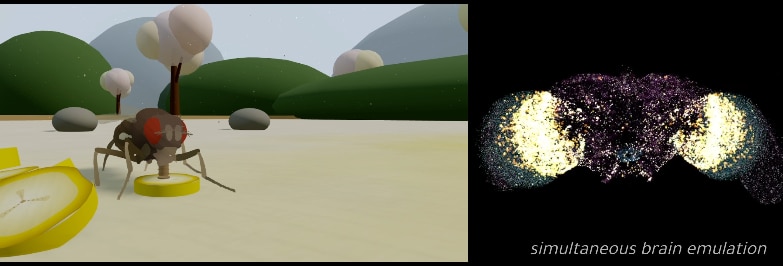
Eon Systems researchers created a virtual fly by scanning a fruit fly’s brain via electron microscopy. (Image Credit: Eon Systems)
Recently, US scientists from biotech company Eon Systems created a virtual fly that walks, flies, grooms, and feeds in a simulated environment without any training or prompting. The team scanned and reconstructed a fruit fly brain using electron microscopy to replicate its neural wiring in software. This suggests that some forms of behavior can be encoded into neural structure rather than learned through experience.
A fruit fly’s brain has approximately 140,000 neurons. Meanwhile, the virtual one has 87 joints and can copy a real fly’s basic movements and behavior. However, the simulated environment is still limited in realism.
This model can’t mimic sensory detail. Although it represents basic cues like sweet or bitter signals, it doesn’t have real-world taste or smell. And that means the simulation works more like an approximation rather than a full reproduction of a fly’s environment.
Have a story tip? Message me here at element14.