


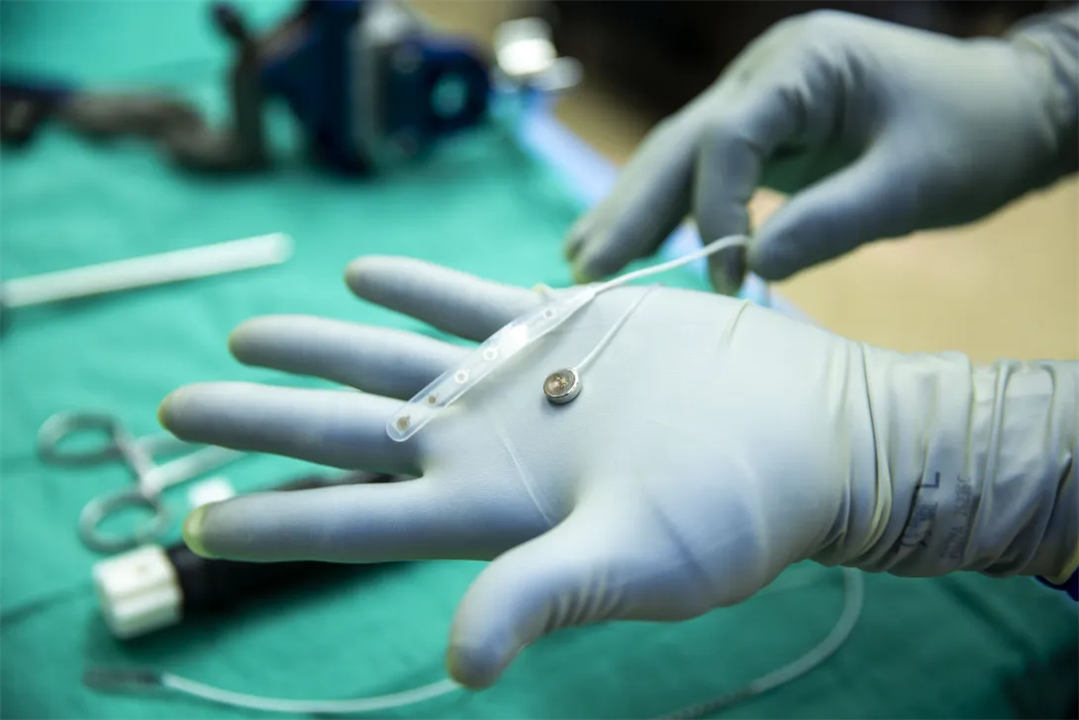
The Connexus BCI recorded neural activity as soon as they fire. (Image Credit: University of Michigan)
Elon Musk’s Neuralink has competition in the brain-computer interface (BCI) space. In collaboration with Paradromics, University of Michigan surgeons temporarily implanted the Connexus BCI in a research participant during a temporal lobectomy. The team also completed the first recording with this chip. They believe this technology could restore lost functionalities, like communication, for people with conditions affecting speech, such as motor neuron disease.
Paradromics’ Connexus is a wireless system. It has a hermetically sealed enclosure designed to prevent moisture from getting in and damaging all the electronics. The company built the BCI for long-term durability to ensure users get the most out of it for as long as possible. They hope it can provide neural recordings for over ten years. During pre-clinical trials, the Connexus implant achieved over 200 bps, 20 times faster than current BCIs.
The dime-sized implant is placed atop the brain surface and contains 421 platinum-iridium microwires embedded 1.5mm deep within the brain tissue. While there, the BCI records speech-related brain signals in the motor cortex. Extension leads route under the skin along the left side of the neck and connect to a transceiver beneath the left clavicle. Those leads send data to the transceiver that securely transmits the data to a user-worn external transceiver via a near-infrared optical link. That same external device provides power to the system via inductive charging.
Information is then sent to a computer that runs AI language models and neural decoding algorithms. Machine learning analyzes neural patterns to figure out what the patient wants to say or do. Afterward, it turns the user intent into screen text, computer commands, or synthesized speech.
“This research is incredibly significant to me because it is a goal in my lifetime to be able to see patients with untreatable neurological diseases and offer them BCIs that they can take home and use in their daily lives,” said Jordan Lam, MBBS, a neurosurgical resident at U-M Health who researches BCIs.
Paradromics expects to continue monitoring the patient over the next five years. During yjr first year, the startup planned to collect data such as safety, words per minute, vocabulary size, and how many bits of data the implant transmits during a conversation.
Have a story tip? Message me here at element14.