


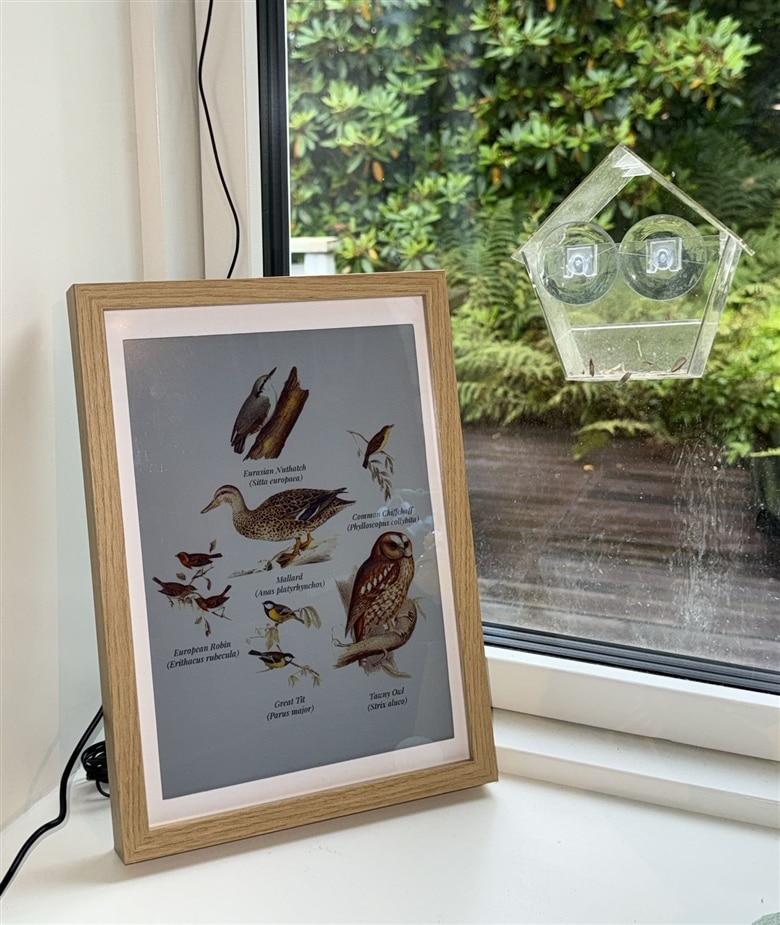
The Fugleramme device captures bird songs and draws an illustration of the species on an e-ink display. (Image Credit: arnegiacomo/GitHub)
I love love love this. It’s one of those project where you lean back and say, why didn’t I think of it.
Bird lovers and garden growers are curious about what sort of flying visitors are nearby. With Fugleramme, they can easily identify them based on the sounds they make and see them illustrated on a display. This system is built on top of BirdNET-Go, which handles the audio, machine-learning classification, and detection settings. Once it has those detections, Fugleramme converts them into a visual.
On the device, BirdNET-Go is always listening for bird calls through a USB microphone. The BirdNET-Go API is periodically polled for recent detections. After identifying a bird, Fugleramme matches each detected species with a corresponding illustration before arranging the images on the e-ink display. If the system detects a different bird, it will redraw the image instead of constantly refreshing the panel.
All illustrations are sourced from public-domain natural-history drawings. Birds are cut out with the background removed before they’re set on a textured-paper background. Bigger birds are centered on the paper and sized based on their body mass. This process produces a piece that looks similar to a traditional illustrated natural-history plate.
To achieve this, the system requires certain hardware. And that involves a Raspberry Pi 5 with 2 GB of RAM, a 32+ GB microSD card, an active cooler, an Inky Impression 13.3” Spectra 6 e-ink display (1600x1200 resolution), a USB microphone, and a 27W Raspberry Pi power supply. An A4-sized picture frame fits inside the display, making the system function like a framed artwork. The frame’s back must stay open at all times for sufficient airflow. After all, BirdNET-Go constantly runs the classifier and produces a lot of heat. According to the developer, a weaker power supply may cause the Pi to throttle or brown out under load.
It’s optional to use the e-ink panel. Fugleramme also runs as a web kiosk, which means it can be viewed from another device on the same network or via HDMI. If needed, BirdNET-Go runs on a separate computer with the device connecting to it over the network.
However, the system isn’t perfect. For example, it only pulls artwork from Northern Europe. British and Scandinavian plates cover the Nordics, the British Isles, and Germany. The microphone, where it’s placed, and surrounding conditions may affect detection quality. So far, the project supports basic password authentication for BirdNET-Go, as OIDC authentication is still under development. Although users can try different hardware, the developer hasn’t confirmed that every combination will work. A Raspberry Pi 4 could function for this project, but it hasn’t been tested. Inky display alternatives sacrifice the size and resolution of the recommended panel.
Have a story tip? Message me here at element14.
