


Table of Contents
Introduction
The SCT013 (sometimes called SCT-013) is popular in a lot of home automation projects, for monitoring the current consumption of mains devices and circuits. There are several models of it, intended for different current ranges.
Due to a lack of time I decided to experiment with an SCT013 in a not-very-thorough way.
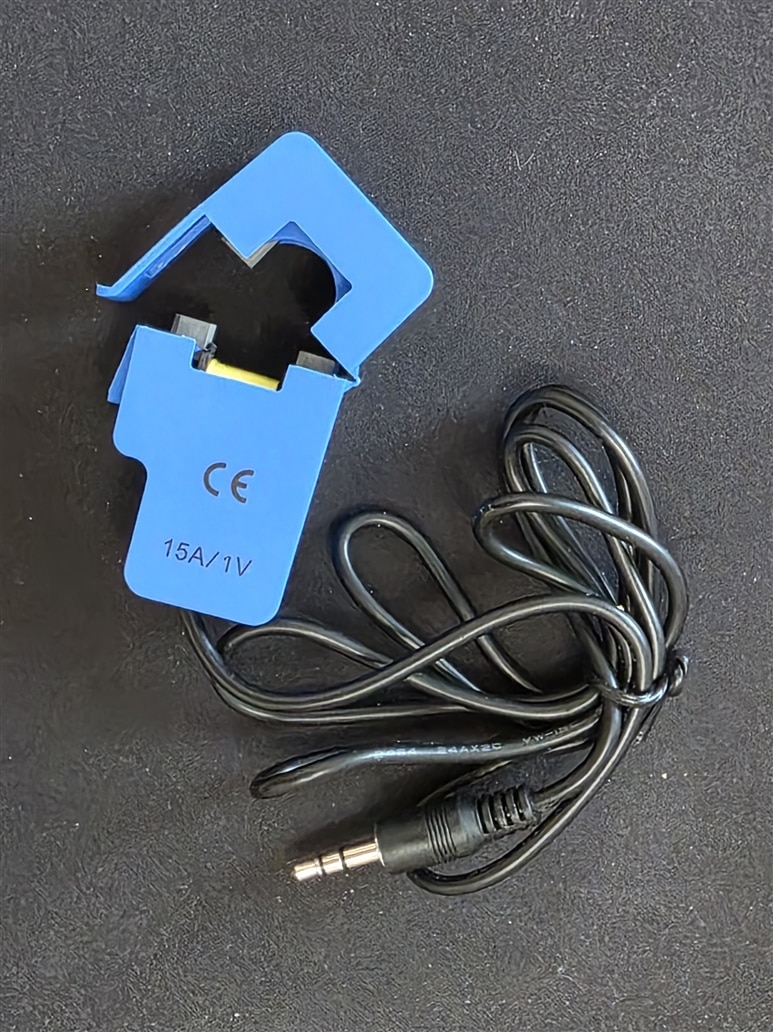
What Is It?
The SCT013 is a clampable current transformer; there is a winding and two halves of a ferrite core inside, and the plastic shell clips onto a single mains wire (which then becomes a single-turn primary winding for the transformer). An AC current flows in the secondary winding, i.e. the coil of wire inside the clamp. The SCT013 has a specified frequency range of 50 Hz to 1 kHz.
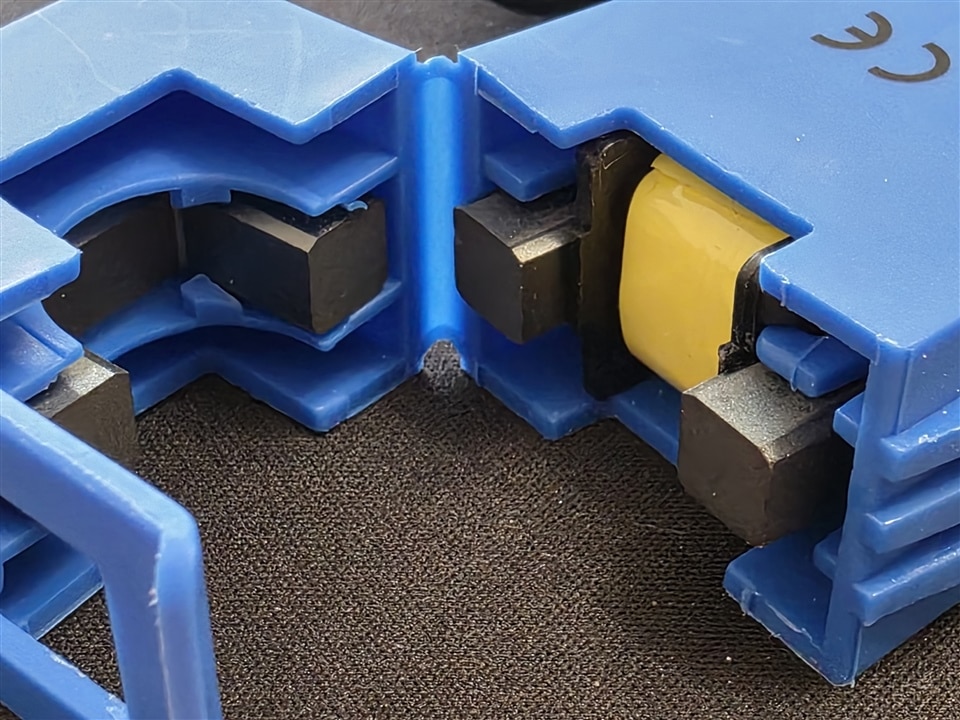
Note that as with all clamps, the SCT013 need to be used with a single mains conductor (for instance usually live, or perhaps neutral), and not the entire mains flex!
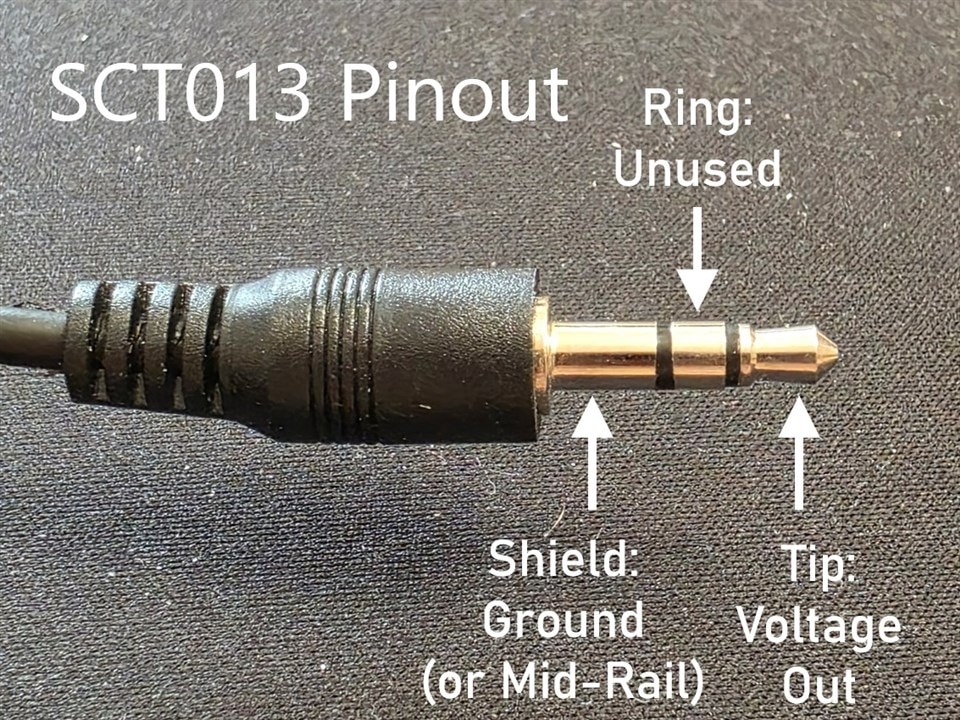
There is a resistor across the coil (it’s known as a burden resistor, and is built-in on most SCT013 models but check the specs; never operate the transformer without it!) through which current flows. Screened cable (terminated with a 3.5 mm audio plug) is attached across the resistor, so that a voltage proportional to the current can be measured relatively safely, by just connecting a multimeter (set to AC voltage) across the two terminals, or attach those two terminals to an oscilloscope, or connect to an ADC circuit (either to differential inputs, or, easier, attach the shield to a mid-rail, and connect the tip to a single-ended ADC input) and sample at a few hundred Hz.
Note that in electrically noisy environments, filtering or perhaps even ADC isolation may be needed, if you think noise may be picked up along the screened cable, i.e. usually common-mode noise.
Also, note that despite there being isolation, care still needs to be taken due to the proximity with mains wiring.
Sensitivity
There are SCT013 models that are 5A 1V or 15A 1V rated, and there are other options too. Note that the 100A model can be supplied as a 2000-turn clamp without a built-in resistor.
Here is how to interpret the sensitivity of each model in terms of millivolts per amp:
| Model | Rated Input (A) | Rated Output (V) | Sensitivity (mV/A) |
| -005 | 5 | 1 | 200 |
| -010 | 10 | 1 | 100 |
| -015 | 15 | 1 | 66.67 |
| -020 | 20 | 1 | 50 |
| -025 | 25 | 1 | 40 |
| -030 | 30 | 1 | 33.3 |
| -050 | 50 | 1 | 20 |
| -060 | 60 | 1 | 16.67 |
| -100 | 100 | 1 | 10 |
| -100 | 100 | 50 mA (requires external resistor) | User-selectable. R = 2000 * (S/1000) where S is in mV/A. Example: For 10mV/A, R=20 ohm) |
If there is no built-in resistor fitted, the formula R = Turns * (S/1000) can be used for any current transformer, where Turns is the Sec:Pri ratio, i.e. 2000 for the SCT013, and S is in mV/A.
Testbed
I used a mains breakout box to bring out the live connection, so I could place current clamps on the wire. The clamps were connected to an oscilloscope. I used an SCT013-005 model, i.e. 200mV/A sensitivity.
For the load, I used a mains fan set to its top speed because it’s a warm day!

‘Scope Traces
For this first test, I compared the SCT013 with a Pico Tech TA018 current probe. The TA018 was set to 100mV per amp.
The TA018 trace in yellow is a fraction shaky, because it is a more complicated probe (the TA018 responds from 20 kHz down to DC, it responds to magnetic fields).
| Measured Output (mV RMS) | Calculated Current (mA RMS) | |
| SCT013 (Red trace) | 62.33 | 311 |
| TA018 (Yellow trace) | 29.63 | 296 |

I compared the SCT013 with a Yokogawa current clamp which is AC-responding only. The Yokogawa clamp outputs 10mV per amp, and has a frequency response of 20 Hz to 20 kHz.
| Measured Output (mV RMS) | Calculated Current (mA RMS) | |
| SCT013 (Red trace) | 62.42 | 312 |
| Yokogawa (Yellow trace) | 2.966 | 296 |

As can be seen, the TA018 and the Yokogawa clamp measurements agree with each other, and the SCT013 measured around 5% higher.
Despite the very basic ‘scope shots for now, I think that’s fairly conclusive, the SCT013 will provide a usable measurement, but don’t expect the accuracy of a decent known-brand clamp. It could be interesting to measure the frequency response (for example, by using a power amplifier and looping the cable through the clamp several times), but again, time is limited, and I didn’t have a need, considering that the SCT013 will only ever be used for a ballpark figure, not for accuracy, where I’d use a known-brand clamp.
Example ADC Circuit
I tried the following circuit (using an ADC in-built to a microcontroller):

There's no protection in case there is a fault and the internal burden resistor is disconnected.
In my limited tests, I'm getting good measurements with this, although I need to improve my software.
Summary
The SCT013 range are affordable current clamps for basic current monitoring needs.
The clamps were compared with known-brand ones, using a fan as a load, and the output was monitored with an oscilloscope.
The conclusion was that the SCT013 is fine for non-critical measurements. I only tested one SCT013; I don't know if the results are typical for all SCT013 clamps.
Note that care must be taken when using current clamps, since they are usually in close proximity to potentially dangerous environments.
Thanks for reading.
