


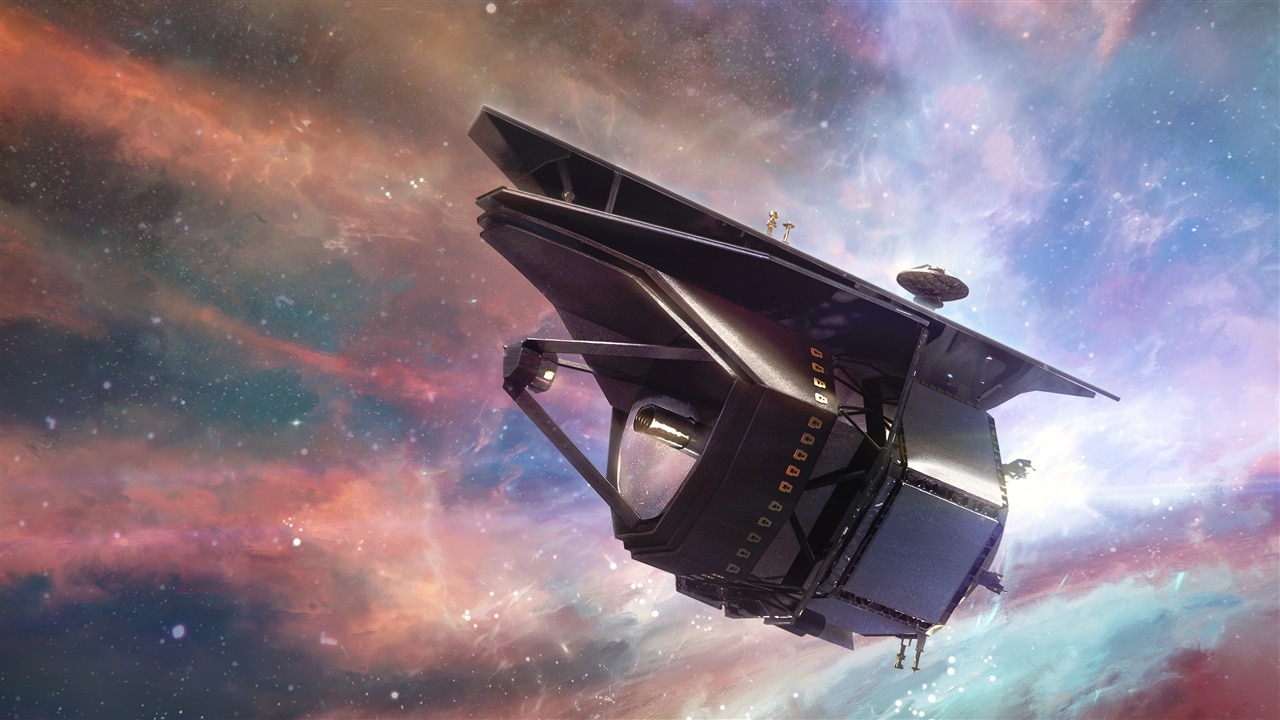
Artist’s illustration of the PRIMA observatory. (Image Credit: NASA/JPC-Caltech)
NASA recently chose the Probe Far-Infrared Mission for Astrophysics (PRIMA) to move from Phase A to Phase B, the next development stage. This brings PRIMA closer to becoming flight-ready. It also serves as the first mission in the space agency’s new class of astrophysics missions called Probe Explorers. PRIMA launches in 2033, orbiting Earth-Sun L2 and operating for five years.
The probe will study the universe in far-infrared wavelengths. By doing so, it observes cosmic objects and processes that other telescopes may not detect. According to NASA, PRIMA can help investigate how planets form outside our solar system, the evolution of galaxies and their black holes, and how dust and heavy elements built up throughout the cosmic history.
Moving into Phase B allows PRIMA’s design and technology development to advance. However, a confirmation review will take place before implementation begins. This involves examining the programmable, technical, and cost performance. NASA put a $1.2 billion project cost cap in place, but this doesn’t account for launch and non-project costs.
During its mission, PRIMA will use its 5.9-foot all-aluminum telescope (actively cooled to 4.5 K) to conduct deep far-infrared surveys. The goal is to help cover an observational gap between infrared observatories like the James Webb Space Telescope and radio telescopes.
NASA is designing PRIMA with a cryogenically cooled telescope and detectors to reduce thermal noise that may cause observation interference. The mission includes instruments like PRIMAger and FIRESS. PRIMAger (PRIMA Imager) is an imaging polarimeter that combines hyperspectral imaging from 24-84 micrometers with polarimetric imaging across 90-235 micrometers to map large sections of the sky.
Meanwhile, the Far-Infrared Enhanced Survey Spectrometer (FIRESS), a high-res spectrometer with four slit-fed grating modules that covers wavelengths from 24 to 235 micrometers, will be used for multimode spectroscopy. The standard mode has a resolving power above 85, while a high-resolution Fourier-transform mode reaches a resolving power of 4,400 at 112 micrometers. Both the PRIMAger and FIRESS instruments use kinetic inductance detectors (KIDs), with arrays totaling 11,000 to 12,000 detectors operating at extremely low temperatures (120 millikelvin).
With these capabilities, PRIMA can study cold material and phenomena across the universe, such as the formation of planetary systems and exoplanet atmosphere composition. Along with that, the mission aims to offer new observations of molecular outflow from active galaxies and supermassive black holes.
Have a story tip? Message me here at element14.