


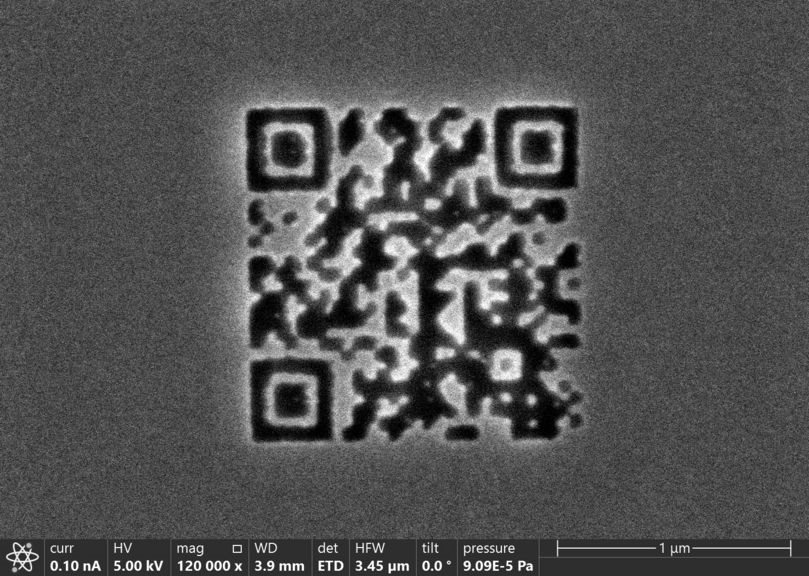
The smallest QR code is 1.98 square micrometers and can only be seen under an electron microscope. (Image Credit: TU Wien)
TU Wien recently collaborated with Cerabyte, a data storage company, to create the smallest QR code measuring just 1.98 square micrometers. Even the Guinness World Records verified and recognized this achievement. In the future, the technology could be utilized for long-term data storage. While standard magnetic or electronic data storage systems last a few years, writing data bit by bit into ceramic materials can extend the lifespan by centuries or millennia.
To make the tiny, stable QR code, the team had to select the right material. "We conduct research on thin ceramic films, such as those used for coating high-performance cutting tools," explain Erwin Peck and Balint Hajas, who played key roles in achieving the world record. "For high-performance tools, it is essential that materials remain stable and durable even under extreme conditions. And that is exactly what makes these materials ideal for data storage as well."
The researchers carved the QR code onto an ultra-thin ceramic layer with focused ion beams. Each square in the pattern measures only 49 nanometers across, an order of magnitude smaller than visible light wavelengths. This means the structure can’t interact with light to reveal its form, making it undetectable to optical microscopes. Under an electron microscope, the tiny features become visible, allowing viewers to read the QR code.
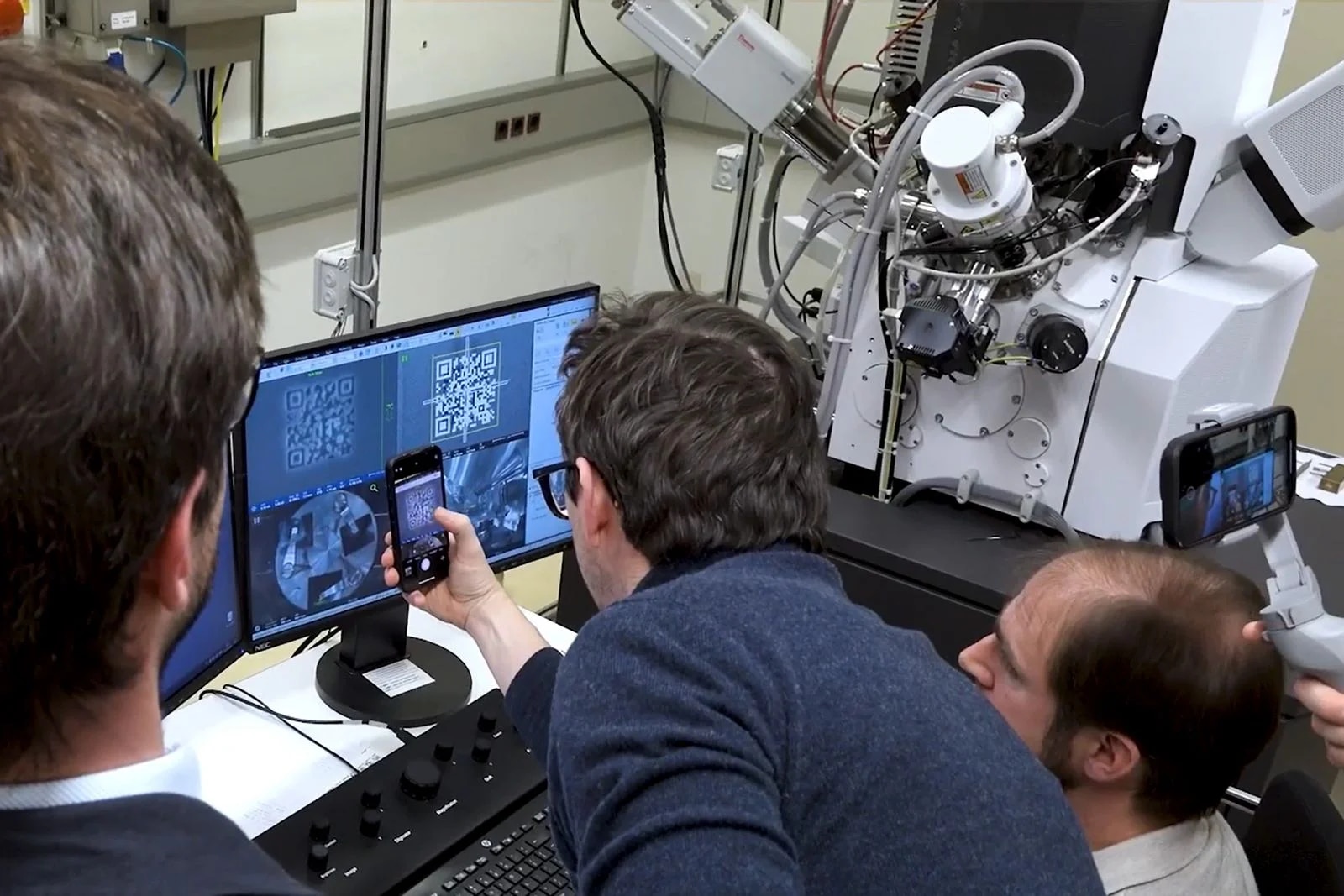
Testing the tiny QR code, which was made by focusing ion beams on a ceramic-based material. (Image Credit: TU Wien)
Their technique achieves an extraordinary storage density. For example, the surface area of an A4 sheet of paper could hold over two terabytes of data. Compared to standard storage media, ceramic-based data structures do not require power or cooling to maintain the stored data. In addition, the information is physically embedded in the material, ensuring long-term durability.
"With ceramic storage media, we are pursuing a similar approach to that of ancient cultures, whose inscriptions we can still read today," says Alexander Kirnbauer. "We write information into stable, inert materials that can withstand the passage of time and remain fully accessible to future generations."
The record-setting demonstration, which includes retrieving data with an electron microscope, was performed by TU Wien and Cerabyte. The University of Vienna validated the results as an independent authority. After review, Guinness certified the achievement. This tiny QR code occupies 37% of the area of the previous record holder.
"The now confirmed world record marks just the beginning of a very promising development," says Alexander Kirnbauer. "We now aim to use other materials, increase writing speeds, and develop scalable manufacturing processes so that ceramic data storage can be used not only in laboratories but also in industrial applications. At the same time, we are investigating how more complex data structures—far beyond simple QR codes—can be written robustly, quickly, and energy-efficiently into ceramic thin films and read out reliably."
The team believes their achievement may pave the way toward a more climate-friendly future, in which data is stored permanently, securely, and without consuming a lot of energy.
Have a story tip? Message me here at element14.
-

e14phil
-
Cancel
-
Vote Up
0
Vote Down
-
-
Sign in to reply
-
More
-
Cancel
Comment-

e14phil
-
Cancel
-
Vote Up
0
Vote Down
-
-
Sign in to reply
-
More
-
Cancel
Children