


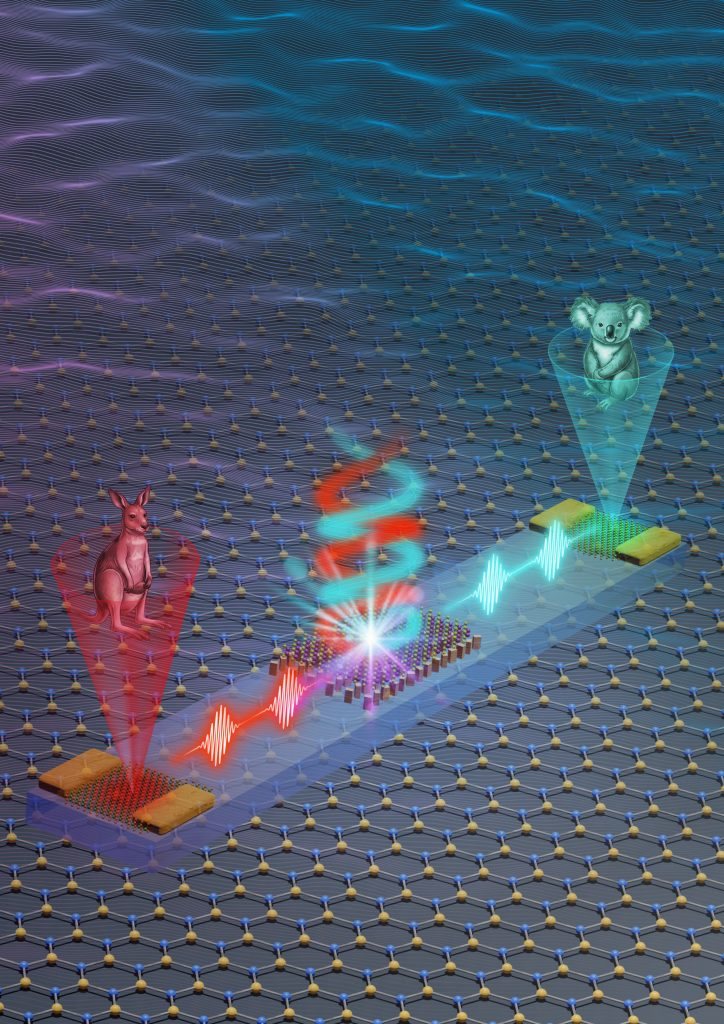
Artist’s impression of a photonic valleytronic chip that processes information. (Image Credit: Chi Linn)
Monash University researchers recently developed a tiny circuit that generates light signals, precisely routes them, and turns them into electrical signals. This happens within a chip and solves a major hurdle in valleytronics, which could enable faster, more energy-efficient computing and quantum technologies. Each light signal transmits data via the “valley degree of freedom”, a quantum property that could unlock new methods for data processing and computation.
According to Dr. Chi Li, this development addresses a limitation that held the field back for years. “Until now, we could generate or detect these signals, but not do everything in one integrated device,” Dr Li said. “What we’ve built is a complete on-chip system that can create, route and read this information with very high precision.”
Their device uses extremely thin materials that measure a few atoms thick. These work with custom-designed nanostructures that manipulate light’s behavior at tiny scales. “We employ a straightforward stacking approach to integrate ultra-thin materials with metasurfaces, overcoming the technical challenges of direct material growth on photonic structures, and enabling further advances in valleytronics,” Dr Kaijian Xing, co-first author and Research Fellow at Monash University said.
The system also runs at room temperature. Quantum technologies typically need extreme cooling to operate. So, moving away from those requirements makes this system practical for real-world applications. The team says it may lead to the next generation of compact, programmable photonic devices and enable faster, more energy-efficient computers.
“This is a significant step toward scalable, chip-based technologies that use light instead of electricity to process information,” Senior author Dr Haoran Ren, ARC Future Fellow and leader of Monash NanoMeta Group said. “Photonic devices use light to achieve massive bandwidths, ultra-fast data transmission speeds, and lower energy consumption, so what we have achieved has strong potential for applications in quantum computing, advanced imaging, and next-generation optical communication systems.”
The researchers tested their device and proved that it can encode and process two different images at the same time. “This is an important step toward fully integrated valleytronic systems,” said Professor Stefan A. Maier, Head of the School of Physics and Astronomy and Nanophotonics Laboratory at Monash. “By combining light and quantum materials on a chip, we can access new ways of encoding and processing information.”
Have a story tip? Message me here at element14.