element14 Community
element14 Community
    Register Log In
  • Site
  • Search
  • Log In Register
  • Community Hub
    Community Hub
    • What's New on element14
    • Feedback and Support
    • Benefits of Membership
    • Personal Blogs
    • Members Area
    • Achievement Levels
  • Learn
    Learn
    • Ask an Expert
    • eBooks
    • element14 presents
    • Learning Center
    • Tech Spotlight
    • STEM Academy
    • Webinars, Training and Events
    • Learning Groups
  • Technologies
    Technologies
    • 3D Printing
    • FPGA
    • Industrial Automation
    • Internet of Things
    • Power & Energy
    • Sensors
    • Technology Groups
  • Challenges & Projects
    Challenges & Projects
    • Design Challenges
    • element14 presents Projects
    • Project14
    • Arduino Projects
    • Raspberry Pi Projects
    • Project Groups
  • Products & Partners
    Products & Partners
    • Arduino
    • Avnet & Tria Boards Community
    • Dev Tools
    • Manufacturers
    • Multicomp Pro
    • Product Groups
    • Raspberry Pi
    • RoadTests & Reviews
  • About Us
    About the element14 Community
  • Store
    Store
    • Visit Your Store
    • Choose another store...
      • Europe
      •  Austria (German)
      •  Belgium (Dutch, French)
      •  Bulgaria (Bulgarian)
      •  Czech Republic (Czech)
      •  Denmark (Danish)
      •  Estonia (Estonian)
      •  Finland (Finnish)
      •  France (French)
      •  Germany (German)
      •  Hungary (Hungarian)
      •  Ireland
      •  Israel
      •  Italy (Italian)
      •  Latvia (Latvian)
      •  
      •  Lithuania (Lithuanian)
      •  Netherlands (Dutch)
      •  Norway (Norwegian)
      •  Poland (Polish)
      •  Portugal (Portuguese)
      •  Romania (Romanian)
      •  Russia (Russian)
      •  Slovakia (Slovak)
      •  Slovenia (Slovenian)
      •  Spain (Spanish)
      •  Sweden (Swedish)
      •  Switzerland(German, French)
      •  Turkey (Turkish)
      •  United Kingdom
      • Asia Pacific
      •  Australia
      •  China
      •  Hong Kong
      •  India
      •  Japan
      •  Korea (Korean)
      •  Malaysia
      •  New Zealand
      •  Philippines
      •  Singapore
      •  Taiwan
      •  Thailand (Thai)
      •  Vietnam
      • Americas
      •  Brazil (Portuguese)
      •  Canada
      •  Mexico (Spanish)
      •  United States
      Can't find the country/region you're looking for? Visit our export site or find a local distributor.
  • Translate
  • Profile
  • Settings
Sensors
  • Technologies
  • More
Sensors
Blog Researchers Develop a Tiny Device That Functions Like a Human Brain
  • Blog
  • Forum
  • Documents
  • Quiz
  • Events
  • Polls
  • Members
  • Mentions
  • Sub-Groups
  • Tags
  • More
  • Cancel
  • New
Join Sensors to participate - click to join for free!
  • Share
  • More
  • Cancel
Group Actions
  • Group RSS
  • More
  • Cancel
Engagement
  • Author Author: Catwell
  • Date Created: 11 Nov 2026 8:05 PM Date Created
  • Views 25 views
  • Likes 3 likes
  • Comments 0 comments
  • Processor
  • hmi
  • University of Würzburg
  • university
  • sensor
  • brain
  • innovation
Related
Recommended

Researchers Develop a Tiny Device That Functions Like a Human Brain

Catwell
Catwell
11 Nov 2026

image

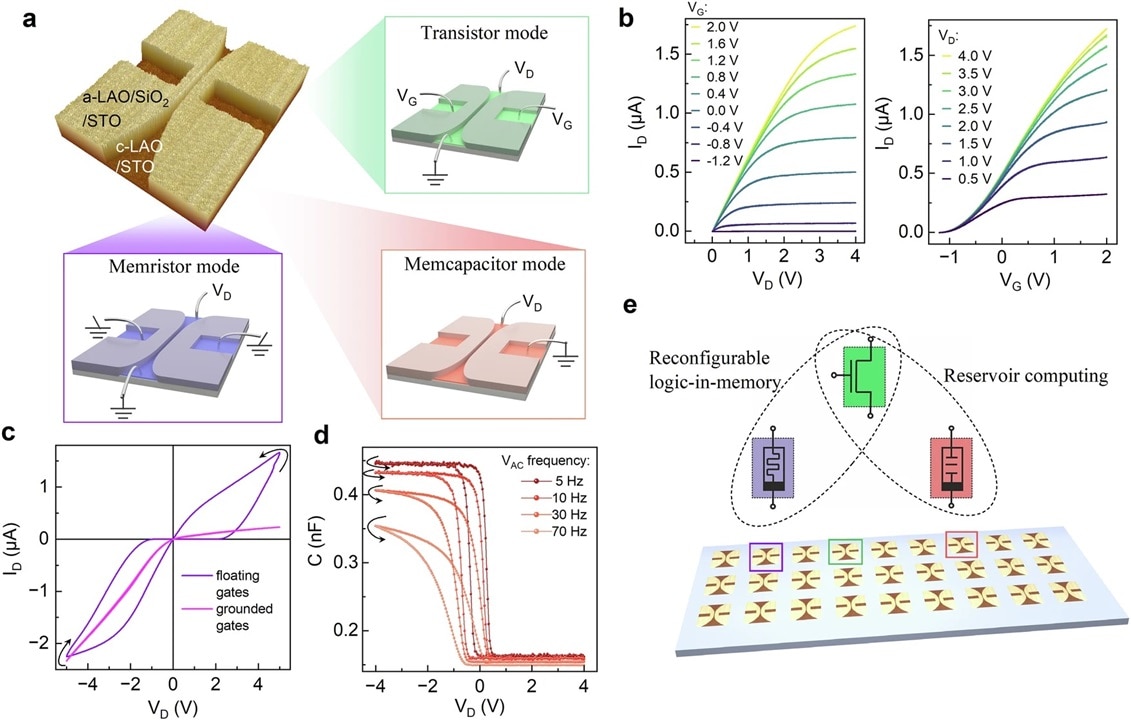
The device’s transistor, memristor, and memcapacitor operating modes. (Image Credit: Pradham et al. , Nature Communications (2026). CC BY 4.0)

Researchers at the University of Würzburg developed a device that stores information and displays learning-like behavior. In this way, it replicates certain functions of the human brain. This system features a lanthanum aluminate (LaAlO3) and strontium titanate (SrTiO3) heterostructure. While they are insulators, the materials’ interfaces produce a high-mobility, quasi-two-dimensional electron gas (q2-DEG). The ultra-conductive layer is where electrons can flow and be controlled.

They made the device by starting with a titanium-oxide-terminated STO substrate, patterning it with electron-beam lithography. Afterward, an 11-nanometer silicon dioxide (SiO2) layer was deposited. Following that, the team used a lift-off process to define a narrow conducting nanowire channel and two rectangular lateral gates on both sides. Lastly, a six-unit-cell LAO film was grown via pulsed laser deposition.

Depositing LAO on the crystalline STO caused it to crystallize and form the conductive q2-DEG at the interface. In contrast, depositing it on the SiO2 kept the LAO amorphous and insulating. This results in a device featuring a nanowire channel with two lateral gates on either side.

The components operate in three modes, depending on wiring and voltage. As an n-channel field-effect transistor, voltage being distributed to the lateral gates regulates the current flowing through the nanowire channel. Measurements were taken of the on-current in the microamp range and the on/off current. They reached 105, suggesting strong switching control.

Functioning as a memristor, the device uses resistance to remember its initial electrical state. Floating gates enable the current-voltage curve to generate a pinched hysteresis loop. As a result, this produces an 8.52 gigohm high-resistance state and a 1.53 megohm low-resistance state (5.6 x 10³ resistance ratio).

The third mode is a memcapacitor, in which the device capacitance relies on its electrical history. Repetitive cycling generated stable high and low capacitance states of 432.0 ± 0.8 picofarads and 159.0 ± 0.7 picofarads at zero bias. When the lateral floating gates release charge, the device learns. Grounded gates cause transferred charge to drain without any hysteresis appearing. Charge collects gradually while they float, which alters the channel’s electrical behavior over time.

When connected to a transistor-memristor circuit, repeated voltage pulses increased the number of postsynaptic currents and the pulse width. At lower drain voltages, the response decayed rapidly, resembling short-term potentiation. Meanwhile, higher drain voltages made the response last longer, resembling long-term potentiation. This effect is similar to biological synapses strengthening from repeated stimulation.

The team connected a transistor and memcapacitor into a reservoir-computing circuit. They used this to identify 5 x 4-pixel images of digits 0 through 5. Every 4-bit pulse train generated a distinguishable output voltage. Repeated trials demonstrated reliable separation between patterns. The device used 2.71 nanojoules/pulse.

Additionally, they developed a two-transistor, one-memristor circuit. It executed OR and AND logic operations while storing the output. -2V represented logic “0” while 3V represented logic “1”, and a 4-nanoamp threshold separated output states. High logic outputs were stored for 1,500 to 2,000 seconds after removing the inputs. By altering the voltage-sweep’s direction, the device could switch between AND and OR behavior.

Although this work is still research, it shows that complex oxide interfaces may enable energy-efficient neuromorphic hardware for sensing, AI, and adaptive edge devices.

Have a story tip? Message me here at element14.

  • Sign in to reply
element14 Community

element14 is the first online community specifically for engineers. Connect with your peers and get expert answers to your questions.

  • Members
  • Learn
  • Technologies
  • Challenges & Projects
  • Products
  • Store
  • About Us
  • Feedback & Support
  • FAQs
  • Terms of Use
  • Privacy Policy
  • Legal and Copyright Notices
  • Sitemap
  • Cookies

An Avnet Company © 2026 Premier Farnell Limited. All Rights Reserved.

Premier Farnell Ltd, registered in England and Wales (no 00876412), registered office: Farnell House, Forge Lane, Leeds LS12 2NE.

Follow element14

  • X
  • Facebook
  • linkedin
  • YouTube