


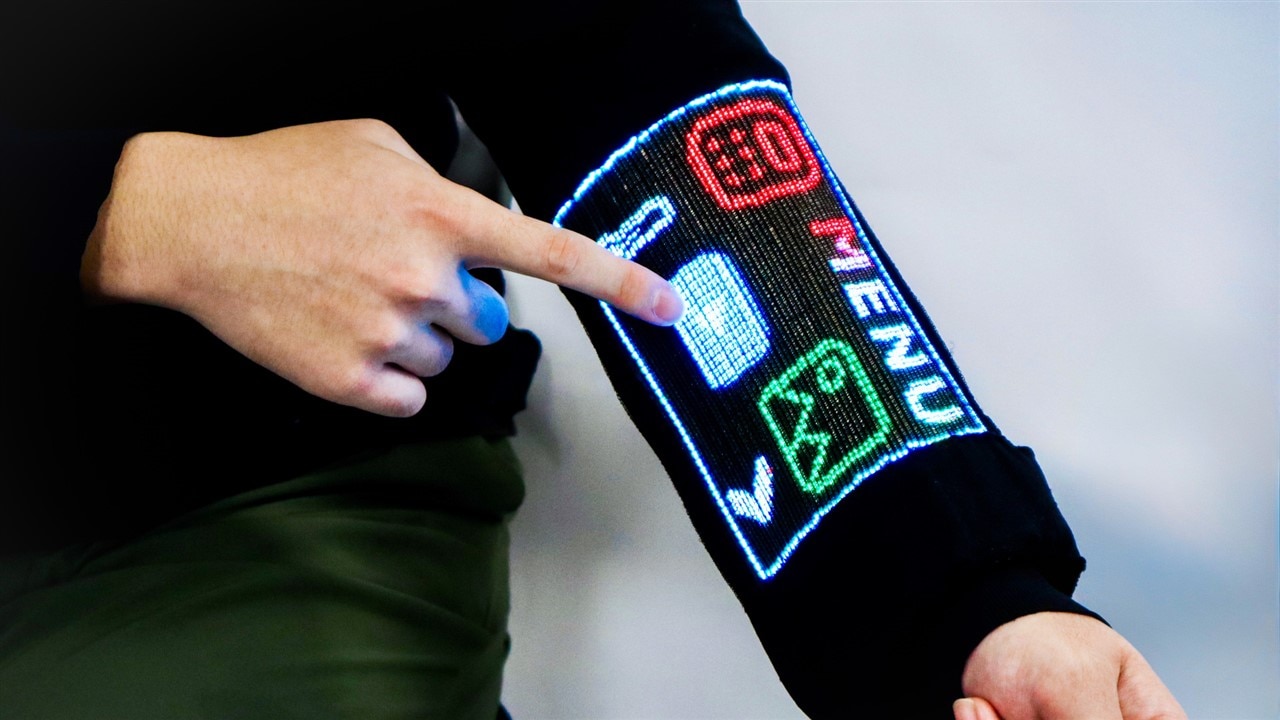
The team’s LED sleeve works like early-gen smartphones. (Image Credit: National University of Singapore)
Finally! I can’t wait for something like this in clothing.
Researchers at the National University of Singapore (NUS) developed a touchscreen sleeve. To do this, the team built electronic functionality into thread-like fibres, enabling it to work as a flexible garment that senses touch, displays images and videos, and connects wirelessly to other devices.
A digital pixel fibre makes it possible to create such a system. Digital pixel fibres have the functionality of a row of display pixels and a touch sensor. 54 of these fibres, each containing 96 LEDs. were placed within a sleeve’s forearm. It has a 30 FPS refresh rate and 8-bit color depth.
Fitting electronics into a fibre instead of a PCB proved more challenging. To overcome this, the researchers developed a programmable interconnection technique so that electrical connection points are created along insulated wires where microchips need them. Insulation is removed by a laser. Meanwhile, molten solder bonds at the programmable points via controlled surface wetting.
This method allowed the team to integrate over 5,000 microelectronic chips via 20,000+ electrical connections. Afterward, they embedded the LED strip within a multilayer fibre. This was done using a thermal drawing process that created a thread one mm thick and up to ten metres long. There is a sensing layer beneath the LEDs to detect pressure. A finger pressing on the fibre causes the circuit to close, which determines where the touch occurred and lights the nearest pixel.
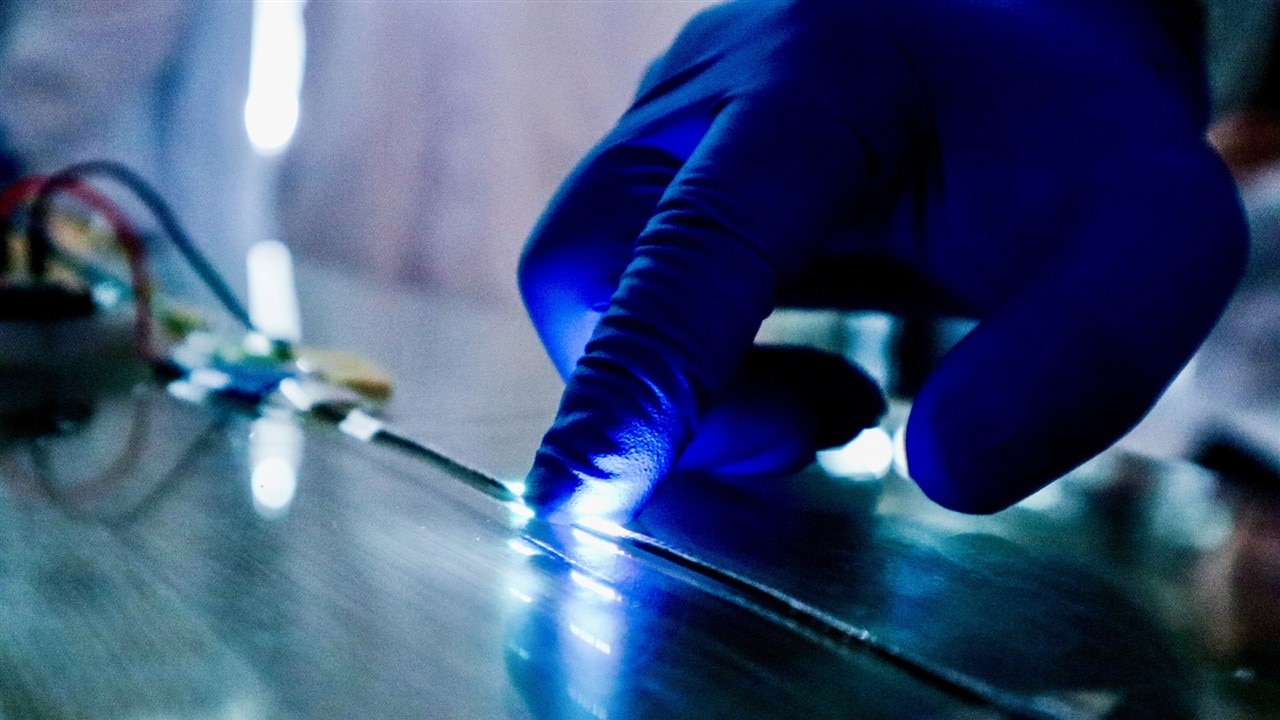
A touch-sensing layer is placed under the LEDs. Pressing the fibre causes the nearest pixel to light up. (Image Credit: National University of Singapore)
They added peripheral fibres as well. These have sensors for movement, magnetic direction, temperature, and ambient light, speakers, and a microphone. Placing it under an arm enables the temperature-sensing fibre to read and display the body temperature of the wearer.
The team’s LED sleeve prototype works like a smartphone. Capabilities include playing videos, showing a photo gallery, and responding to voice commands. It automatically rotates and adjusts brightness based on the light.
Washing the LED sleeve doesn’t affect its performance. After washing it 50 times in a washing machine, the light output and touch response slightly changed. Bending isn’t an issue either, as it sustains 1,000 bends over a 5mm radius. It remained breathable at levels similar to cotton, polyester, and denim. Even then, the sleeve is very safe for skin contact.
The team says it's more than a display. Each fibre is knitted, woven, or embroidered with industrial machines. This means the tech could be used for health monitoring as larger, sharper displays and garments. Combining fibre-based sensors with AI may enable personalized health monitoring, feedback, and assistance through clothing.
Have a story tip? Message me here at element14.