


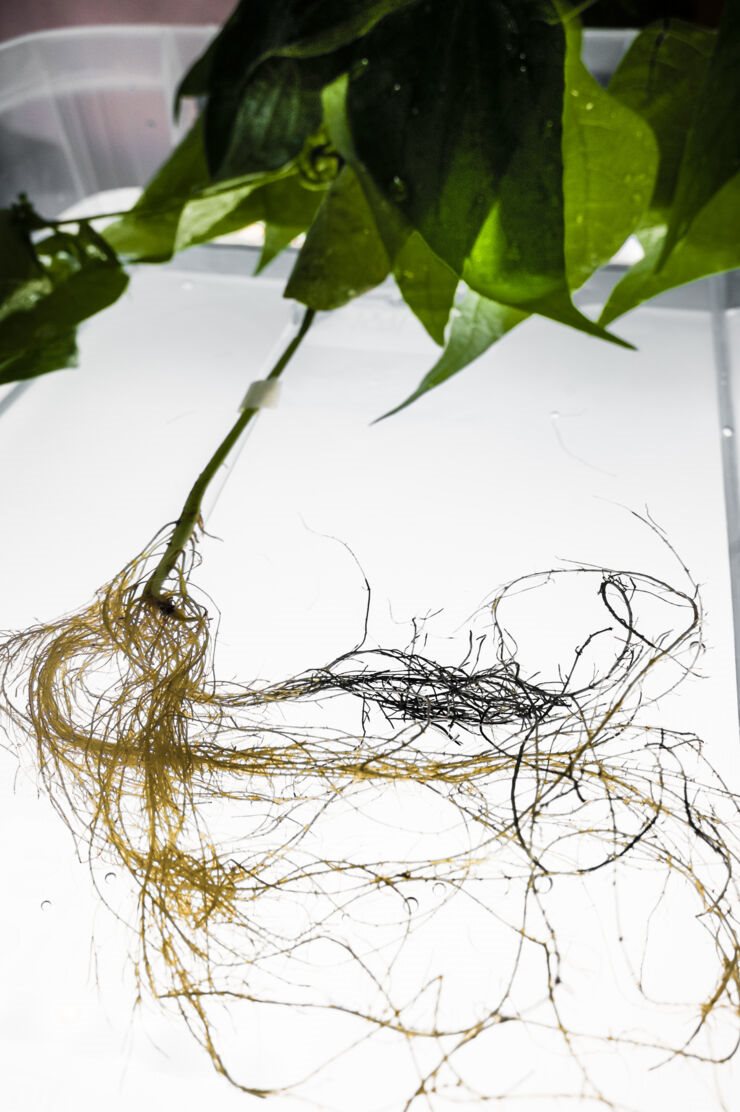
The bean plant with conductive roots (dark roots). (Image Credit: Thor Balkhed/Linköping University)
Researchers at the Laboratory of Organic Electronics, Linköping University, have found a way to turn the roots of a living plant into electronic conductors. They did this by using the plant’s biological system to form a conductive polymer. Their method produces electronic roots that conducts electricity and works as electrodes in a small energy-storage device.
The team’s technique uses p(ETE-S), a mixed ionic-electronic conductor that moves electronic charge and ions. Instead of creating the polymer separately, the scientists provided living roots with its molecular precursor, ETE-S. Cell-wall peroxidase enzymes helped drive the ETE-S oxidative polymerization, which produced p(ETE-S) on the root. This allows the plant’s cell-wall structure to act as a blueprint for polymer formation, resulting in a conductive polymer coating formed along the outer cell layers.
Young bean plants’ roots were exposed to ETE-S solutions at 1 or 2 milligrams per milliliter for three days. Microscopy revealed that the polymer was concentrated around the epidermis instead of spreading through the internal tissues. There also wasn’t much change during the first hour. Progressive darkening occurred as the polymer formed. It took 300 minutes for the polymer to cover the root surface.
The polymer remained confined to the outer cell layers in intact roots. On occasion, the team observed this deeper within wounded samples, suggesting they could provide access to internal tissue. The team also used wide-angle and grazing-incidence wide-angle X-ray scattering to assess the material’s structure. Measurements indicated that the thiophene rings in the polymer formed an ordered, closely stacked structure. The measurements had a peak of approximately 1.85 Å-1 associated with a stacking distance of 3.4 Å. According to these results, root tissue helped organize the polymer into a more ordered structure instead of producing a disordered coating.
Based on electrical measurements, the functionalized roots also work as conductive pathways. The paper says their effective conductivity was on the order of 10 S/cm. Roots treated with 1mg/mL ETE-S reached 12.4 ± 6.1 S/cm. Meanwhile, roots treated with 2 mg/mL ETE-S reached 5.5 ± 1.8 S/cm. The difference between these two wasn’t statistically significant.
Over four weeks, the conductivity remained statistically stable as the roots stayed attached to growing plants. To measure resistance, the team used carbon-fibre electrodes positioned at various distances along the conductive area. Those values described the root-and-polymer structure, and not a uniform, freestanding p(ETE-S) film.
Two functionalized roots were used as electrodes in a small, proof-of-concept supercapacitor. A 0.01 M KCl solution was the electrolyte. It had a capacitance of 8 mF with a 5 μA charging current, which decreased to 4 mF at 50 μA. The cutoff voltage was around 0.6 V, and the equivalent series resistance was 1.3 to 1.8 kilohms.
Meanwhile, the initial xylem-based device had a 0.07 mF capacitance at 0.5 μA with a cutoff voltage of 0.25 V. The team’s root-based design has roughly 100x higher capacitance and about 2.4x the cutoff voltage. However, this is only a demonstration and not a practical power source.
According to the paper, even with the polymer treatments, the plant still grew. In a five-day experiment, treated seedlings grew more lateral roots than controls. Then, in a month-long experiment, the researchers functionalized the whole root system with a lower ETE-S concentration of 0.2 mg/mL for three days. The plant grew, formed new roots, and produced bean pods.
Have a story tip? Message me here at element14.