


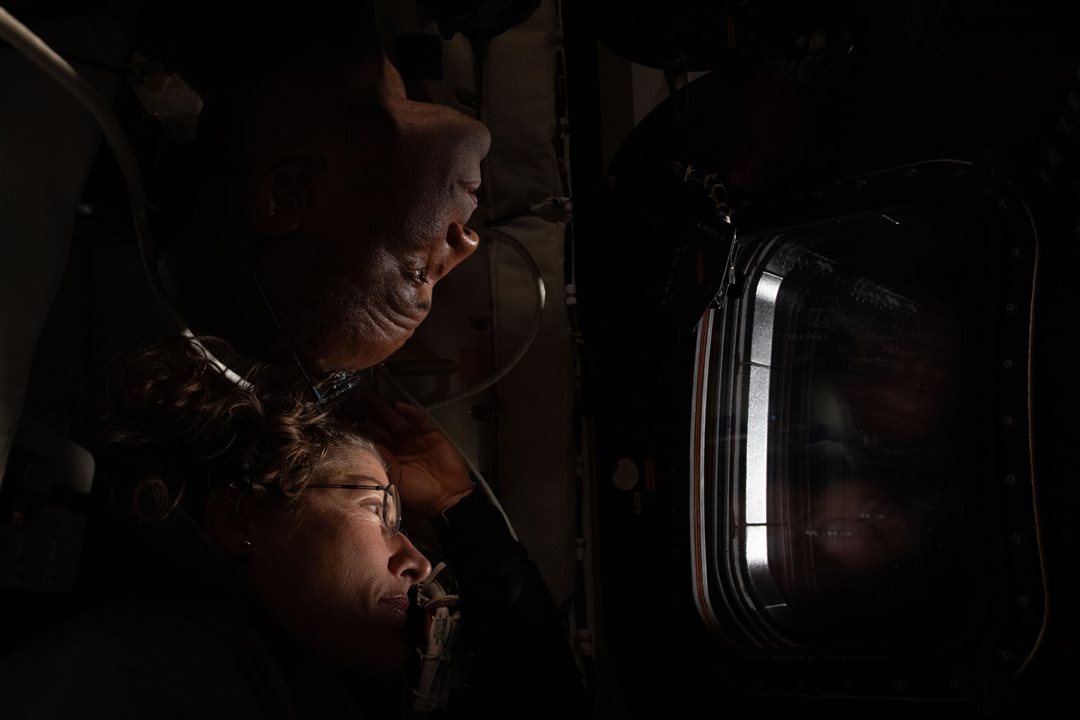
Astronauts Christina Koch and Victor Glover capture images of the lunar surface during the Artemis II mission. (Image Credit: NASA)
On October 7th, NASA published over 800GB of lunar science data from the Artemis II mission. It has 11,000+ full-resolution images and video, 8.5 hours of audio recording observations of the lunar surface, and crew-annotated images from when they flew by the Moon in April. Images were captured from the crew’s handheld cameras and the Orion’s spacecraft cameras. Some content had not been released earlier. All the content is available on the Planetary Data System.
In addition, NASA released the Artemis II Preliminary Lunar Science Report, the Artemis II Lunar Science Operations Report, and the Artemis II Lunar Science Data User Guide. These three reports are an overview of the mission data and activities, as well as a technical summary detailing the process behind the science plan development and implementation. NASA is using this data for the Artemis III mission and beyond.
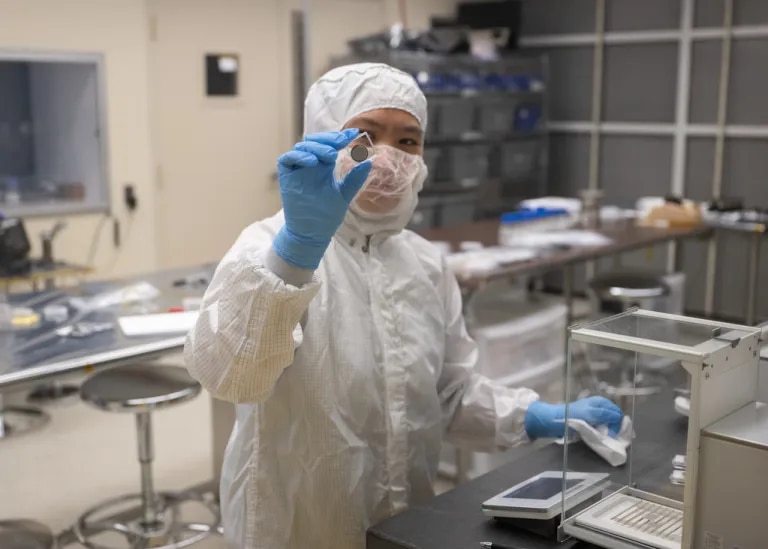
NASA’s SPEARS batteries could power space-based applications while functioning in the extreme cold and heat. (Image Credit: NASA/Ryan Hill)
NASA is developing Solid Power for Extreme Environment Adaptability and Resilience in Space (SPEARS) batteries that operate in heat and extreme cold. These batteries, which have solid ceramic- or polymer-based materials, would be used instead of the standard liquid electrolytes. During thermal vacuum tests, prototypes functioned in temperatures ranging from 176°F to -76°F. However, at -112°F, the performance slightly worsened. NASA even exposed the SPEARS batteries to temperatures as high as 212°F and as low as -274°F without sustaining damage. The team also proposes using small heaters to warm up the batteries before using them again. SPEARS batteries have potential to be used for rovers, astronauts’ emergency power packs, and scientific instruments.
On October 11th, NASA’s Perseverance Mars rover broke a record for the longest distance traveled by a vehicle on another planet. It reached 28.10 miles, overtaking the 28.06-mile record set by the Opportunity rover in 2018. While Opportunity took nearly 15 years to cover that much ground, Perseverance did it in just five and a half years. This new record was set as the rover drove toward Idubi, an area beyond Jezero Crater’s western rim. Most of the driving is handled by AutoNav, the rover’s self-driving navigation system. While rolling, the rover images the terrain and constructs a 3D map of hazards. It then creates a route between waypoints chosen by planners on Earth. Over 90% of Perseverance’s driving has involved AutoNav.
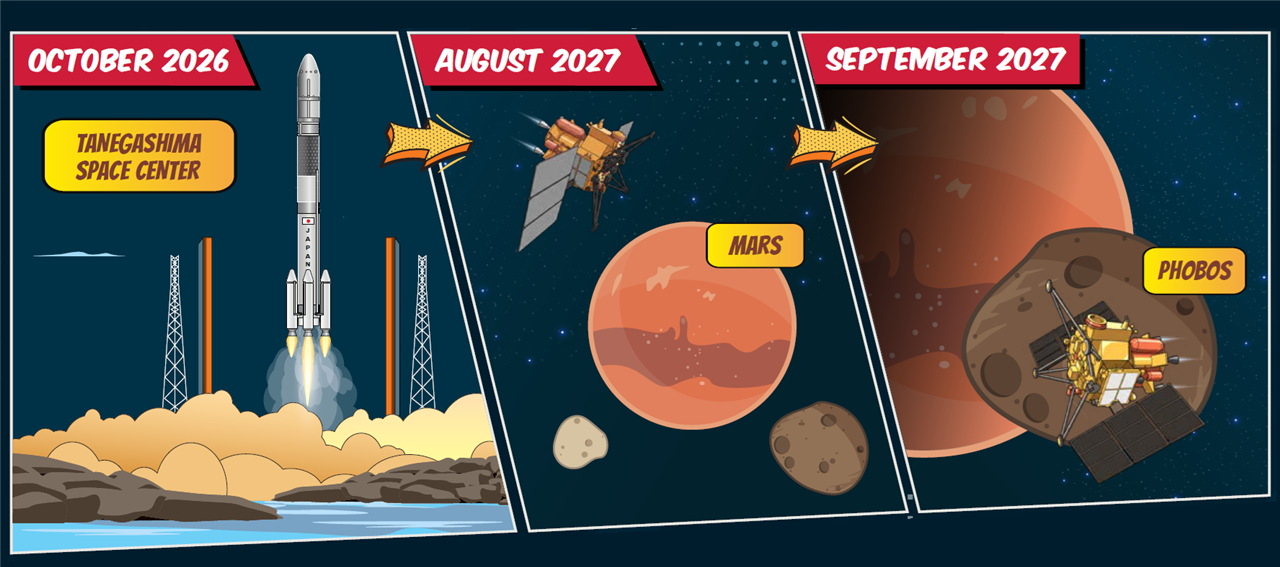
JAXA’s MMX mission will travel to Mars and collect samples from Phobos. (Image Credit: ESA)
JAXA has recently launched the Martian Moons eXploration (MMX) spacecraft to Phobos, Mars’ largest moon, to collect samples of Martian rock and return them to Earth. MMX lifted off on October 20th and is expected to reach Mars next year. Its mission involves observing Mars, Phobos, and Deimos, deploying a small French-German rover called IDEFIX, and collecting surface material to bring back to Earth in 2031. With those samples, researchers hope to uncover how Mars got both moons. For instance, they may provide clues if they were formed from debris due to a huge impact or captured asteroids.
Have a story tip? Message me here at element14.