element14 Community
element14 Community
    Register Log In
  • Site
  • Search
  • Log In Register
  • Community Hub
    Community Hub
    • What's New on element14
    • Feedback and Support
    • Benefits of Membership
    • Personal Blogs
    • Members Area
    • Achievement Levels
  • Learn
    Learn
    • Ask an Expert
    • eBooks
    • element14 presents
    • Learning Center
    • Tech Spotlight
    • STEM Academy
    • Webinars, Training and Events
    • Learning Groups
  • Technologies
    Technologies
    • 3D Printing
    • FPGA
    • Industrial Automation
    • Internet of Things
    • Power & Energy
    • Sensors
    • Technology Groups
  • Challenges & Projects
    Challenges & Projects
    • Design Challenges
    • element14 presents Projects
    • Project14
    • Arduino Projects
    • Raspberry Pi Projects
    • Project Groups
  • Products
    Products
    • Arduino
    • Avnet & Tria Boards Community
    • Dev Tools
    • Manufacturers
    • Multicomp Pro
    • Product Groups
    • Raspberry Pi
    • RoadTests & Reviews
  • About Us
    About the element14 Community
  • Store
    Store
    • Visit Your Store
    • Choose another store...
      • Europe
      •  Austria (German)
      •  Belgium (Dutch, French)
      •  Bulgaria (Bulgarian)
      •  Czech Republic (Czech)
      •  Denmark (Danish)
      •  Estonia (Estonian)
      •  Finland (Finnish)
      •  France (French)
      •  Germany (German)
      •  Hungary (Hungarian)
      •  Ireland
      •  Israel
      •  Italy (Italian)
      •  Latvia (Latvian)
      •  
      •  Lithuania (Lithuanian)
      •  Netherlands (Dutch)
      •  Norway (Norwegian)
      •  Poland (Polish)
      •  Portugal (Portuguese)
      •  Romania (Romanian)
      •  Russia (Russian)
      •  Slovakia (Slovak)
      •  Slovenia (Slovenian)
      •  Spain (Spanish)
      •  Sweden (Swedish)
      •  Switzerland(German, French)
      •  Turkey (Turkish)
      •  United Kingdom
      • Asia Pacific
      •  Australia
      •  China
      •  Hong Kong
      •  India
      •  Japan
      •  Korea (Korean)
      •  Malaysia
      •  New Zealand
      •  Philippines
      •  Singapore
      •  Taiwan
      •  Thailand (Thai)
      •  Vietnam
      • Americas
      •  Brazil (Portuguese)
      •  Canada
      •  Mexico (Spanish)
      •  United States
      Can't find the country/region you're looking for? Visit our export site or find a local distributor.
  • Translate
  • Profile
  • Settings
Sensors
  • Technologies
  • More
Sensors
Blog Voyager 1 Signal Detected by Amateurs
  • Blog
  • Forum
  • Documents
  • Quiz
  • Events
  • Polls
  • Members
  • Mentions
  • Sub-Groups
  • Tags
  • More
  • Cancel
  • New
Join Sensors to participate - click to join for free!
  • Share
  • More
  • Cancel
Group Actions
  • Group RSS
  • More
  • Cancel
Engagement
  • Author Author: Catwell
  • Date Created: 27 Aug 2026 9:41 PM Date Created
  • Views 36 views
  • Likes 2 likes
  • Comments 1 comment
  • signal
  • nasa
  • diy
  • space
  • wireless
  • voyager
  • antenna
  • communication
Related
Recommended

Voyager 1 Signal Detected by Amateurs

Catwell
Catwell
27 Aug 2026

image

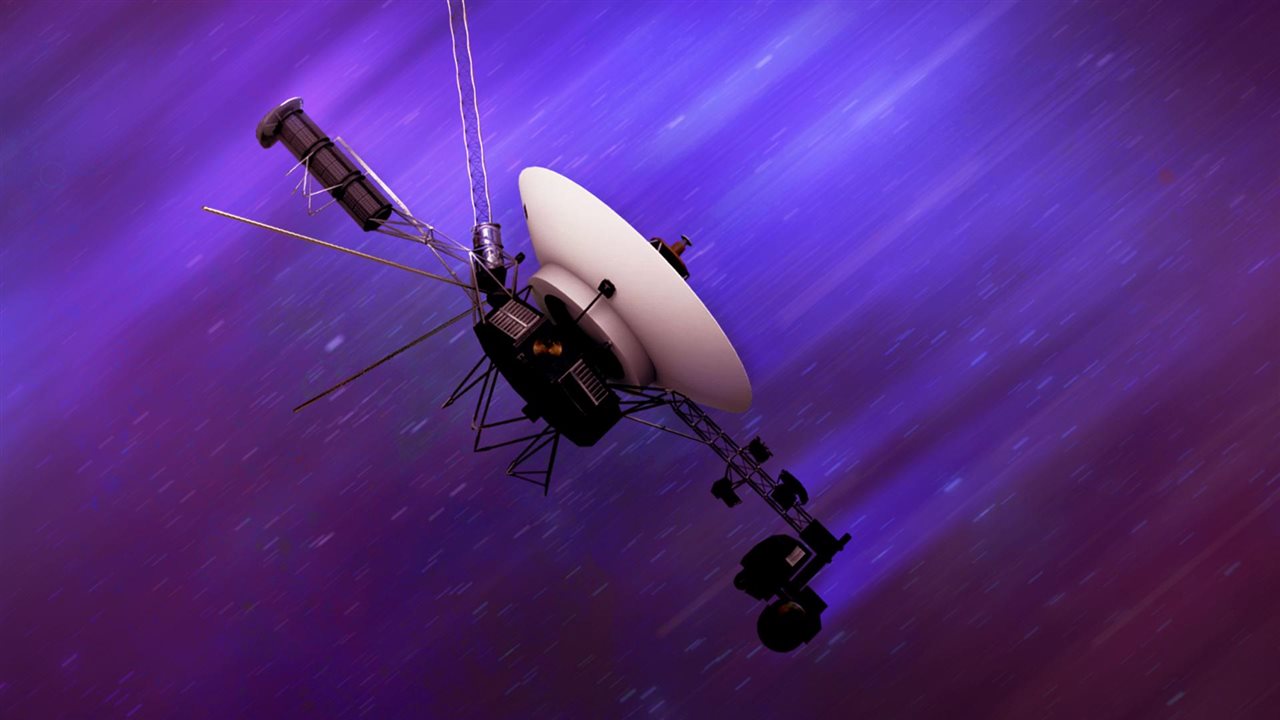
Artist’s rendering of Voyager traveling through space. (Image Credit: NASA/JPL-Caltech)

In late 2024, skilled radio amateurs with CAMRAS used the Dwingeloo Observatory to detect the carrier signal of Voyager 1 from over 15.5 billion miles away. To pick up the signal, they added more equipment to the dish and made adjustments to remove noise. The team originally detected the space probe in 2006, when it was 9.1 billion miles from Earth. It’s very difficult for astronomers to detect Voyager 1’s signal without relying on NASA’s equipment. Only elite detectors, such as VLBA arrays and the Green Bank Telescope, have achieved it in the past.

For their discovery, the CAMRAS team leveraged the observatory’s 25-meter dish. They installed a custom high-frequency feed to handle 8.4 GHz at the telescope’s focus. Adding this turned out to be the right choice as the wire mesh-based dish (optimized for lower frequencies) reflects those waves inefficiently without it.

Afterward, they performed pre-observation tuning. The team precisely modeled Voyager’s trajectory using JPL ephemerides (orbital data) and simulated the expected frequency drift over the ~15.5-billion-mile path, adjusting the receiver beforehand. These predictions were used to predict and correct the Doppler shift caused by their relative motion. Making this adjustment in real-time allowed the live carrier signal to emerge from noise during observations.
image
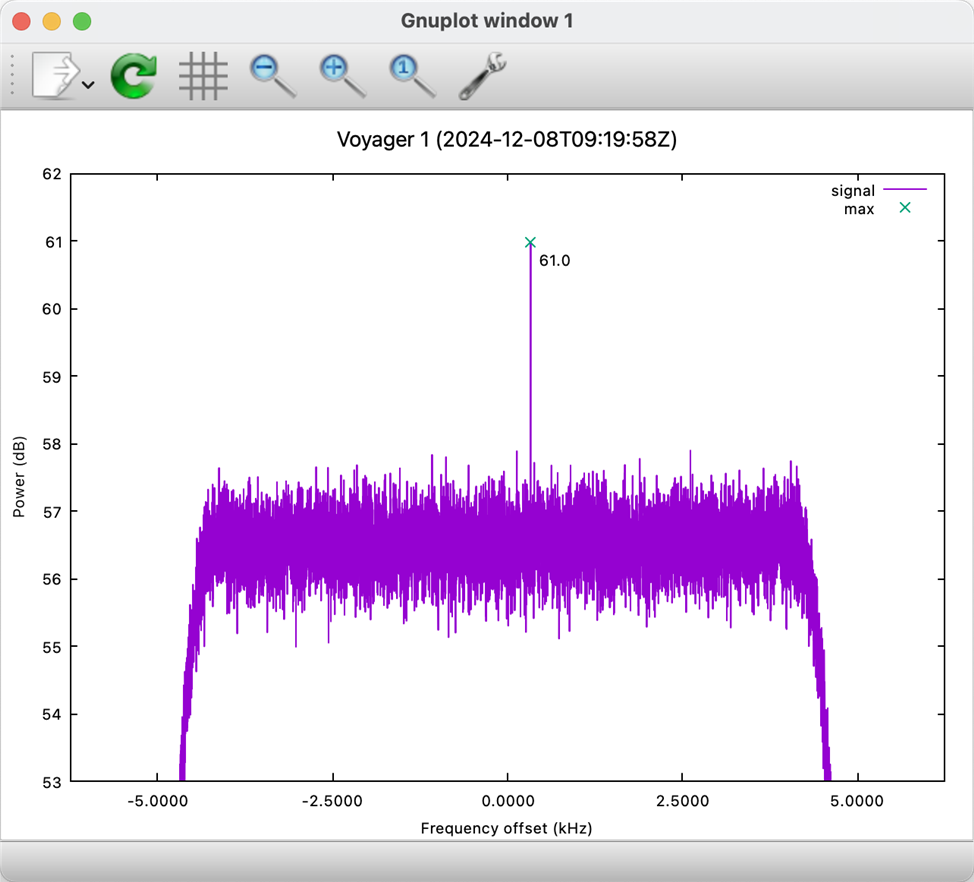
Carrier peak emerging from noise floor. (Image Credit: Radio Telescope Dwingaloo/CAMRAS)

The receiver chain details involve cryogenically cooling a low-noise amplifier (LNA) chain to drastically reduce thermal noise. A spectrum analyzer was also used for visualizing the carrier peak ascending from the noise floor in real time. Pulling the very faint signal (10-16 W/m2) from background noise required approximately two hours of integration per session, cryogenic low-noise amplifiers, and post-processing verification via the telltale Doppler wiggle and spectrograms.

Astronomy enthusiasts can’t use home equipment like big amateur dishes or software-based radios without DSN-scale gear to pick up Voyager 1’s signal. After all the traveling, it becomes very weak by the time it reaches Earth. The probe transmits 22W via its 3.7-meter dish antenna at 8.4 GHz, over 15.5 billion miles. When it arrives to Earth, the signal drops down to ~10-16 watts per m2, trillions of times weaker than a cell phone signal. Some demos used linked global arrays like VLBA or the Green Bank Telescope. Even then, the carrier tone is theoretically audible with elite radio astronomy tools.

You don't have permission to edit metadata of this video.
Edit media
x
image
Upload Preview
image

Have a story tip? Message me here at element14.

  • Sign in to reply
  • Qbit
    Qbit 10 hours ago

    That’s incredible news! It's so cool to see the Dwingeloo Observatory dish picking up Voyager 1's signal  out of the noise floor is a mind-blowing achievement for the team.

    Thanks so much for sharing this update, Catwell!

    • Cancel
    • Vote Up 0 Vote Down
    • Sign in to reply
    • More
    • Cancel
element14 Community

element14 is the first online community specifically for engineers. Connect with your peers and get expert answers to your questions.

  • Members
  • Learn
  • Technologies
  • Challenges & Projects
  • Products
  • Store
  • About Us
  • Feedback & Support
  • FAQs
  • Terms of Use
  • Privacy Policy
  • Legal and Copyright Notices
  • Sitemap
  • Cookies

An Avnet Company © 2026 Premier Farnell Limited. All Rights Reserved.

Premier Farnell Ltd, registered in England and Wales (no 00876412), registered office: Farnell House, Forge Lane, Leeds LS12 2NE.

Follow element14

  • X
  • Facebook
  • linkedin
  • YouTube