


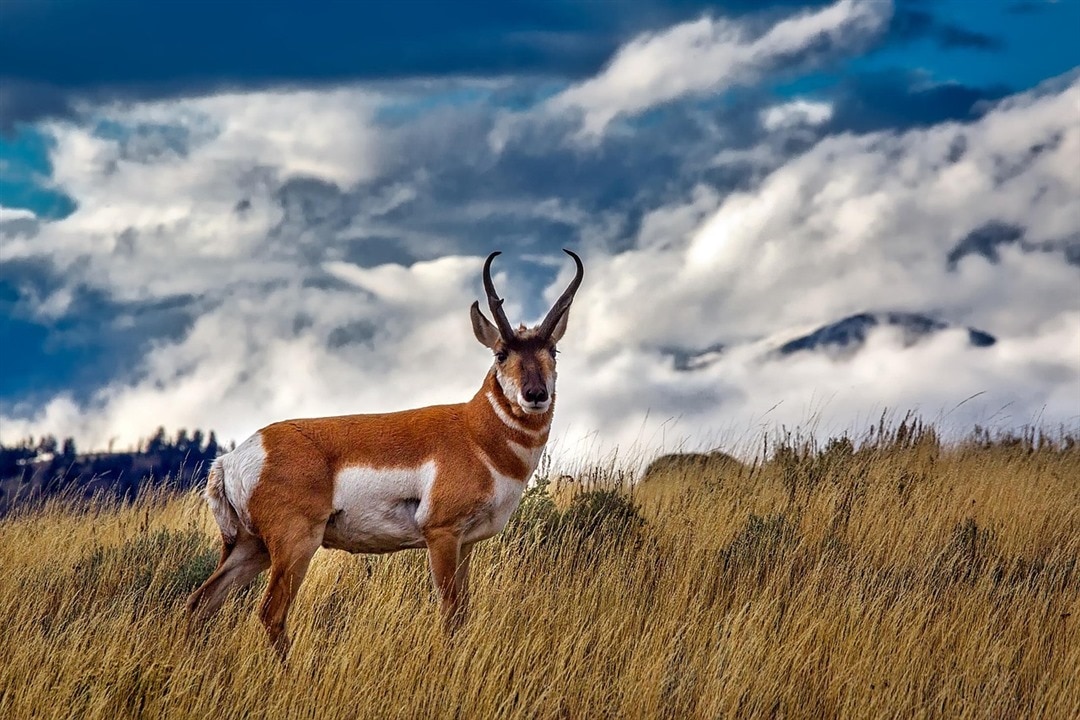
A pronghorn. (Image: pixabay)
Solar projects are spreading across landscapes, and researchers are investigating how wildlife adapts to them. Wildlands Network fitted 75 female pronghorns with GPS collars to understand how they move across areas with solar development. The project started in 2024, when 60 pronghorns near Farmington, New Mexico were fitted with these trackers. Then, the organization added another 15 collars in January 2025.
With this study, researchers can track the animals’ movement routes, determining if the San Juan Solar and Storage Project affect their pathways. According to Wildlands Network, the pronghorn in this area traverses a changing landscape. Data from these collars allow researchers to compare movement patterns before and after the construction of solar projects. Researchers hope the findings will help them figure out how renewable-energy development can coexist with wildlife movement.
GPS collars are strapped around an animal’s neck. They use a GPS chip to determine their location, a battery that powers the electronics, and a satellite modem, radio, or Bluetooth connection for data transmission. Researchers also position the GPS antenna toward the sky for a clear line-of-sight.
These GPS collars aren’t always recording data. Instead, they take location fixes at a certain time, such as once per hour or a few times per day. This helps to extend battery life, making it last longer. In Wildlands Network’s case, each collar collects location data once an hour per day. And by 2025, they have collected over 700,000 locations from pronghorn so far.
Collars may also store the data locally and send it later, either through satellite several times a day or a USB when the collar is recovered. Some are built with an automated drop-off mechanism, allowing the collar to be released and picked up without recapturing the animal.
Other features like a gyroscope or mortality sensor may be included to understand movement or determine if an animal remained in the same place for a long time. To make the collars last longer, designers may keep electronics asleep between fixes or integrate solar charging or other energy-harvesting features. That’s why wildlife collars can collect data for months or years.
With such a large dataset, Wildlands Network can examine how pronghorn movement changes across different seasons. The organization measured home ranges, space-use, and movements of 22 female pronghorns within 100 meters of solar fencing. This includes those using passages between fenced solar arrays.
Researchers say that slightly changing the design of solar projects could benefit animals. For example, making the bottom of fences higher could allow pronghorn to crawl under them and use their normal travel paths.
Have a story tip? Message me here at element14.