


The channel isolation describes how much signal on one input channel unintentionally appears on another channel. In case when we are measuring some signal, e.g. on channel 1 and has channel 2 not connected to any signal, in an ideal scenario, there should not be any signal on channel 2. In reality, the tiny portion of signal from channel 1 may leak into channel 2. This parameter is important, especially when we perform measurements of a very small signal on one channel while a large signal on the other. Often this parameter is present in the specification of the measuring instrument. I have checked how it looks in the case of Analog Discovery 3.
Measurement
To evaluate this parameter, the channel 1 of the signal generator was configured to produce a 1 Vpp signal at 5 MHz. The generator output was connected to channel 1 of the oscilloscope, and channel 2 was terminated with a 50 Ω load. The signals on both oscilloscope channels were measured, and their FFTs were calculated. In the first scenario, Dupont wires were used. The setup and measurement results are presented below.
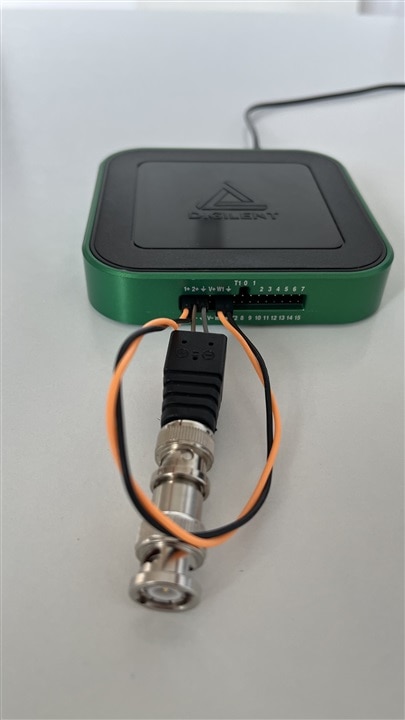
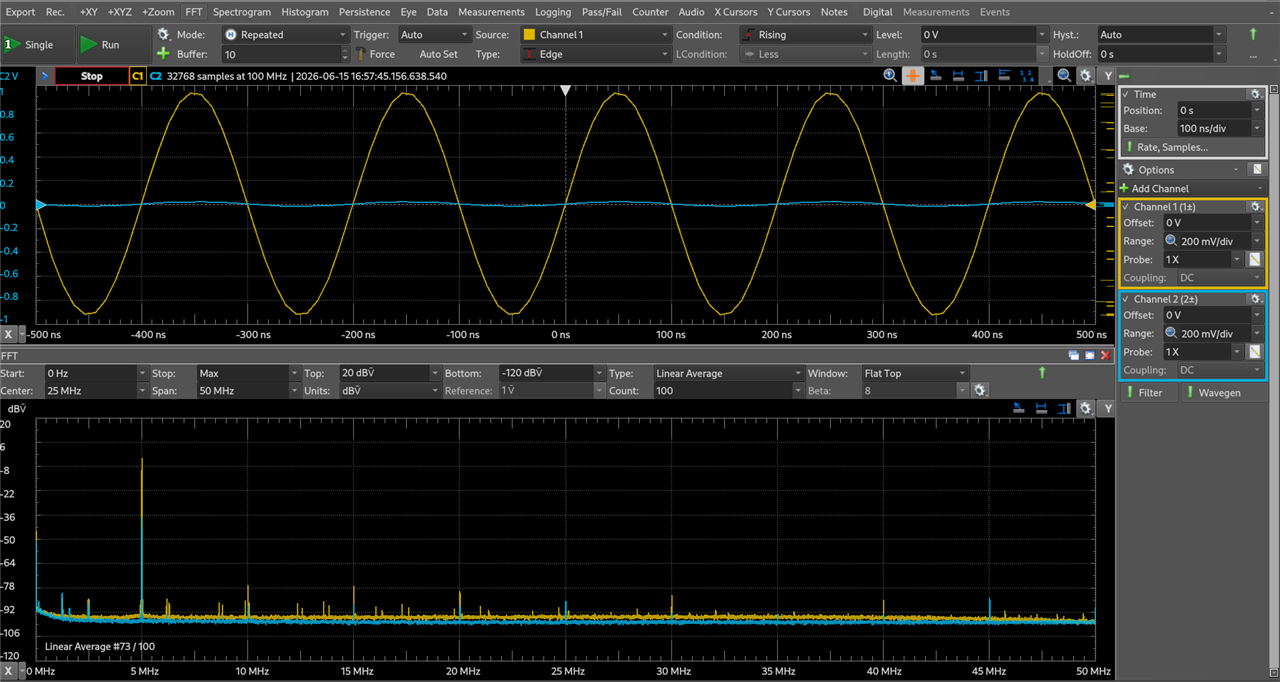
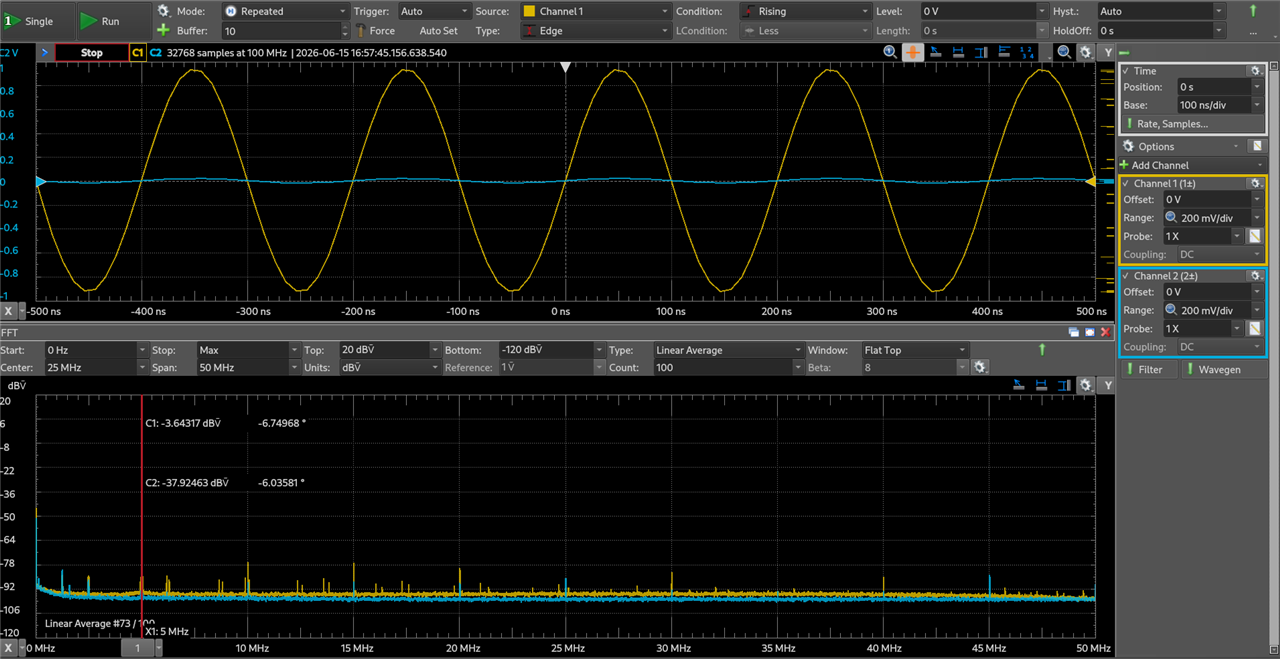
The amplitude of the 5 MHz component was -3.64 dBV on channel 1 and -37.92 dBV on channel 2. The measured crosstalk between the oscilloscope channels was therefore approximately -34.3 dBV.
The similar measurement was done for case of usage of the BNC adapter. The setup and measurement results are presented below.
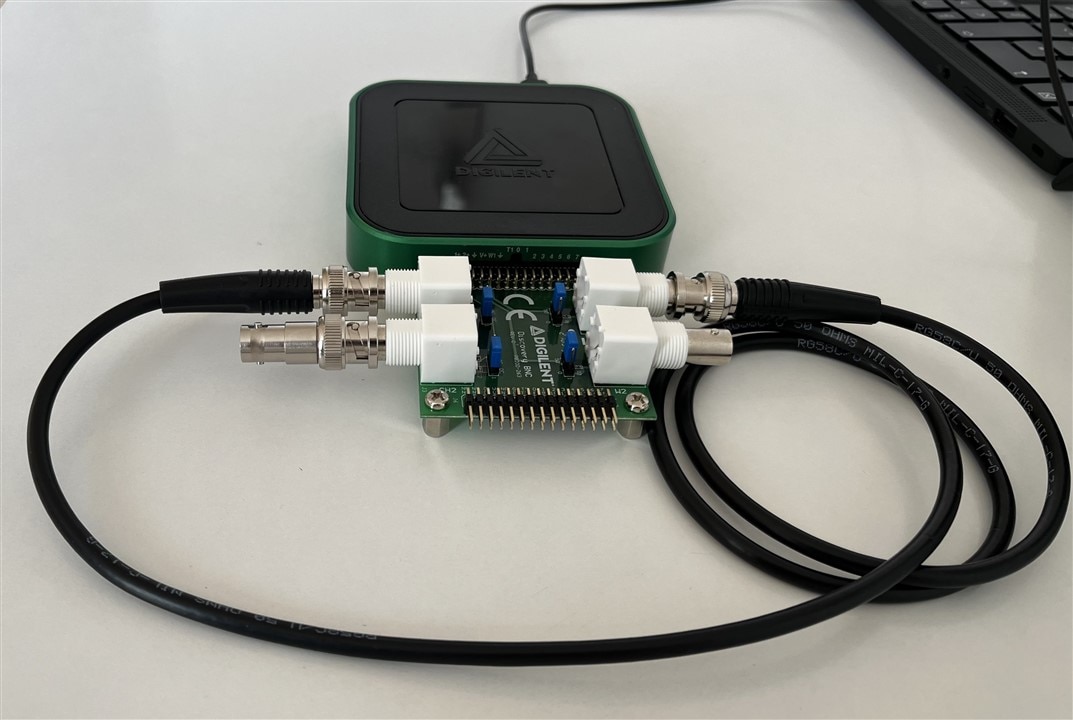

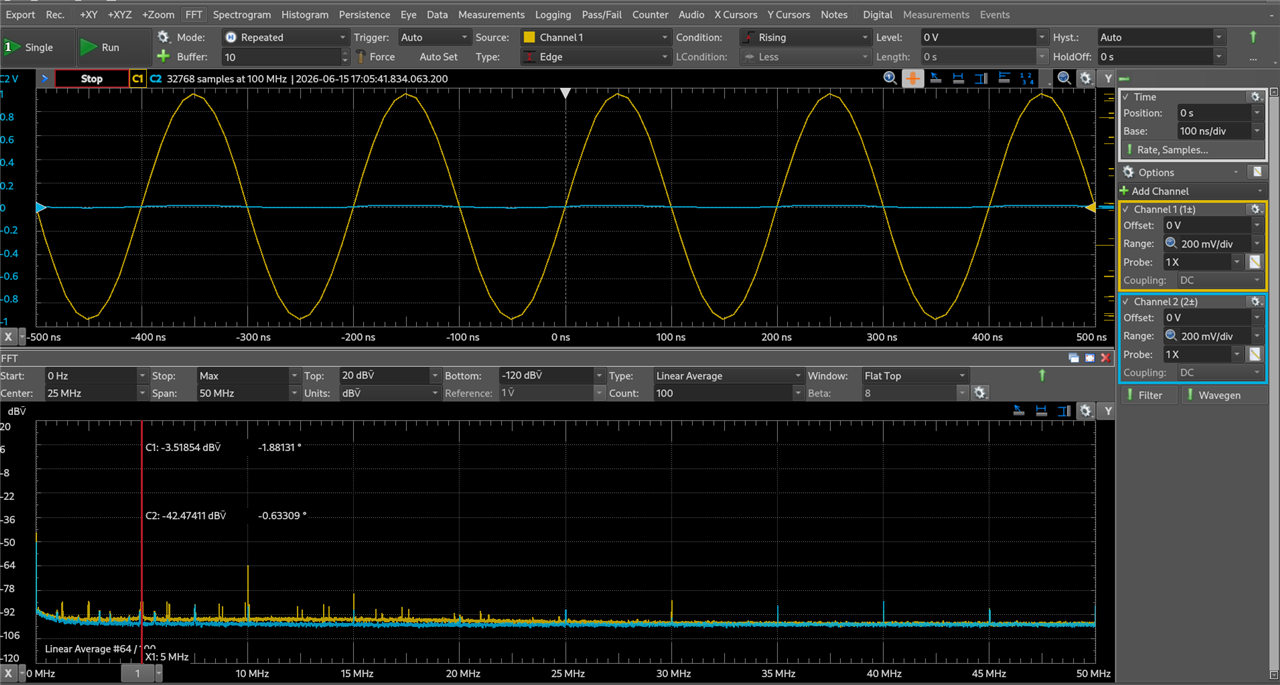
The amplitude of the 5 MHz component was -3.52 dBV on channel 1 and -42.47 dBV on channel 2. Therefore, the measured crosstalk was approximately -39.0 dBV. Compared to the measurement performed using Dupont wires, the BNC adapter reduced the observed crosstalk by approximately 4.7 dBV.
Summary
The measured crosstalk values are consistent with the general design goals of the Analog Discovery 3. Similar to the previously evaluated noise performance, the device was not designed as an ultra-low-noise or high-isolation measurement instrument. For example, the oscilloscope channels do not appear to be individually shielded internally, which can contribute to increased channel-to-channel coupling.
Probably the ADP2230 series and particularly the ADP3450 or ADP3250, are expected to achieve better results in this area. The recently introduced ADP2440 and ADP2450 series may also provide improved channel isolation. However, Digilent does not currently specify channel-to-channel crosstalk in the published specifications for these instruments.

