element14 Community
element14 Community
    Register Log In
  • Site
  • Search
  • Log In Register
  • Community Hub
    Community Hub
    • What's New on element14
    • Feedback and Support
    • Benefits of Membership
    • Personal Blogs
    • Members Area
    • Achievement Levels
  • Learn
    Learn
    • Ask an Expert
    • eBooks
    • element14 presents
    • Learning Center
    • Tech Spotlight
    • STEM Academy
    • Webinars, Training and Events
    • Learning Groups
  • Technologies
    Technologies
    • 3D Printing
    • FPGA
    • Industrial Automation
    • Internet of Things
    • Power & Energy
    • Sensors
    • Technology Groups
  • Challenges & Projects
    Challenges & Projects
    • Design Challenges
    • element14 presents Projects
    • Project14
    • Arduino Projects
    • Raspberry Pi Projects
    • Project Groups
  • Products
    Products
    • Arduino
    • Avnet & Tria Boards Community
    • Dev Tools
    • Manufacturers
    • Multicomp Pro
    • Product Groups
    • Raspberry Pi
    • RoadTests & Reviews
  • About Us
  • Store
    Store
    • Visit Your Store
    • Choose another store...
      • Europe
      •  Austria (German)
      •  Belgium (Dutch, French)
      •  Bulgaria (Bulgarian)
      •  Czech Republic (Czech)
      •  Denmark (Danish)
      •  Estonia (Estonian)
      •  Finland (Finnish)
      •  France (French)
      •  Germany (German)
      •  Hungary (Hungarian)
      •  Ireland
      •  Israel
      •  Italy (Italian)
      •  Latvia (Latvian)
      •  
      •  Lithuania (Lithuanian)
      •  Netherlands (Dutch)
      •  Norway (Norwegian)
      •  Poland (Polish)
      •  Portugal (Portuguese)
      •  Romania (Romanian)
      •  Russia (Russian)
      •  Slovakia (Slovak)
      •  Slovenia (Slovenian)
      •  Spain (Spanish)
      •  Sweden (Swedish)
      •  Switzerland(German, French)
      •  Turkey (Turkish)
      •  United Kingdom
      • Asia Pacific
      •  Australia
      •  China
      •  Hong Kong
      •  India
      • Japan
      •  Korea (Korean)
      •  Malaysia
      •  New Zealand
      •  Philippines
      •  Singapore
      •  Taiwan
      •  Thailand (Thai)
      • Vietnam
      • Americas
      •  Brazil (Portuguese)
      •  Canada
      •  Mexico (Spanish)
      •  United States
      Can't find the country/region you're looking for? Visit our export site or find a local distributor.
  • Translate
  • Profile
  • Settings
Test & Tools
  • Technologies
  • More
Test & Tools
Blog MIT researchers develop a camera that captures at a trillion frames per second - see light move
  • Blog
  • Forum
  • Documents
  • Files
  • Members
  • Mentions
  • Sub-Groups
  • Tags
  • More
  • Cancel
  • New
Join Test & Tools to participate - click to join for free!
  • Share
  • More
  • Cancel
Group Actions
  • Group RSS
  • More
  • Cancel
Engagement
  • Author Author: Catwell
  • Date Created: 7 Sep 2021 6:47 PM Date Created
  • Views 1632 views
  • Likes 5 likes
  • Comments 0 comments
  • mit
  • on_campus
  • cabeatwell
  • speed of light
  • university
  • innovation
Related
Recommended

MIT researchers develop a camera that captures at a trillion frames per second - see light move

Catwell
Catwell
7 Sep 2021

image

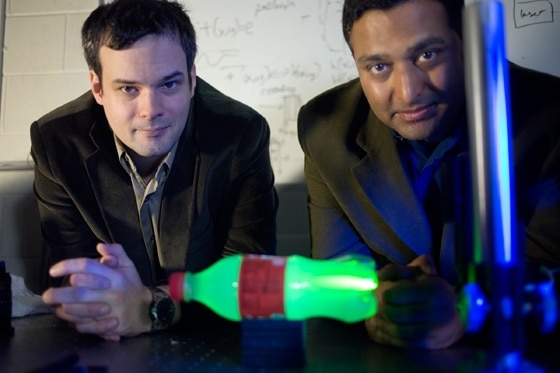
Researchers developed a camera that captures images at a trillion frames per second using a streak camera and a laser that generates light pulses. (Image Credit: M. Scott Brauer/MIT)


In 2011, MIT scientists developed a camera capable of capturing images at a trillion frames per second. Accomplishing such a feat allowed the team to obtain video footage of light traveling 600 million miles per hour in a one-liter bottle filled with water. It only took a nanosecond for the event to transpire, but the camera slowed it down to twenty seconds. The camera took millions of scans to reproduce each image since it’s impossible to capture images of light.


The technology relies on a streak camera deployed in a unique approach. Photons enter the camera via the narrow slit located on the aperture and are transformed into electrons. Afterward, these pass through an electric field, diverting them into a direction perpendicular to the slit. The electric field’s quick-change causes more deflection to the electrons equivalent to photons arriving later than it does to those arriving early.


This process produces a 2D image, but only the direction corresponding to the slit’s direction is spatial. Meanwhile, the dimension that corresponds to the deflection’s degree is time. As a result, an image represents the photons’ arrival as they pass through a one-dimensional slice of space. The camera was designed for experiments where light passes through or diffuses by a chemical sample.


However, to create ultra slow-motion videos, the team needed to perform the same process repetitively. This involved passing a light pulse through a bottle while repositioning the camera to produce a 2D image. Using an array of specialized optical equipment and mechanical control allowed the camera and laser, which generates the light pulse, to synchronize. It may take a nanosecond for light to travel through a bottle, but it takes an hour to collect the data for the video.


After an hour passes, the team collects hundreds of thousands of data sets. Each one maps out the one-dimensional positions of photons against their arrival times. Then, the team created algorithms that put the raw data together in a set of sequential 2D images.


Since the imaging system needs multiple passes to produce videos, it can’t record non-repeatable events. Some practical applications include situations where light scatters, providing useful information. Such cases may also include analysis of manufactured materials’ physical structure.


You don't have permission to edit metadata of this video.
Edit media
x
image
Upload Preview
image


Have a story tip? Message me at: http://twitter.com/Cabe_Atwell

  • Sign in to reply
element14 Community

element14 is the first online community specifically for engineers. Connect with your peers and get expert answers to your questions.

  • Members
  • Learn
  • Technologies
  • Challenges & Projects
  • Products
  • Store
  • About Us
  • Feedback & Support
  • FAQs
  • Terms of Use
  • Privacy Policy
  • Legal and Copyright Notices
  • Sitemap
  • Cookies

An Avnet Company © 2025 Premier Farnell Limited. All Rights Reserved.

Premier Farnell Ltd, registered in England and Wales (no 00876412), registered office: Farnell House, Forge Lane, Leeds LS12 2NE.

ICP 备案号 10220084.

Follow element14

  • X
  • Facebook
  • linkedin
  • YouTube