element14 Community
element14 Community
    Register Log In
  • Site
  • Search
  • Log In Register
  • Community Hub
    Community Hub
    • What's New on element14
    • Feedback and Support
    • Benefits of Membership
    • Personal Blogs
    • Members Area
    • Achievement Levels
  • Learn
    Learn
    • Ask an Expert
    • eBooks
    • element14 presents
    • Learning Center
    • Tech Spotlight
    • STEM Academy
    • Webinars, Training and Events
    • Learning Groups
  • Technologies
    Technologies
    • 3D Printing
    • FPGA
    • Industrial Automation
    • Internet of Things
    • Power & Energy
    • Sensors
    • Technology Groups
  • Challenges & Projects
    Challenges & Projects
    • Design Challenges
    • element14 presents Projects
    • Project14
    • Arduino Projects
    • Raspberry Pi Projects
    • Project Groups
  • Products
    Products
    • Arduino
    • Avnet & Tria Boards Community
    • Dev Tools
    • Manufacturers
    • Multicomp Pro
    • Product Groups
    • Raspberry Pi
    • RoadTests & Reviews
  • About Us
  • Store
    Store
    • Visit Your Store
    • Choose another store...
      • Europe
      •  Austria (German)
      •  Belgium (Dutch, French)
      •  Bulgaria (Bulgarian)
      •  Czech Republic (Czech)
      •  Denmark (Danish)
      •  Estonia (Estonian)
      •  Finland (Finnish)
      •  France (French)
      •  Germany (German)
      •  Hungary (Hungarian)
      •  Ireland
      •  Israel
      •  Italy (Italian)
      •  Latvia (Latvian)
      •  
      •  Lithuania (Lithuanian)
      •  Netherlands (Dutch)
      •  Norway (Norwegian)
      •  Poland (Polish)
      •  Portugal (Portuguese)
      •  Romania (Romanian)
      •  Russia (Russian)
      •  Slovakia (Slovak)
      •  Slovenia (Slovenian)
      •  Spain (Spanish)
      •  Sweden (Swedish)
      •  Switzerland(German, French)
      •  Turkey (Turkish)
      •  United Kingdom
      • Asia Pacific
      •  Australia
      •  China
      •  Hong Kong
      •  India
      • Japan
      •  Korea (Korean)
      •  Malaysia
      •  New Zealand
      •  Philippines
      •  Singapore
      •  Taiwan
      •  Thailand (Thai)
      • Vietnam
      • Americas
      •  Brazil (Portuguese)
      •  Canada
      •  Mexico (Spanish)
      •  United States
      Can't find the country/region you're looking for? Visit our export site or find a local distributor.
  • Translate
  • Profile
  • Settings
Test & Tools
  • Technologies
  • More
Test & Tools
Blog Researchers discover a new phenomenon that could lead to quantum devices
  • Blog
  • Forum
  • Documents
  • Files
  • Members
  • Mentions
  • Sub-Groups
  • Tags
  • More
  • Cancel
  • New
Join Test & Tools to participate - click to join for free!
  • Share
  • More
  • Cancel
Group Actions
  • Group RSS
  • More
  • Cancel
Engagement
  • Author Author: Catwell
  • Date Created: 26 Jun 2020 6:43 PM Date Created
  • Views 583 views
  • Likes 1 like
  • Comments 0 comments
  • quantum
  • on_campus
  • cabeatwell
  • next generation
  • university
  • innovation
Related
Recommended

Researchers discover a new phenomenon that could lead to quantum devices

Catwell
Catwell
26 Jun 2020

image

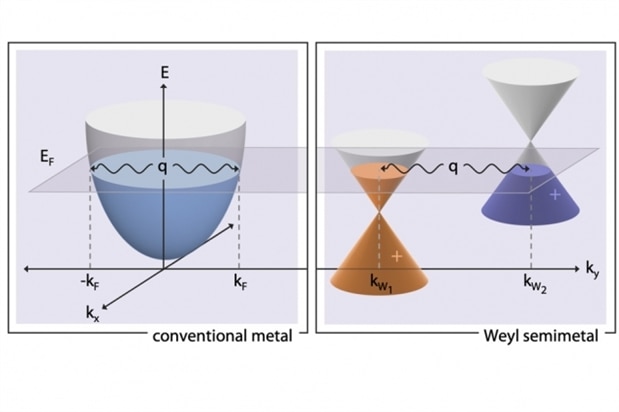
The diagram shows the conditions that cause the Kohn anomaly to rise in convenient metals (left) and a material is known as a Weyl semimetal (right).  (Image Credit: MIT)


Researchers at MIT and elsewhere have discovered an exotic physical phenomenon called Kohn anomaly for the first time in an unexpected type of material. Their findings could develop a better understanding of certain processes that help to determine why metals and other materials exhibit complex electronic properties that dominate today’s technology. The team presented their findings in the journal Physical Review Letters.


How electrons interact with phonons, which involves vibrations passing through a crystalline material, determines the physical processes that occur in electronic devices. The electron-phonon interactions influence how metals resist electric current, the temperature that unexpectedly transforms some materials into superconductors, and the very low-temperature necessities for quantum computers, are among many other processes.


It has been difficult to observe electron-phonon interactions since they are usually fragile, but the study has discovered a new type of unusual electron-phonon interaction. The team produced a Kohn anomaly, which was believed to only exist in an exotic material known as a topological Weyl semimetal. Their discovery could shed light on crucial aspects of the complex interplay between electrons and phonons.


Kohn anomaly had never been examined before in a topological material with electrical behaviors that are robust against perturbation. The researchers discovered that a Weyl semimetal, a type of topological material, specifically tantalum phosphide, is capable of exhibiting this anomaly. Conventional metals contain a property known as the Fermi surface, which drives the Kohn anomaly’s formation.  In the tantalum phosphide material, the Weyl points act as a driving force.


Since electron-phonon couplings are commonly used everywhere, they can be a significant source of disturbance in physical systems like those used to represent data in quantum computers. It can be challenging to measure the strength of these interactions, which is vital to protect quantum-based technologies, but this new study makes it easier to create the needed measurements.


The researchers used advanced neutron and X-ray scattering probes to measure the interactions, which were done at three national laboratories---Argonne National Laboratory, Oak Ridge National Laboratory, and the National Institute of Standards and Technology. Afterward, they probed the behavior of the tantalum phosphide material.


“We predicted that there is a Kohn anomaly in the material just based on pure theory,” Professor Mingda Li at MIT says “we could guide the experiments to the point where we want to search for the phenomenon, and we see a very good agreement between theory and the experiments.”


New insights on the electron-phonon couplings could lead to the development of such materials as improved high-temperature superconductors or fault-tolerant quantum computers. This could also be used to probe material properties in search of the ones that aren’t affected at higher temperatures.


Have a story tip? Message me at: cabe(at)element14(dot)com

http://twitter.com/Cabe_Atwell

  • Sign in to reply
element14 Community

element14 is the first online community specifically for engineers. Connect with your peers and get expert answers to your questions.

  • Members
  • Learn
  • Technologies
  • Challenges & Projects
  • Products
  • Store
  • About Us
  • Feedback & Support
  • FAQs
  • Terms of Use
  • Privacy Policy
  • Legal and Copyright Notices
  • Sitemap
  • Cookies

An Avnet Company © 2026 Premier Farnell Limited. All Rights Reserved.

Premier Farnell Ltd, registered in England and Wales (no 00876412), registered office: Farnell House, Forge Lane, Leeds LS12 2NE.

ICP 备案号 10220084.

Follow element14

  • X
  • Facebook
  • linkedin
  • YouTube