element14 Community
element14 Community
    Register Log In
  • Site
  • Search
  • Log In Register
  • Community Hub
    Community Hub
    • What's New on element14
    • Feedback and Support
    • Benefits of Membership
    • Personal Blogs
    • Members Area
    • Achievement Levels
  • Learn
    Learn
    • Ask an Expert
    • eBooks
    • element14 presents
    • Learning Center
    • Tech Spotlight
    • STEM Academy
    • Webinars, Training and Events
    • Learning Groups
  • Technologies
    Technologies
    • 3D Printing
    • FPGA
    • Industrial Automation
    • Internet of Things
    • Power & Energy
    • Sensors
    • Technology Groups
  • Challenges & Projects
    Challenges & Projects
    • Design Challenges
    • element14 presents Projects
    • Project14
    • Arduino Projects
    • Raspberry Pi Projects
    • Project Groups
  • Products
    Products
    • Arduino
    • Avnet & Tria Boards Community
    • Dev Tools
    • Manufacturers
    • Multicomp Pro
    • Product Groups
    • Raspberry Pi
    • RoadTests & Reviews
  • About Us
  • Store
    Store
    • Visit Your Store
    • Choose another store...
      • Europe
      •  Austria (German)
      •  Belgium (Dutch, French)
      •  Bulgaria (Bulgarian)
      •  Czech Republic (Czech)
      •  Denmark (Danish)
      •  Estonia (Estonian)
      •  Finland (Finnish)
      •  France (French)
      •  Germany (German)
      •  Hungary (Hungarian)
      •  Ireland
      •  Israel
      •  Italy (Italian)
      •  Latvia (Latvian)
      •  
      •  Lithuania (Lithuanian)
      •  Netherlands (Dutch)
      •  Norway (Norwegian)
      •  Poland (Polish)
      •  Portugal (Portuguese)
      •  Romania (Romanian)
      •  Russia (Russian)
      •  Slovakia (Slovak)
      •  Slovenia (Slovenian)
      •  Spain (Spanish)
      •  Sweden (Swedish)
      •  Switzerland(German, French)
      •  Turkey (Turkish)
      •  United Kingdom
      • Asia Pacific
      •  Australia
      •  China
      •  Hong Kong
      •  India
      • Japan
      •  Korea (Korean)
      •  Malaysia
      •  New Zealand
      •  Philippines
      •  Singapore
      •  Taiwan
      •  Thailand (Thai)
      • Vietnam
      • Americas
      •  Brazil (Portuguese)
      •  Canada
      •  Mexico (Spanish)
      •  United States
      Can't find the country/region you're looking for? Visit our export site or find a local distributor.
  • Translate
  • Profile
  • Settings
Test & Tools
  • Technologies
  • More
Test & Tools
Blog Researchers discover a rare form of magnetism in a graphene structure
  • Blog
  • Forum
  • Documents
  • Files
  • Members
  • Mentions
  • Sub-Groups
  • Tags
  • More
  • Cancel
  • New
Join Test & Tools to participate - click to join for free!
  • Share
  • More
  • Cancel
Group Actions
  • Group RSS
  • More
  • Cancel
Engagement
  • Author Author: Catwell
  • Date Created: 4 Nov 2020 7:07 PM Date Created
  • Views 1393 views
  • Likes 4 likes
  • Comments 4 comments
  • test
  • graphene
  • on_campus
  • cabeatwell
  • university
  • tool
  • innovation
Related
Recommended

Researchers discover a rare form of magnetism in a graphene structure

Catwell
Catwell
4 Nov 2020

image

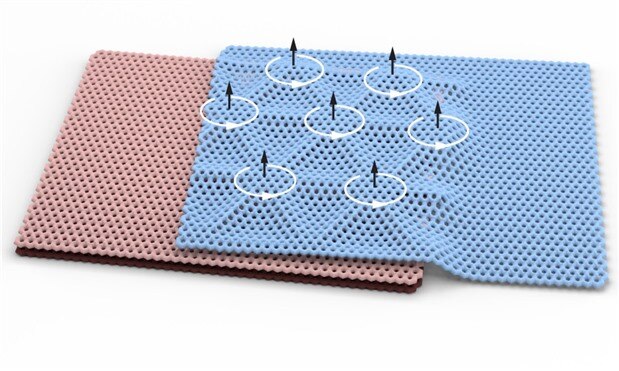
Stacking and twisting a set of graphene sheets on top of each other produces a rare form of magnetism. (Image Credit: Columbia University)


Graphene has excellent thermal and electromagnetic properties, aside from being the world’s strongest and thinnest material. Now, researchers at Columbia University and the University of Washington have discovered that stacking and twisting a three-layer graphene structure can produce a rare form of magnetism.


“We wondered what would happen if we combined graphene monolayers and bilayers into a twisted three-layer system,” said Cory Dean, a physicist at Columbia University and one of the paper’s senior authors. “We found that varying the number of graphene layers endows these composite materials with some exciting new properties that had not been seen before.”


When observing the effects of graphene layering in previous studies, scientists discovered that slightly twisting one of the layers - so that both layers are resting at a balanced angle - created a twisted angle structure. The structure is capable of changing back and forth between an insulator and a superconductor, which obstructs the electricity flowing through the material or encourages it with no resistance.

In their experiments, the team stacked a single monolayer sheet on top of a bilayer sheet and twisted them by one degree. When the twisted monolayer-bilayer graphene (tMBG) system became exposed to temperatures a few degrees above absolute zero, it exhibited an array of insulating states. These states could be controlled by applying an electric field to the structure.


Pointing the electric field towards the monolayer sheet caused the bilayer graphene sheet to become twisted. However, when the electric field’s direction was reversed and pointed towards the bilayer graphene sheet, it mimicked a four-layer graphene structure comprised of a twisted double bilayer system.

Additionally, the researchers detected a rare form of magnetism in the three-layer graphene structure. They observed a collective swirling motion of electrons underlying the magnetism.


Another team discovered that graphene, when bonded with boron nitride, produced a magnetic field that rose from carbon’s molecular bonds in graphene and the boron in boron nitride. Dean and his team’s new study demonstrated that this form of magnetism could occur in a structure made entirely out of graphene due to interactions between carbon molecules.


“Pure carbon is not magnetic,” said Matthew Yankowitz, a physicist at the University of Washington. “Remarkably, we can engineer this property by arranging our three graphene sheets at just the right twist angles.”


The study also unveiled signs of topology in the structure. The topological properties of graphene could lead to new types of information storage, which “may be a platform for quantum computation or new types of energy-efficient data storage applications,” Professor Xiaodong Xu said.


The team is performing additional experiments to learn more about the properties of the new states they discovered in this system. “This is really just the beginning,” said Yankowitz.    


Have a story tip? Message me at: http://twitter.com/Cabe_Atwell                                                                                                                                                           

  • Sign in to reply
  • jipilabont
    jipilabont over 5 years ago

    If i may, normally the electrical conductivity of ‘graphite’ is due to the delocalized electron not in the covalence bond between 4 carbon atoms.

    Layering 2 sheets of Graphene you may be mimicking generation of graphite delocalized electrons of each layer facing away from one another, at least it is possible. Freezing those layer to near absolute Zero temperature should freeze those delocalized electron on top of each other making a vector like electric field giving the found magnetic field the more you turn the orientation of those sheets. But i might be wrong.

    • Cancel
    • Vote Up 0 Vote Down
    • Sign in to reply
    • More
    • Cancel
  • jipilabont
    jipilabont over 5 years ago in reply to jipilabont

    Thanks for the

    correction

    • Cancel
    • Vote Up 0 Vote Down
    • Sign in to reply
    • More
    • Cancel
  • DAB
    DAB over 5 years ago

    In my research I have found that you can get a magnetic field anywhere you can initiate photon flow between atoms.

    The Graphene structure would not support this effect as a single sheet, but once you establish the three dimensional structure with atoms between the hexagon structure, you can establish a charge flow structure that would indeed support magnetism.


    Many people believe that only ferrous material can support magnetism. That is not true. You can build structures of many types of atoms that if you allow them to form a crystal in a magnetic field, they can sustain charge flow and retain that magnetism after they reach a solid state.


    DAB

    • Cancel
    • Vote Up 0 Vote Down
    • Sign in to reply
    • More
    • Cancel
  • jipilabont
    jipilabont over 5 years ago

    I thought transmutation was not possible in « magnetism » to produce magnesium like it is written in this article résumé or maybe it is a typo.

    • Cancel
    • Vote Up 0 Vote Down
    • Sign in to reply
    • More
    • Cancel
element14 Community

element14 is the first online community specifically for engineers. Connect with your peers and get expert answers to your questions.

  • Members
  • Learn
  • Technologies
  • Challenges & Projects
  • Products
  • Store
  • About Us
  • Feedback & Support
  • FAQs
  • Terms of Use
  • Privacy Policy
  • Legal and Copyright Notices
  • Sitemap
  • Cookies

An Avnet Company © 2026 Premier Farnell Limited. All Rights Reserved.

Premier Farnell Ltd, registered in England and Wales (no 00876412), registered office: Farnell House, Forge Lane, Leeds LS12 2NE.

ICP 备案号 10220084.

Follow element14

  • X
  • Facebook
  • linkedin
  • YouTube