


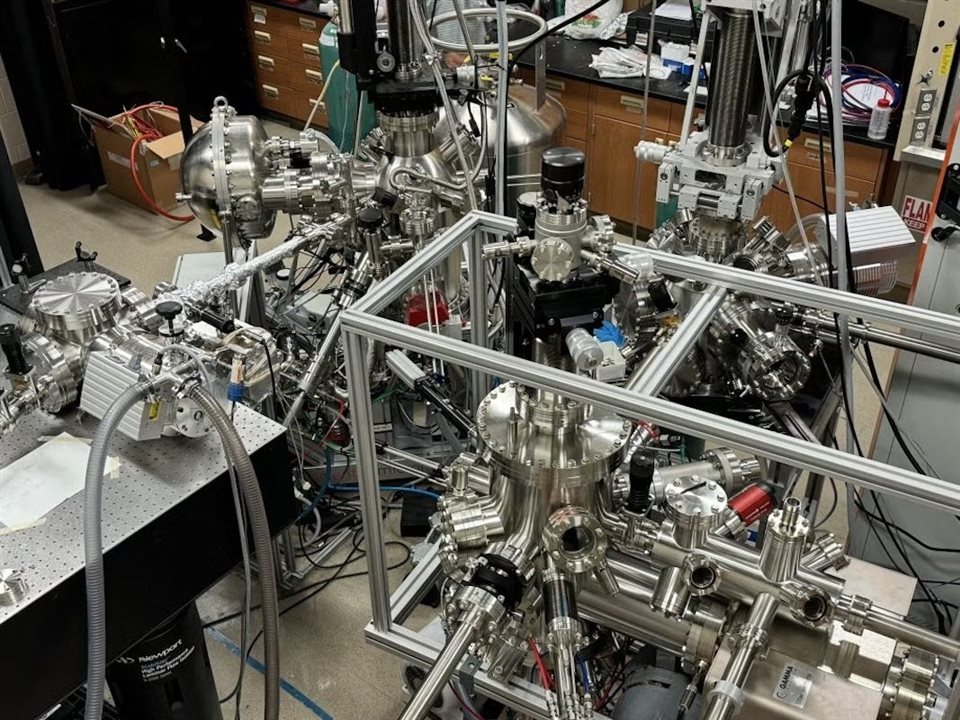
The lab has molecular beam epitaxy (MBE), angle-resolved photoemission spectroscopy (ARPES), and time-resolved ARPES systems. (Image Credit: UCF)
Researchers are looking for new techniques to achieve faster computing. To do this, they are focusing on spin rather than the electrical charge of electrons. Physicists at the University of Central Florida (UCF) have recently experimentally observed altermagnetism in a layered material. This revealed spin-split electronic states that occur regardless of the material having no net magnetization.
The Co1/4TaSe3 material is made of cobalt atoms intercalated between tantalum diselenide layers. This crystal has a hexagonal structure, and the cobalt doubles the in-plane unit cell. Magnetic susceptibility measurements revealed the material is antiferromagnetically ordered below a Néel temperature of 178 K. With this Type-A antiferromagnetic configuration, the cobalt moments match ferromagnetically within a layer but have opposing orientations in adjacent layers. This generates zero net magnetization.
Single crystals were grown by the team using chemical vapor transport. To produce a precursor, cobalt, tantalum, and selenium powders were sealed in an evacuated silica ampoule and heated at 1,742°F for five days. Afterward, the material was pulverized and annealed for another five days. They then combined that powder with iodine before being sealed under vacuum and heated It at 1,724°F for two weeks. This process produced flat, plate-like single crystals.
Angle-resolved photoemission spectroscopy (ARPES) was used by the team to examine the electronic structure. They cleaved the crystals at 7 K under an ultrahigh vacuum. This exposed a fresh surface for measurements. ARPES used 55-eV photons to map the electrons’ energy and momentum. Various photon energy measurements allowed the team to probe different positions along the material’s out-of-plane momentum direction.
Measurements showed a six-fold (g-wave) spin-splitting pattern. Splitting became more evident along a specific direction in the material’s momentum space. It went away along symmetry-protected directions where the electronic states were still spin-degenerate. Momentum-distribution curve analysis discovered two peaks separated by 0.09 Å-1, close to the instrument’s resolution of 0.08 Å-1.
The team used spin-resolved ARPES at the Advanced Light Source to examine the bands’ spin character. Across the electronic band, the spin polarization changed from -13% to +13%, which means the dominant spin character reversed as the team moved through momentum space. This revealed that the splitting was associated with the altermagnetic spin texture predicted by density functional theory calculations.
Temperature-dependent ARPES proved that the electronic structure was connected to magnetic ordering. 7 K and 200 K measurements revealed that the Fermi surface and valence-band structure changed as the material was heated through the 178-K Néel temperature. This includes band shifts and changes in spectral weight.
The team’s observations establish Co1/4TaSe3 as a platform for studying altermagnetic materials and their spin-dependent electronic properties. Since the material has antiferromagnetic order with spin-split electronic bands and zero net magnetization, it could be used for studying altermagnetism in spintronic technologies.
Have a story tip? Message me here at element14.