element14 Community
element14 Community
    Register Log In
  • Site
  • Search
  • Log In Register
  • Community Hub
    Community Hub
    • What's New on element14
    • Feedback and Support
    • Benefits of Membership
    • Personal Blogs
    • Members Area
    • Achievement Levels
  • Learn
    Learn
    • Ask an Expert
    • eBooks
    • element14 presents
    • Learning Center
    • Tech Spotlight
    • STEM Academy
    • Webinars, Training and Events
    • Learning Groups
  • Technologies
    Technologies
    • 3D Printing
    • FPGA
    • Industrial Automation
    • Internet of Things
    • Power & Energy
    • Sensors
    • Technology Groups
  • Challenges & Projects
    Challenges & Projects
    • Design Challenges
    • element14 presents Projects
    • Project14
    • Arduino Projects
    • Raspberry Pi Projects
    • Project Groups
  • Products
    Products
    • Arduino
    • Avnet & Tria Boards Community
    • Dev Tools
    • Manufacturers
    • Multicomp Pro
    • Product Groups
    • Raspberry Pi
    • RoadTests & Reviews
  • About Us
  • Store
    Store
    • Visit Your Store
    • Choose another store...
      • Europe
      •  Austria (German)
      •  Belgium (Dutch, French)
      •  Bulgaria (Bulgarian)
      •  Czech Republic (Czech)
      •  Denmark (Danish)
      •  Estonia (Estonian)
      •  Finland (Finnish)
      •  France (French)
      •  Germany (German)
      •  Hungary (Hungarian)
      •  Ireland
      •  Israel
      •  Italy (Italian)
      •  Latvia (Latvian)
      •  
      •  Lithuania (Lithuanian)
      •  Netherlands (Dutch)
      •  Norway (Norwegian)
      •  Poland (Polish)
      •  Portugal (Portuguese)
      •  Romania (Romanian)
      •  Russia (Russian)
      •  Slovakia (Slovak)
      •  Slovenia (Slovenian)
      •  Spain (Spanish)
      •  Sweden (Swedish)
      •  Switzerland(German, French)
      •  Turkey (Turkish)
      •  United Kingdom
      • Asia Pacific
      •  Australia
      •  China
      •  Hong Kong
      •  India
      • Japan
      •  Korea (Korean)
      •  Malaysia
      •  New Zealand
      •  Philippines
      •  Singapore
      •  Taiwan
      •  Thailand (Thai)
      • Vietnam
      • Americas
      •  Brazil (Portuguese)
      •  Canada
      •  Mexico (Spanish)
      •  United States
      Can't find the country/region you're looking for? Visit our export site or find a local distributor.
  • Translate
  • Profile
  • Settings
Test & Tools
  • Technologies
  • More
Test & Tools
Blog Sensors attached to mussels can determine if the water is contaminated
  • Blog
  • Forum
  • Documents
  • Files
  • Members
  • Mentions
  • Sub-Groups
  • Tags
  • More
  • Cancel
  • New
Join Test & Tools to participate - click to join for free!
  • Share
  • More
  • Cancel
Group Actions
  • Group RSS
  • More
  • Cancel
Engagement
  • Author Author: Catwell
  • Date Created: 1 Apr 2021 6:17 PM Date Created
  • Views 1235 views
  • Likes 2 likes
  • Comments 4 comments
  • on_campus
  • cabeatwell
  • environmental sensor
  • university
  • sensor
  • innovation
Related
Recommended

Sensors attached to mussels can determine if the water is contaminated

Catwell
Catwell
1 Apr 2021

image

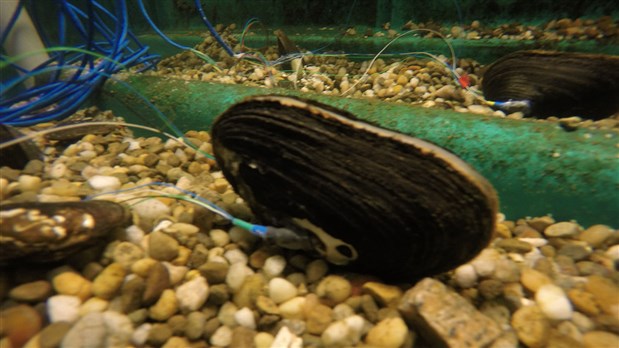
The NSCU team developed a new mussel-monitoring system to determine if there are toxins in the water. (Image Credit: NSCU)


This seems like an April Fools joke, but it isn't.


Or is it? It's not…. Or is it?


No.


Or is it? J/K, it's not.


Researchers at North Carolina State University developed and demonstrated a new system capable of remotely monitoring freshwater mussels and their behavior. Researchers could use the system to detect toxins in aquatic ecosystems.


"When mussels feed, they open their shells; but if there's something noxious in the water, they may immediately close their shells, all at once," says Jay Levine, co-author of a paper on the work and a professor of epidemiology at NC State. "Folks have been trying to find ways to measure how widely mussels or oysters open their shells off and on since the 1950s, but there have been a wide variety of challenges. We needed something that allows the animals to move, can be placed in streams and collects data – and now we have it."


"We've basically designed a custom Fitbit to track the activities of mussels," says Alper Bozkurt, corresponding author of the paper and a professor of electrical and computer engineering at NC State.


The idea behind this research comes from mussels' feeding behavior, which is asynchronous. If a group of mussels simultaneously shut their shells, it's likely an indication of contaminated water. The team is already performing tests with their sensor system to determine if mussels close their shells in coordination without toxins present in water.


"Think of it as a canary in the coal mine, except we can detect the presence of toxins without having to wait for the mussels to die," Levine says. "At the same time, it will help us understand the behavior and monitor the health of the mussels themselves, which could give us insights into how various environmental factors affect their health. Which is important, given that many freshwater mussel species are threatened or endangered."


To develop the low-cost system, the team deployed commercially available components. The system consists of two inertial measurement units (IMUs) with a magnetometer and an accelerometer. One IMU was placed on a mussel's top shell and the other on its bottom shell. With these specific placements, the team can record and compare how the shell halves move relative to each other. It allows the researchers to conclude whether the mussel is closing its shell or being tumbled in the water by a strong current.


The wires of the IMUs run to a data acquisition system mounted on a stake in the waterway. A solar cell powers the data acquisition system when it's in a natural environment. Data collected from the sensors then gets wirelessly transmitted to the researchers via a cellular network.  There are four mussels connected to the system, but it can support dozens.


Over 250 hours of testing was conducted with live mussels in a laboratory fish tank. The team discovered the sensors provided incredibly accurate measurements of the mussel's shell opening, which was recorded at less than one degree. Now, the team is conducting more tests to understand the system's robustness. For example, they want to find out how long it can last in practical use under real-life conditions. They plan to start field testing soon.


"In addition to exploring its effectiveness as an environmental monitor, we're optimistic that the technology can help us learn new things about the mussels themselves," Levine says. "What prompts them to filter and feed? Does their behavior change in response to changes in temperature? While we know a lot about these animals, there is also a lot we don't know. The sensors provide us with the opportunity to develop baseline values for individual animals and to monitor their shell movement in response to environmental changes."


Have a story tip? Message me at: http://twitter.com/Cabe_Atwell

  • Sign in to reply

Top Comments

  • beacon_dave
    beacon_dave over 4 years ago in reply to ralphjy +1
    First method was off-the-shelf ethyl-2-cyanacrylate adhesive but not so good for the shell upon removal. Second method was a custom adhesive made from silicone and corn starch.
  • beacon_dave
    beacon_dave over 4 years ago in reply to ralphjy +1
    "...I wonder what value the cornstarch added?..." Apparently it helps reduce the curing process to approximately 5mins.
Parents
  • ralphjy
    ralphjy over 4 years ago

    It would be interesting to know how they did the sensor attach to the shell.  Does anyone have access to IEEE Xplore and could see if that was described in the article?

    • Cancel
    • Vote Up 0 Vote Down
    • Sign in to reply
    • More
    • Cancel
  • beacon_dave
    beacon_dave over 4 years ago in reply to ralphjy

    First method was off-the-shelf ethyl-2-cyanacrylate adhesive but not so good for the shell upon removal.

    Second method was a custom adhesive made from silicone and corn starch.

    • Cancel
    • Vote Up +1 Vote Down
    • Sign in to reply
    • More
    • Cancel
  • ralphjy
    ralphjy over 4 years ago in reply to beacon_dave

    Thx.  I'm surprised that those adhesives would work, but I guess there isn't a lot of stress on the joint.  The key must be getting the shell surface clean and dry before attach.  I wonder what value the cornstarch added?


    Be interesting to see how well this works in the wild.  And they'll probably need a much larger sample size.

    • Cancel
    • Vote Up 0 Vote Down
    • Sign in to reply
    • More
    • Cancel
Comment
  • ralphjy
    ralphjy over 4 years ago in reply to beacon_dave

    Thx.  I'm surprised that those adhesives would work, but I guess there isn't a lot of stress on the joint.  The key must be getting the shell surface clean and dry before attach.  I wonder what value the cornstarch added?


    Be interesting to see how well this works in the wild.  And they'll probably need a much larger sample size.

    • Cancel
    • Vote Up 0 Vote Down
    • Sign in to reply
    • More
    • Cancel
Children
  • beacon_dave
    beacon_dave over 4 years ago in reply to ralphjy

    "...I wonder what value the cornstarch added?..."


    Apparently it helps reduce the curing process to approximately 5mins.

    • Cancel
    • Vote Up +1 Vote Down
    • Sign in to reply
    • More
    • Cancel
element14 Community

element14 is the first online community specifically for engineers. Connect with your peers and get expert answers to your questions.

  • Members
  • Learn
  • Technologies
  • Challenges & Projects
  • Products
  • Store
  • About Us
  • Feedback & Support
  • FAQs
  • Terms of Use
  • Privacy Policy
  • Legal and Copyright Notices
  • Sitemap
  • Cookies

An Avnet Company © 2025 Premier Farnell Limited. All Rights Reserved.

Premier Farnell Ltd, registered in England and Wales (no 00876412), registered office: Farnell House, Forge Lane, Leeds LS12 2NE.

ICP 备案号 10220084.

Follow element14

  • X
  • Facebook
  • linkedin
  • YouTube