element14 Community
element14 Community
    Register Log In
  • Site
  • Search
  • Log In Register
  • Community Hub
    Community Hub
    • What's New on element14
    • Feedback and Support
    • Benefits of Membership
    • Personal Blogs
    • Members Area
    • Achievement Levels
  • Learn
    Learn
    • Ask an Expert
    • eBooks
    • element14 presents
    • Learning Center
    • Tech Spotlight
    • STEM Academy
    • Webinars, Training and Events
    • Learning Groups
  • Technologies
    Technologies
    • 3D Printing
    • FPGA
    • Industrial Automation
    • Internet of Things
    • Power & Energy
    • Sensors
    • Technology Groups
  • Challenges & Projects
    Challenges & Projects
    • Design Challenges
    • element14 presents Projects
    • Project14
    • Arduino Projects
    • Raspberry Pi Projects
    • Project Groups
  • Products
    Products
    • Arduino
    • Avnet & Tria Boards Community
    • Dev Tools
    • Manufacturers
    • Multicomp Pro
    • Product Groups
    • Raspberry Pi
    • RoadTests & Reviews
  • About Us
    About the element14 Community
  • Store
    Store
    • Visit Your Store
    • Choose another store...
      • Europe
      •  Austria (German)
      •  Belgium (Dutch, French)
      •  Bulgaria (Bulgarian)
      •  Czech Republic (Czech)
      •  Denmark (Danish)
      •  Estonia (Estonian)
      •  Finland (Finnish)
      •  France (French)
      •  Germany (German)
      •  Hungary (Hungarian)
      •  Ireland
      •  Israel
      •  Italy (Italian)
      •  Latvia (Latvian)
      •  
      •  Lithuania (Lithuanian)
      •  Netherlands (Dutch)
      •  Norway (Norwegian)
      •  Poland (Polish)
      •  Portugal (Portuguese)
      •  Romania (Romanian)
      •  Russia (Russian)
      •  Slovakia (Slovak)
      •  Slovenia (Slovenian)
      •  Spain (Spanish)
      •  Sweden (Swedish)
      •  Switzerland(German, French)
      •  Turkey (Turkish)
      •  United Kingdom
      • Asia Pacific
      •  Australia
      •  China
      •  Hong Kong
      •  India
      •  Japan
      •  Korea (Korean)
      •  Malaysia
      •  New Zealand
      •  Philippines
      •  Singapore
      •  Taiwan
      •  Thailand (Thai)
      •  Vietnam
      • Americas
      •  Brazil (Portuguese)
      •  Canada
      •  Mexico (Spanish)
      •  United States
      Can't find the country/region you're looking for? Visit our export site or find a local distributor.
  • Translate
  • Profile
  • Settings
Test & Tools
  • Technologies
  • More
Test & Tools
Documents Wishlist - What do you need for Soldering?
  • Blog
  • Forum
  • Documents
  • Files
  • Members
  • Mentions
  • Sub-Groups
  • Tags
  • More
  • Cancel
  • New
Join Test & Tools to participate - click to join for free!
Actions
  • Share
  • More
  • Cancel
Engagement
  • Author Author: dychen
  • Date Created: 18 Jan 2023 11:08 PM Date Created
  • Last Updated Last Updated: 12 Jun 2023 1:58 PM
  • Views 36739 views
  • Likes 15 likes
  • Comments 63 comments
Related
Recommended

Wishlist - What do you need for Soldering?

Broken tip soldering iron
Oh no! I've broken the tip of my soldering iron. This wishlist is coming just in the nick of time!

If you're shopping around for a gift for an electrical engineer or maker, look no further! Soldering is something pretty much every engineer does, and the better the tools, the happier they'll be! In this wishlist, we'll focus on through-hole soldering.

Soldering Iron

Soldering iron

A soldering iron is used to melt the solder that joins the metal pieces together. A soldering iron with adjustable temperature is a useful feature, because component manufacturers will often specify a maximum temperature (along with a duration). An adjustable temperature lets you set the max temperature and not have to worry about damaging the component. 

Buy now

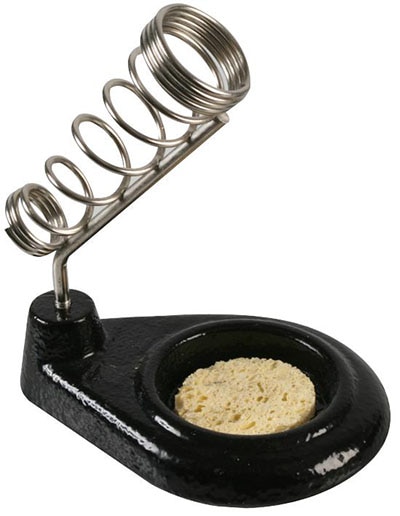
Soldering Iron Base

Soldering iron base

A soldering iron based includes a stand and a sponge for cleaning the tip of the soldering iron.

Buy now

Soldering Station

For engineers who will do a lot of soldering, it might be worthwhile to invest in a good soldering station. 

Soldering Station

Buy now

Soldering Iron Tip

Ah yes, this is what I was looking for! Tips of soldering irons don't last forever, but replacements are available in a variety of sizes.

soldering iron tip

Buy now

soldering iron tip

Buy now

Solder

Solder

Buy now

Flux

Flux Pen


Flux is a cleaning agent that removes oxidation from the metals that will be joined.

Buy now

Desoldering

If you have to repair a circuit, you'll need desoldering tools. Here are some of the most common:

Desoldering Braid (Wick)

Desoldering wick
Wicks are used to absorbing solder after it's been heated.

Buy now

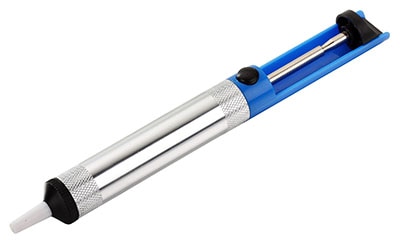
Desoldering Pump

Desoldering pump
You can also use a pump to suck the melted solder in.

Buy now

Desoldering Iron

Desoldering iron
If you need to do a lot of desoldering, it's well worth it to get yourself a desoldering iron, which both melts and removes the solder. 

Buy now

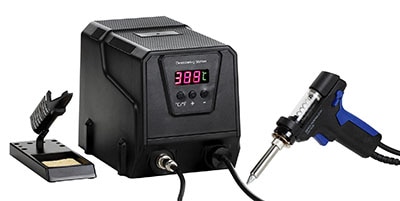
Desoldering Rework Station

Desoldering rework station
A desoldering station lets you adjust the temperature of the desoldering iron, and comes with the desoldering iron, cleaning tools, and nozzles of various sizes.

Buy now

Soldering Iron Tip Cleaner, Brass Wool
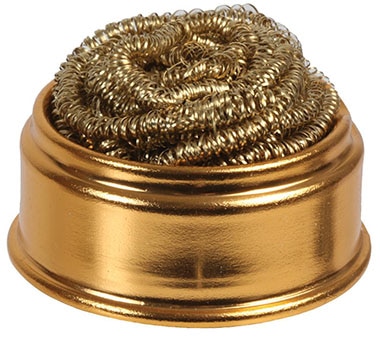
Brass wool soldering iron tip cleaner

Buy now


Fume Extractor

The fumes that are released when soldering are pretty nasty. Every bench should have a fume extractor to prevent you from breathing them in.

Fume extractor

Buy now

Fume extractor

Buy now

Pliers

Pliers

To make sure you don't burn your fingers, grab a pair of pliers to hold the wire as you solder.

Buy now

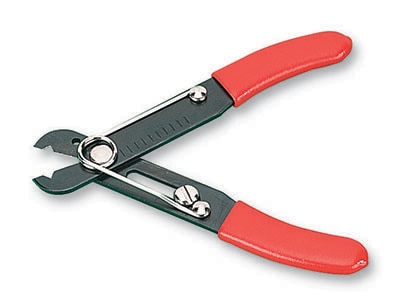
Wire Stripper/Cutter

Wire Stripper Cutter

Wire strippers are a must have when soldering, although I have a friend who is surprisingly good at stripping wires with his teeth. 

Buy now


Helping Hands

Helping hands hold the components in place while you solder, helping to prevent soldering iron accidents.
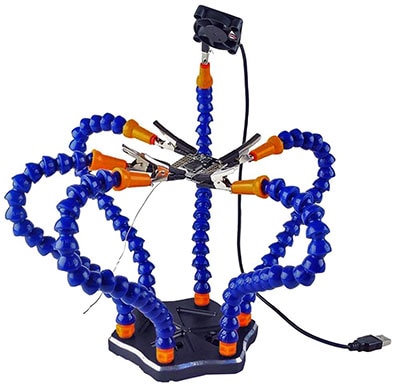
Helping hands

Buy now

For smaller components, a magnifier is very helpful.

Helping hands with magnifier

Buy now

  • soldering station
  • fume extractor
  • repair
  • through hole
  • desoldering
  • soldering iron
  • soldering
  • flux
  • workbench
  • Share
  • History
  • More
  • Cancel
  • Sign in to reply

Top Comments

  • BigBozo
    BigBozo over 2 years ago +1
    There are quite a few things that can help a soldering procedure, but my biggest tip is to use flux every time. It basically does the work for you, first it lowers the melting point of the solder so even…
  • MarioPJ98
    MarioPJ98 over 2 years ago +1
    Here are the best tips and tricks on soldering: Cleanliness is crucial. Always make sure the soldering iron tip is clean before starting, as a dirty tip can cause poor conductivity and lead to bad…
  • Kolmanpg
    Kolmanpg over 2 years ago +1
    My best tip for soldering is just to practice as much as you can, you do not need to have the best equipment to be good at it, you just need to practice and do it as much as you can and you will become…
  • Mastadox
    Mastadox over 3 years ago

    Removing components can be just as important as soldering them on. Always adding some fresh solder, preferable low melting point, before removing a component, can save headaches later. 

    • Cancel
    • Vote Up 0 Vote Down
    • Sign in to reply
    • More
    • Cancel
  • Anand03
    Anand03 over 3 years ago

    Here are the some of simple and best tips while soldering...... 

    1.Use the right soldering iron for the job.

    2.Clean the soldering iron tip with a damp sponge or brass wire brush before and after each use.

    3.Use only enough solder to make a good connection.

    4.When soldering wires to a printed circuit board, heat both the wire and the pad before applying solder.

    5.Use flux to help the solder flow and make it easier to create a good connection.

    6.Use a helping hand tool to hold components in place while soldering.

    7.Practice soldering to improve your skills.

    8.Use safety precautions such as wearing eye protection and working in a well-ventilated area.

    9.Use lead-free solder for electronics and rosin-core solder for general purpose work.

    10.Be patient and take your time when soldering.

    • Cancel
    • Vote Up 0 Vote Down
    • Sign in to reply
    • More
    • Cancel
  • me_Cris
    me_Cris over 3 years ago

    I started soldering a little late, although my father had an old soldering gun that had a 1.5-2mm diameter copper wire at the tip. I was gluing one wire, another. Then when I got hired, I worked with a soldering iron that was always connected to the 230VAC socket. I couldn't adjust the temperature and it was a bit difficult, but I didn't solder small components back then. Then I had the opportunity to use a better soldering station, with temperature control, display, sharp tips, I learned to solder SMD components with this station. I personally use a common 60W soldering station, which connects directly to 230VAC, is pen type, and everything is in this pen; it has the possibility to adjust the temperature, it also has a small display. But, it doesn't have an On-Off button, when I turn it on it shows me 160° from the start, so it doesn't start from 0°; it is a bit uncomfortable for finer soldering, and the tips are not durable. Having said that, I can say that:
    - we need a soldering station with On/Off button;
    - temperature adjustment starting from 0° would be useful;
    - use tips depending on how strong/hard the soldering is, for SMDs use thin tips, for THDs a normal conical tip is good, for components with a larger pad or thermal pad as we see with transistors, use a chisel type tip, wider/ thicker;
    - try not to use leaded soldering wire, it is not very healthy, in general you should also have a system with a filter for smoke absorption, I drink a lot of water when soldering;
    - use a wet sponge to clean the tip, or a wire type sponge if you have one;
    - if you don't have a soldering station that turns off by itself when you don't use it, put soldering wire on the tip so that it doesn't stay hot when dry;
    - if you touch plastic materials with the tip, clean it as quickly as you can;
    - be careful with thin tips, with a tip of 0.4, for example, like the ones you use when gluing SMD components, they can easily bend if you hit something hard, and they are expensive;
    - when I solder THDs, I put my tip so that it simultaneously touches both the component pin and the pad, anyway they heat up quickly, then I come with soldering wire, and I try to make a complete solder, with a slightly conical appearance if you want to call it that so;
    - for SMD components, for example an 0805 capsule resistor which is very common, I put a little soldering wire on a pad, and then with tweezers I grab the part and bring it over the pads;
    - do not damage your eyes trying to glue small SMD components, use a magnifying glass if you have, or even better, a microscope;
    - do not heat the LEDs too much, they can still be destroyed;
    - when I unsolder components, I prefer to put extra soldering wires on the solder so that the tip heats up the pad and the piece faster;
    - if you use soldering flux, clean the excess with isopropyl alcohol, for example;
    - the very sharp tips can scratch the PCB, be careful;
    - if you want to glue an integrated SMD or THD, and you made a short between the pins, and you don't manage to remove it, use absorbent braid, but be careful that it can leave small strands of wire behind;
    - about two times I used a hot air blower to unglue a QFP package, also use protective thermal tape to avoid ungluing other components;
    - perhaps the easiest way is to unsolder THD components using the absorption pump, heat the pad and quickly pull the solder with the pump, or you can clean the PCB holes;
    - do not leave the pins from THDs uncut, you have glued the part, cut the terminals that are long, otherwise they can cause a short circuit;
    - don't keep your eyes too close to the solder, something might jump on your face, I still spot this on old boards where saccaze or I don't know what substances were used;
    - make sure that the solder has cooled down before moving the piece or plate;
    - and last but not least, if you take care of your clothes, avoid contact with melted soldering wire, I for one did not manage to save my pants and shoes.

    If anyone has any more advice, put it next to this list if they want.

    Sorry for typos, I used an online translator.

    • Cancel
    • Vote Up 0 Vote Down
    • Sign in to reply
    • More
    • Cancel
  • Saikiran
    Saikiran over 3 years ago

    Cleaning tip of soldering gun and using flux to avoid dry soldering . 

    • Cancel
    • Vote Up 0 Vote Down
    • Sign in to reply
    • More
    • Cancel
  • gordonmx
    gordonmx over 3 years ago

    I wouldn't call them tricks, but a good temperature-controlled soldering iron and some solder flux is always helpful in soldering components.  For removing components, especially SMD, preheating the board along with solder wick or sucker is helpful.  Maybe a pair of tweezers too.  Also, if you need to stabilize a component being soldered to use the smallest clamp available (like an alligator clip) instead of your dad's 20-year-old bench vise 8^).  BUT the best advice I could give would be to have patience.  It will save you from much rework and burnt fingers.  

    • Cancel
    • Vote Up 0 Vote Down
    • Sign in to reply
    • More
    • Cancel
  • FrancoisAR
    FrancoisAR over 3 years ago

    Most things I think will come with experience, like the temp I need to set the soldering iron to (still get that wrong). Another thing is keeping the soldering iron lead detangled, sounds stupid, but put it down on the worktop (I know a no-no) for a second to grab a pcb that was falling, the lead detangled and burnt my arm... And lastly don, whatever you do, feel if the tip is hot enough using your finger Slight smile

    • Cancel
    • Vote Up 0 Vote Down
    • Sign in to reply
    • More
    • Cancel
  • ashley4syth
    ashley4syth over 3 years ago

    There are no shortcuts worth trying.  Assemble everything you will need.  Obtain a good mechanical connection. ALWAYS try to have good ventilation

    • Cancel
    • Vote Up 0 Vote Down
    • Sign in to reply
    • More
    • Cancel
  • kmschmi
    kmschmi over 3 years ago

    This applies to those new to soldering . Best tip I got from the Electrical Engineers I worked with when I started playing with electronics was to get an old board and learn how to properly desolder and  then resolder the components. You can take it slow and learn from your mistakes without wasting components.

    • Cancel
    • Vote Up 0 Vote Down
    • Sign in to reply
    • More
    • Cancel
  • JWx
    JWx over 3 years ago in reply to el34

    do You mean sandpaper? I was told to never do it because it destroys tip's coating, exposing copper core that is then quickly eaten up during soldering...

    • Cancel
    • Vote Up 0 Vote Down
    • Sign in to reply
    • More
    • Cancel
  • el34
    el34 over 3 years ago

    I clean  the tip of my soldering iron with a paper like a saw

    • Cancel
    • Vote Up 0 Vote Down
    • Sign in to reply
    • More
    • Cancel
<>
element14 Community

element14 is the first online community specifically for engineers. Connect with your peers and get expert answers to your questions.

  • Members
  • Learn
  • Technologies
  • Challenges & Projects
  • Products
  • Store
  • About Us
  • Feedback & Support
  • FAQs
  • Terms of Use
  • Privacy Policy
  • Legal and Copyright Notices
  • Sitemap
  • Cookies

An Avnet Company © 2026 Premier Farnell Limited. All Rights Reserved.

Premier Farnell Ltd, registered in England and Wales (no 00876412), registered office: Farnell House, Forge Lane, Leeds LS12 2NE.

ICP 备案号 10220084.

Follow element14

  • X
  • Facebook
  • linkedin
  • YouTube