



Hedy Lamarr public photo for The Heavenly Body (1944). (Image Credit: Wikimedia Commons/doctormacro.com)
Hedy Lamarr isn’t recognized as just a famous actress who starred in Hollywood classics like Algiers. She was also a self-taught technical thinker. Lamarr exhibited curiosity throughout her childhood, fascinated with finding out how things worked. Her father, a bank director who shared that same engineering passion, sat with her and explained the working principles of machines, including streetcars and printing presses. At five years old, Lamarr took apart music boxes, learning about how the gears turned.
During the 1930s and 1940s, she pursued invention along with her film career, working on ideas during breaks in her trailer and at home at an invention table. Here, Lamarr experimented with ideas, such as more efficient traffic lights and a tablet that turned water into a carbonated beverage. What helped was that she saw connections missed by others, believing that “improving things came naturally.”
During WW2, on September 17, 1940, a German U-Boat attacked and sank the SS City of Benares. This ship was enroute to Canada from Britain, carrying refugee/evacuee children and other passengers. Most on board didn’t survive, and the tragedy affected Lamarr, who wanted to help provide the Allies with a wartime advantage. At the same time, she learned that radio-controlled torpedoes were vulnerable to signal interference. A single frequency guiding a radio-controlled torpedo could easily be jammed. All the enemy had to do was find the frequency and emit a stronger signal. Lamarr understood that making them hard to jam or intercept was crucial.
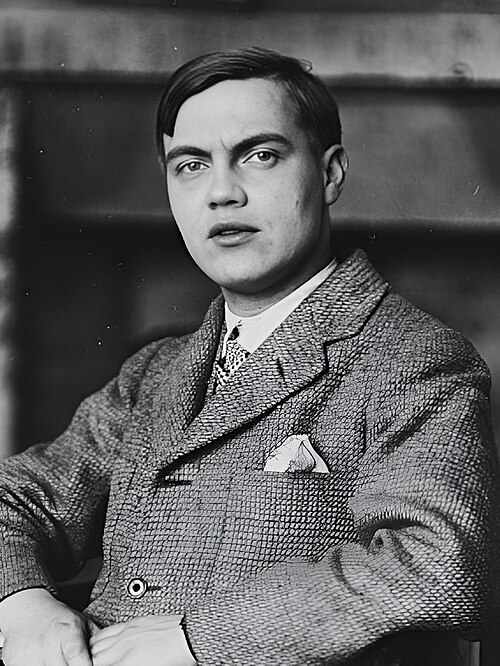
Hedy Lamarr collaborated with George Antheil to develop the frequency hopping system. (Image Credit: Wikimedia Commons/A&M Penn Photography Foundation)
She then collaborated with George Antheil, an avant-garde composer, to develop the technology behind radio-controlled torpedo communication systems designed to resist jamming. While Lamarr came up with the idea, Antheil helped adapt the synchronization idea to radio frequency changes. Previously, Antheil worked on Ballet Mécanique, a piece that involved multiple synchronized player pianos. Dubbed a ”Secret Communication System,” their invention drew inspiration from player piano rolls. They created a mechanism designed to hop between frequencies in a synchronized pattern. The duo went with 88 frequencies to match the number of piano keys.
The musical concept was reimagined as a radio system featuring player-piano-style perforated paper records. Switches, which connected different tuning condensers to a variable frequency oscillator, were controlled by those record strips. Holes in the ribbon moved across a vacuum manifold, actuating rods that switched frequencies hundreds of times a minute. Identical rolls in the transmitter and receiver ensured both ends remained synchronized. In this system, the piano-player mechanism worked like a timing device. It determined when a frequency shifted so that both ends of the system remained synchronized.
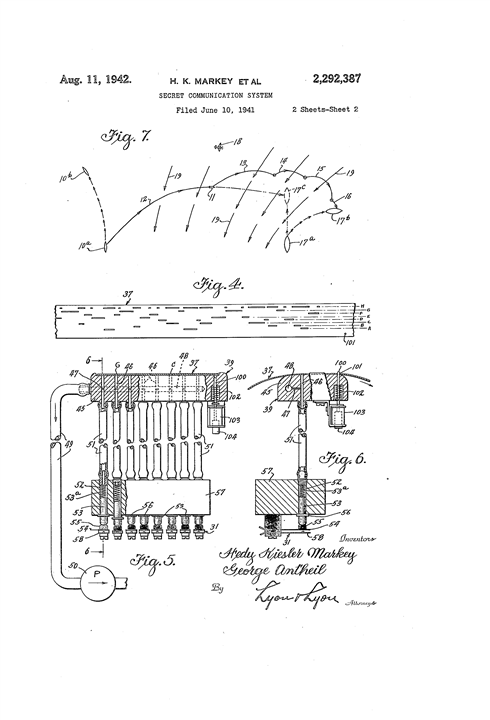
Image showing U.S. patent 2,292,387 for the Secret Communication System developed by Hedy Lamarr and George Antheil. (Image Credit: Google Patents)
The project spurred a lot of interest, particularly with the National Inventors Council, to which the duo presented it. Both filed a patent application on June 10, 1941, and approval followed one year later as U.S. patent number 2,292,387 for this Secret Communication System. Lamarr recalled that both sat on her living room rug and used a silver matchbox and matches as a model for this idea to simulate the wiring. This allowed a receiver and transmitter to stay synchronized without a wired connection.
The two presented it to the U.S. Navy. A lot of doubt surrounded their work. The Navy dismissed the design as they believed a weapon with this technology would be too complex and bulky. Instead, the Navy advised her to use her Hollywood fame to sell war bonds. She followed their suggestion and raised millions of dollars in war bonds while the Navy shelved her patent and left it unused for years. Unfortunately, this meant the patent was ahead of its time. Although the Navy had the right idea about the technical limitations, engineering underwent a major change.
It still served its purpose decades later. The U.S. military gave their frequency-hopping concept another chance during the 1960s. Instead of using the piano player rolls in the patent analogy, they used electronic systems for faster hopping. The invention became a precursor to spread-spectrum technology, the basis of secure communication.
Today’s communication systems, such as Bluetooth, still use this principle. This enables many devices, like smartphones, to share similar airwaves without disrupting each other. Even though her original frequency hopping invention relies on 88 frequencies, Bluetooth hops up to thousands of times/second across 79 channels (2.4 GHz). That same idea is used in GPS systems, making weak satellite signals more resistant to interference. GPS satellites orbit at approximately 12,550 miles above the Earth, which means the signals are very weak when they reach a phone.
Modern Replicas
I was looking for some modern recreations of this type of frequency hopping in the Maker/DIY world. I didn’t find many, to be honest. But these few are pretty fun.
First is from an Arduino hobbyists pontificating about making their own frequency hopping system. They used low-cost nRF24L01 radio modules and microcontrollers like the Arduino or Teensy. In one project, two connected devices (master and slave) are synchronized via shared timing. The master goes through each channel list at fixed intervals and transmits packets at the start of each frame. At the same time, the slave uses timing and interrupts to match the same hopping sequence. The system is a two-way wireless link capable of changing frequencies many times per second.
Another more complete project comes from Shubham Paul. Where he uses the concept on a NRF24l01+. I’m shocked how simple the code is for both ends on the system. You can also get the same code and project files at Github. It does work. But when the systems gets out of since he manually sets then over serial. Below is a video of the project working on Shubham Paul’s channel. I’m kind of surprised that he hasn’t made more projects since.
I did find this project using the same NRF24l01 boards by Max-62. The code appears to be wildly different, but this one and Paul’s seem to have posted around the same time. Although Paul’s website has an earlier posting date vs Max-62’s dated code files.
Last thoughts on Lamarr
Although she made great contributions to the war effort, Lamarr’s work was overlooked due to being a Hollywood actress and a woman in a technical role. Her invention wasn’t commercially developed before the patent expired. It wasn’t until 1997 that she and Antheil were recognized for their system. While the Electronic Frontier Foundation rewarded her with a Pioneer Award, the pair were presented with the BULBIE Gnass Spirit of Achievement Award one year later. In 2014, Lamarr was inducted into the National Inventors Hall of Fame,14 years after her death.
Have a story tip? Message me here at element14.

