


What’s next
The joystick makes driving nicer, but you’re still driving blind — next up is the camera, so this actually becomes the “puppy on a leash from your phone” post the original plan promised.
Hi again, it’s Hambreros and Tamadillo. Last post the robot learned to make noise. This one is smaller but makes the whole thing way more fun to actually drive: a real joystick — drag it with a mouse or thumb, or just use WASD / vim-style hjkl on a keyboard — instead of wrestling two separate wheel sliders at once.
Since Post 1, driving meant dragging two independent vertical sliders. Well actually up till now we haven’t connected both servos but yeay a slider per wheel like driving a tank, and how do you even control 2 controls with 1 mouse? So the control page now has:
WASD and vim’s hjkl both drive the same stick — whichever one you reach for first works, and they combine, so forward + turn gives you a proper diagonal instead of a hard pivot.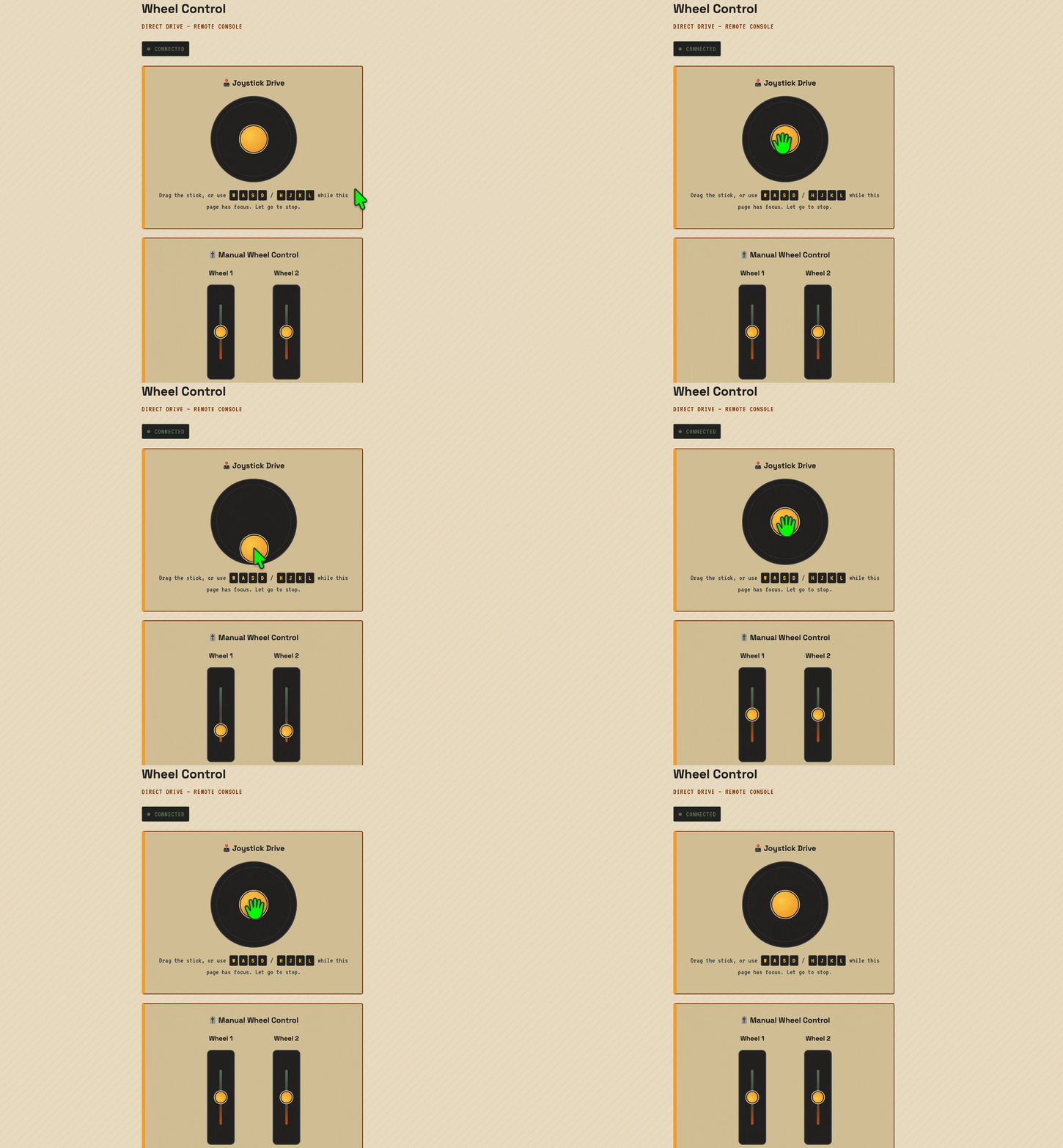
The tempting shortcut was to do the “turn this drag angle into two wheel speeds” math in JavaScript and post straight to the existing /api/wheel/<n> endpoint per wheel. We didn’t do that — the frontend has no business knowing how many wheels this thing has or how they’re mixed. Instead the page posts one thing, {x, y} (turn, throttle, both -100..100), to a new POST /api/drive, and the actual arcade-mixing math lives entirely on the Python side:
def mix_drive(x, y):
    x = max(-100, min(100, int(x)))
    y = max(-100, min(100, int(y)))
    return max(-100, min(100, y + x)), max(-100, min(100, y - x))
One function, one place that knows wheel1 = throttle + turn and wheel2 = throttle - turn. If we ever add a third wheel, a different chassis, or want to curve the turn response, that’s a one-function change, not a hunt through frontend code.
Software done, so time to actually push the stick forward with both wheels connected at once — first time we’d had them both hooked up and driven together rather than one at a time. Robot spun in place instead of driving forward. Wheel 1 was doing exactly what it should; wheel 2 was going backward.
Both servos are the same part, wired the same way, running the same firmware — but they’re bolted to opposite sides of the chassis, mirror image of each other, the same way your left shoe and right shoe are mirror images built from the same last. “Spin clockwise” looks like forward from one side and backward from the other, so the exact same pulse width that drove wheel 1 forward drove wheel 2 in reverse. Nothing wrong with the mixing math from the last section — mix_drive() was handing out perfectly correct forward speeds for both wheels, it’s just that one wheel’s servo interprets “forward” backwards from the other.
Fixed it at the one point in the firmware that turns a commanded speed into an actual pulse, not by touching the mixing math or anything upstream of it:
#define WHEEL1_REVERSED false
#define WHEEL2_REVERSED true
...
servoFrame(SERVO1_PIN, speedToPulseUs(WHEEL1_REVERSED ? -wheel1Speed : wheel1Speed),
           SERVO2_PIN, speedToPulseUs(WHEEL2_REVERSED ? -wheel2Speed : wheel2Speed));
wheel1Speed/wheel2Speed themselves — the values the Bridge handlers store, the values the Python side and the joystick’s arcade mixing both reason about — still mean “positive is forward” for both wheels. The mirroring correction is a single negation right at the pulse-generation step, isolated to the one wheel that’s actually mounted backwards. If it turns out a future chassis needs the other wheel flipped too (or flipped back), it’s a one-line change, not a rethink of the mixing.
With the direction sorted, one servo was still making a faint noise even sitting at commanded speed 0 — the same self-correcting buzz Post 1 first ran into, just quieter now that both servos are trimmed better. Trimming the pot gets you close to the servo’s true center, not exactly onto it, and a held 1500us “stop” pulse still gives the servo’s internal position-holding loop a target to compare itself against. Close-but-not-perfect is still enough for it to keep nudging.
So instead of chasing the trim pot further, we added a real motor power toggle — a button per wheel that does something a commanded speed of 0 can’t: stop sending that servo a pulse train at all.
static void servoFrame(int pin1, unsigned int pulse1Us, bool enable1,
                       int pin2, unsigned int pulse2Us, bool enable2) {
    if (enable1) {
        digitalWrite(pin1, HIGH);
        delayMicroseconds(pulse1Us);
        digitalWrite(pin1, LOW);
    }
    // ...same for pin2/enable2
}
No pulse means nothing for the internal loop to react to — quieter than any stop pulse we could trim to, held or not.
Worth being upfront about what this isn’t: it’s not a real power switch. The board only ever drove the servo signal line — the 5V rail has always come straight off the shared supply with no relay or MOSFET in between , so “motor off” here can’t cut actual voltage to the servo. That would need new hardware — a MOSFET or relay switched from a spare GPIO — not just a firmware change, so we deliberately scoped this to the signal-only version rather than reaching for a soldering iron mid-feature. Given the noise was coming from the signal being held near-but-not-quite-center rather than from anything drawing power at true idle, it’s also very likely the actual fix for the buzz, not just a consolation prize.
First pass: listen for keydown, send the drive command once. Worked for about half a second — press w and the robot lurches forward, then stops on its own even though the key’s still very much held down.
Turns out keydown fires once per press, and after that the browser’s own key-repeat kicks in — which is inconsistent across OSes, has a noticeable initial delay, and isn’t something we should be relying on for “keep the motor running.” Worse: Post 1 built a 1-second watchdog into the STM32 side specifically so a dropped connection stops the wheels instead of leaving them spinning — and a keydown that fires once and then goes quiet for a while looks exactly like a dropped connection to that watchdog.
Fix was the same pattern the wheel sliders already used for drag events, just driven by a timer instead of input events — track which keys are currently down in a Set, and re-send the current vector on a plain interval for as long as any of them are held:
setInterval(() => {
  if (keyboardDriving) drive(...keyboardVector(), false);
}, SEND_INTERVAL_MS);
keydown/keyup just add/remove from the set; the interval is what actually keeps commands flowing often enough to stay ahead of the watchdog.
Second gotcha, found by alt-tabbing away mid-drive without letting go of w first: the robot kept driving. keyup only fires if the browser is still the one listening — alt-tab, clicking outside the page, anything that steals focus, and the browser just stops delivering key events altogether. No keyup, so our held-keys set never clears.
window.addEventListener('blur', () => {
  if (pressedKeys.size === 0) return;
  pressedKeys.clear();
  keyboardDriving = false;
  drive(0, 0, true);
});
Losing focus now stops the robot immediately instead of waiting out the watchdog’s full second — which, at “robot with wheels in a hallway,” felt like the actually-important version of this bug, not just a nice-to-have.
The joystick makes driving nicer, but you’re still driving blind — next up is the camera, so this actually becomes the “puppy on a leash from your phone” post the original plan promised.

