


1 Product Overview
The HX94 Series is a line of duct-mount RH/temperature transmitters designed for reliable, low-cost environmental monitoring in HVAC and industrial applications. It features a robust stainless steel housing, solid-state sensors for fast response, and versatile output options for easy integration. There have many types of sensors, this Omega HX94 is top niche especially for industrial. Go deep for what it is

With key features
|
Feature
|
Description
|
Benefit
|
|---|---|---|
|
Dual Sensing
|
Combines Thin-Film Polymer Capacitor (RH) and 100Ω Platinum RTD (Temp) in one unit.
|
Simplifies installation, reduces cost versus separate sensors.
|
|
Stainless Steel NEMA 4 Enclosure
|
IP66 equivalent, corrosion-resistant housing.
|
Suitable for harsh environments, ducts, and wet conditions. But not for dip into water,
unboxing pic shows why.
|
|
Removable & Adjustable
|
Includes removable sensor filter for cleaning and a variable-depth (1-9") duct flange.
|
Easy maintenance and adaptability to different duct wall thicknesses.
|
|
Linearized Outputs
|
Available in 4-20 mA (HX94C) or 0-1 Vdc (HX94V).
|
Direct compatibility with most PLCs, DDCs, and control systems without complex scaling.
|
|
Fast Response
|
RH time constant <20-30 seconds in moving air.
|
Quickly reflects changes in environmental conditions.
|
The type HX94C is for current signal and HX94V is for voltage signal. the tye in hand is HX94C.
Refer to Omega HX94C. Datasheet.pdf
2 What inside ?
Remove the cap

Get closer,
take the whole sensor out from rear end

magnified with PCB


Nice and neate

3 Esay to install
Gasket flange is provide for easy install

there is tip, one rubber ring in the middle can expand under pressure to clamp the metal enclosure, clever design.

water tight connectors

4 Technical Specifications Analysis
The data is more persuasive as such,Relative Humidity Sensing
-
Sensor Type: Thin-Film Polymer Capacitor.
-
Range: 3% to 95% RH.
-
Accuracy: ±2% RH (Excellent for its class).
-
Repeatability: ±1% RH.
-
Compensation: -20°C to 85°C (Wide temperature compensation range ensures accuracy across operating conditions).
-
Output: 4-20 mA or 0-1 Vdc, linearly proportional to 0-100% RH.
Temperature Sensing
-
Sensor Type: 100Ω Platinum RTD (DIN 43760 standard).
-
Range: 0°C to 100°C (32°F to 212°F).
-
Accuracy: ±0.6°C (±1°F) (Good for HVAC applications).
-
Repeatability: ±0.3°C.
-
Output: 4-20 mA or 0-1 Vdc for the temperature channel (HX94C/V models).
Electrical & Mechanical
-
Power Supply: 6 to 30 Vdc (Polarity Protected). Flexible for use with 12V or 24V systems.
-
Connection Types: Multiple options (4-pin connector, lead wires, or 1/2" NPT with cable) provide mounting versatility.
-
Time Constant (Temp): 60% response time is specified, indicating a slightly slower thermal response compared to the RH sensor.
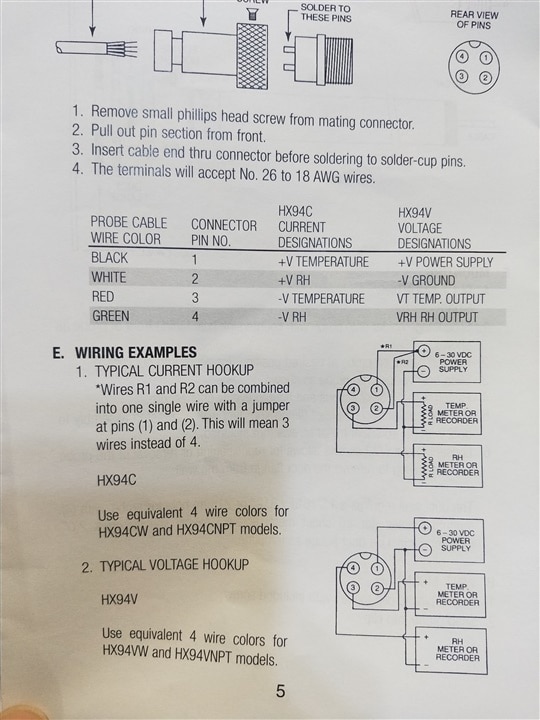
5 Apply the power source
Apply 12VDC to pin 1 and GND to Pin 2

the reading is 12.17V DC

while the current get is jus 0.01mA to pin 3

and 0.01-0.02mA in pin 4.

Here is how to connect it.
Ehn, this is still can not solved yet. But, this sensor is not used in the plan.Jus share it.

