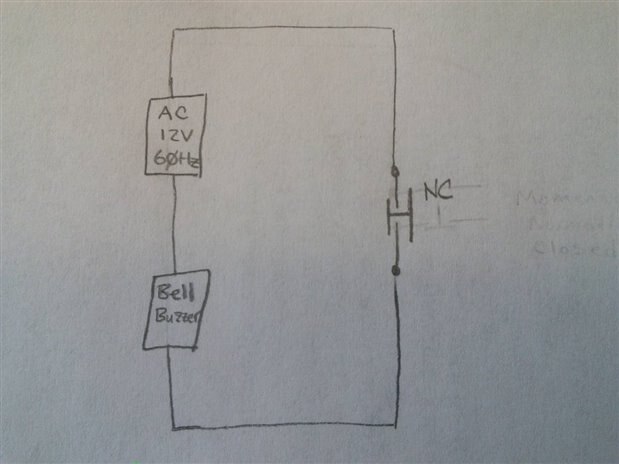
What is the proper approach for adding a disarm button to this circuit, so that the buzzer doesn't sound until the next time the button is released?
Hi Simon,
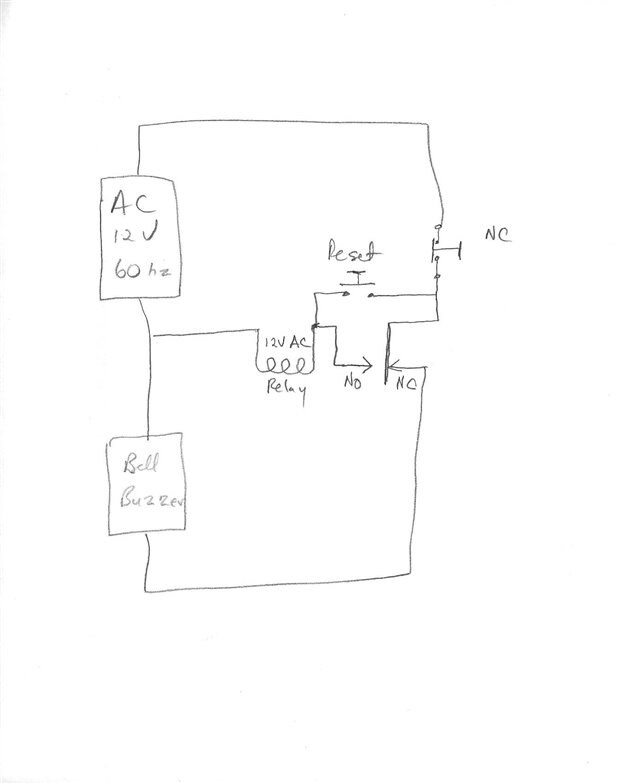
Here is a circuit using a small 12 VAC SPDT Relay that will do the trick for you. If the door opens the switch will start the buzzer sounding. Pushing the reset causes the relay to close which disconnects the buzzer. The closure of the relay also latches the relay so that the buzzer can not sound again until the doo closes and the relay is released by the opening of the door switch.
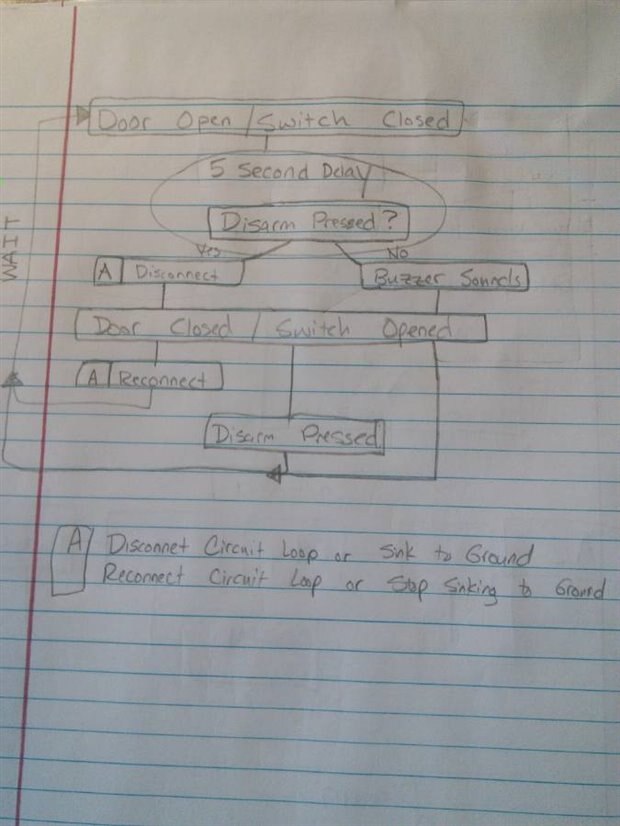
Your excellent flow chart and description with schematic made this a fairly easy problem to address.
John
Hi Simon,
Here is a circuit using a small 12 VAC SPDT Relay that will do the trick for you. If the door opens the switch will start the buzzer sounding. Pushing the reset causes the relay to close which disconnects the buzzer. The closure of the relay also latches the relay so that the buzzer can not sound again until the doo closes and the relay is released by the opening of the door switch.
Your excellent flow chart and description with schematic made this a fairly easy problem to address.
John
Hi again John.
Is there a way to add a delay so that there is an opportunity of 5 seconds to press the button before the alarm does or does not sound? Delays seem to be a complex thing, from the information I'm seeing. In addition, the ways I've tried to add the feature create timing issues that I haven't solved.
By the way, this will be combined with this completed design unless I decide it's better to redesign the system from scratch with the whole in mind (perhaps with a microcontroller approach instead- I may do it just for fun too.)
Hi Simon, While (What is called a Delay on Make circuit) certainly is more complicated it is not impossible. I have one on my bench right now that is working to delay the lighting of a 12 volt bulb by 5 seconds. Here is a link to the device I am testing:
http://www.newark.com/artisan-controls/438usas/solid-state-timer-1024sec-288vac/dp/86K9984
As you can see in the data the device is not rated to work below 19VAC but my unit, however, is working fine at 12 volts AC. There are a couple of catches. First there is about 3 volts that are lost passing through the device. This means that your buzzer would only get 9 volts from your power source. If it is a buzzer or a bell it might be weaker sounding. You could compensate for this with a 15 VAC or 18 VAC transformer. Second, the Delay on Make module is not cheap. I think the Newark site above lists it at $45.00 US. However if you happen to live in the US I could probably find a used one for you. The module itself can be programmed with switches to delay anywhere from 1 to 1024 seconds. It is wired in series with your circuit. Here is a video of the one I have:
There are of course other circuits that could be designed but the Artisan 438USAS would be the simplest solution.
John