element14 Community
element14 Community
    Register Log In
  • Site
  • Search
  • Log In Register
  • Community Hub
    Community Hub
    • What's New on element14
    • Feedback and Support
    • Benefits of Membership
    • Personal Blogs
    • Members Area
    • Achievement Levels
  • Learn
    Learn
    • Ask an Expert
    • eBooks
    • element14 presents
    • Learning Center
    • Tech Spotlight
    • STEM Academy
    • Webinars, Training and Events
    • Learning Groups
  • Technologies
    Technologies
    • 3D Printing
    • FPGA
    • Industrial Automation
    • Internet of Things
    • Power & Energy
    • Sensors
    • Technology Groups
  • Challenges & Projects
    Challenges & Projects
    • Design Challenges
    • element14 presents Projects
    • Project14
    • Arduino Projects
    • Raspberry Pi Projects
    • Project Groups
  • Products
    Products
    • Arduino
    • Avnet & Tria Boards Community
    • Dev Tools
    • Manufacturers
    • Multicomp Pro
    • Product Groups
    • Raspberry Pi
    • RoadTests & Reviews
  • About Us
    About the element14 Community
  • Store
    Store
    • Visit Your Store
    • Choose another store...
      • Europe
      •  Austria (German)
      •  Belgium (Dutch, French)
      •  Bulgaria (Bulgarian)
      •  Czech Republic (Czech)
      •  Denmark (Danish)
      •  Estonia (Estonian)
      •  Finland (Finnish)
      •  France (French)
      •  Germany (German)
      •  Hungary (Hungarian)
      •  Ireland
      •  Israel
      •  Italy (Italian)
      •  Latvia (Latvian)
      •  
      •  Lithuania (Lithuanian)
      •  Netherlands (Dutch)
      •  Norway (Norwegian)
      •  Poland (Polish)
      •  Portugal (Portuguese)
      •  Romania (Romanian)
      •  Russia (Russian)
      •  Slovakia (Slovak)
      •  Slovenia (Slovenian)
      •  Spain (Spanish)
      •  Sweden (Swedish)
      •  Switzerland(German, French)
      •  Turkey (Turkish)
      •  United Kingdom
      • Asia Pacific
      •  Australia
      •  China
      •  Hong Kong
      •  India
      •  Japan
      •  Korea (Korean)
      •  Malaysia
      •  New Zealand
      •  Philippines
      •  Singapore
      •  Taiwan
      •  Thailand (Thai)
      •  Vietnam
      • Americas
      •  Brazil (Portuguese)
      •  Canada
      •  Mexico (Spanish)
      •  United States
      Can't find the country/region you're looking for? Visit our export site or find a local distributor.
  • Translate
  • Profile
  • Settings
element14's The Ben Heck Show
  • Challenges & Projects
  • element14 presents
  • element14's The Ben Heck Show
  • More
  • Cancel
element14's The Ben Heck Show
Forum Disarm Button for AC Bell Buzzer
  • Blog
  • Forum
  • Documents
  • Polls
  • Files
  • Members
  • Mentions
  • Sub-Groups
  • Tags
  • More
  • Cancel
  • New
Join element14's The Ben Heck Show to participate - click to join for free!
Actions
  • Share
  • More
  • Cancel
Forum Thread Details
  • Replies 9 replies
  • Subscribers 31 subscribers
  • Views 1058 views
  • Users 0 members are here
Related

Disarm Button for AC Bell Buzzer

Former Member
Former Member over 10 years ago

image

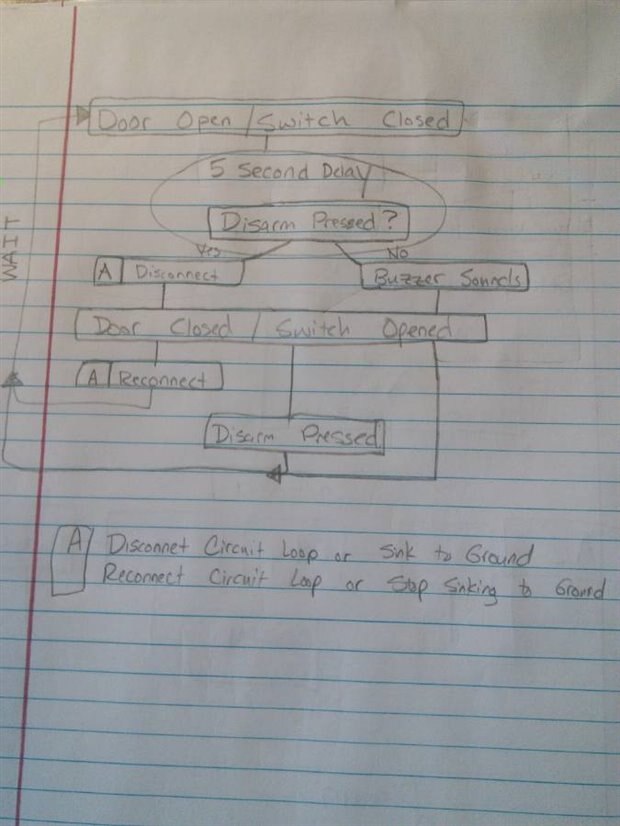
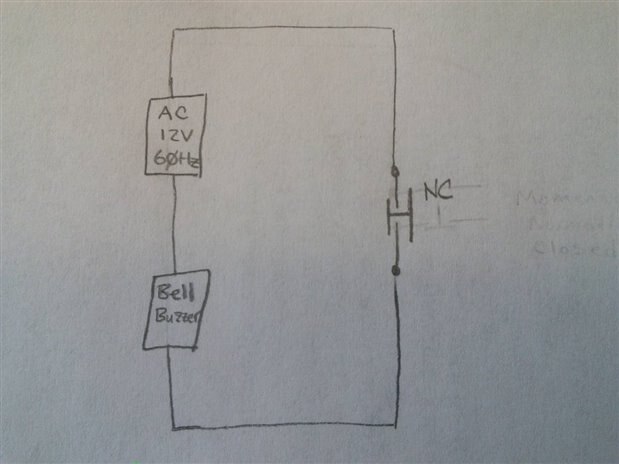
What is the proper approach for adding a disarm button to this circuit, so that the buzzer doesn't sound until the next time the button is released?

  • Sign in to reply
  • Cancel

Top Replies

  • mcb1
    mcb1 over 10 years ago in reply to Former Member +1
    Simon Thats valuable information. Unfortunately Ben isn't going to fix this, so you might consider shifting it ... but where. You mentioned RFID and have some intelligence so maybe Arduino might be the…
Parents
  • Former Member
    Former Member over 10 years ago

    image

    This is what I'm currently working on.

    • Cancel
    • Vote Up 0 Vote Down
    • Sign in to reply
    • Cancel
  • jw0752
    jw0752 over 10 years ago in reply to Former Member

    Hi Simon,

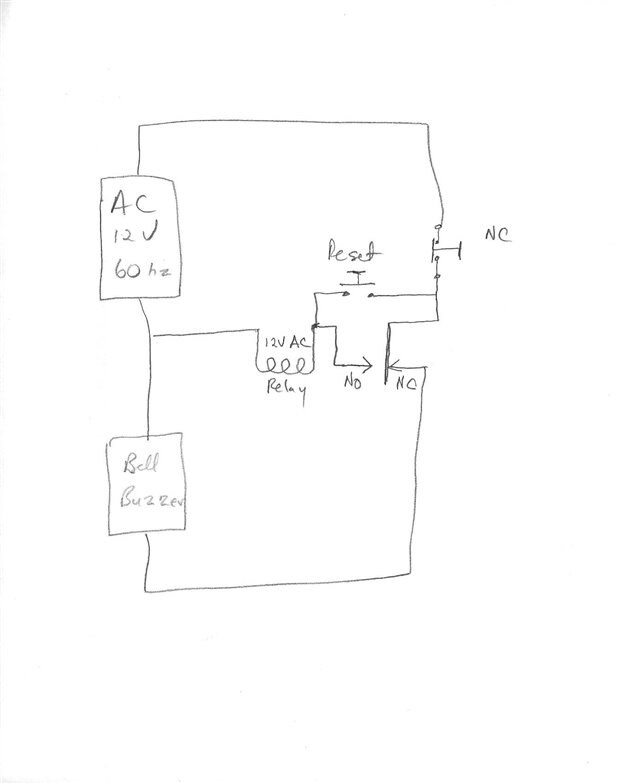
    Here is a circuit using a small 12 VAC SPDT Relay that will do the trick for you. If the door opens the switch will start the buzzer sounding. Pushing the reset causes the relay to close which disconnects the buzzer. The closure of the relay also latches the relay so that the buzzer can not sound again until the doo closes and the relay is released by the opening of the door switch.


    image


    Your excellent flow chart and description with schematic made this a fairly easy problem to address.


    John

    • Cancel
    • Vote Up 0 Vote Down
    • Sign in to reply
    • Cancel
  • Former Member
    Former Member over 10 years ago in reply to jw0752

    Hi again John.


    Is there a way to add a delay so that there is an opportunity of 5 seconds to press the button before the alarm does or does not sound? Delays seem to be a complex thing, from the information I'm seeing. In addition, the ways I've tried to add the feature create timing issues that I haven't solved.


    By the way, this will be combined with this completed design unless I decide it's better to redesign the system from scratch with the whole in mind (perhaps with a microcontroller approach instead- I may do it just for fun too.)

    • Cancel
    • Vote Up 0 Vote Down
    • Sign in to reply
    • Cancel
Reply
  • Former Member
    Former Member over 10 years ago in reply to jw0752

    Hi again John.


    Is there a way to add a delay so that there is an opportunity of 5 seconds to press the button before the alarm does or does not sound? Delays seem to be a complex thing, from the information I'm seeing. In addition, the ways I've tried to add the feature create timing issues that I haven't solved.


    By the way, this will be combined with this completed design unless I decide it's better to redesign the system from scratch with the whole in mind (perhaps with a microcontroller approach instead- I may do it just for fun too.)

    • Cancel
    • Vote Up 0 Vote Down
    • Sign in to reply
    • Cancel
Children
  • jw0752
    jw0752 over 10 years ago in reply to Former Member

    Hi Simon, While (What is called a Delay on Make circuit) certainly is more complicated it is not impossible. I have one on my bench right now that is working to delay the lighting of a 12 volt bulb by 5 seconds. Here is a link to the device I am testing:

    http://www.newark.com/artisan-controls/438usas/solid-state-timer-1024sec-288vac/dp/86K9984

    As you can see in the data the device is not rated to work below 19VAC but my unit, however, is working fine at 12 volts AC. There are a couple of catches. First there is about 3 volts that are lost passing through the device. This means that your buzzer would only get 9 volts from your power source. If it is a buzzer or a bell it might be weaker sounding. You could compensate for this with a 15 VAC or 18 VAC transformer. Second, the Delay on Make module is not cheap. I think the Newark site above lists it at $45.00 US. However if you happen to live in the US I could probably find a used one for you. The module itself can be programmed with switches to delay anywhere from 1 to 1024 seconds. It is wired in series with your circuit. Here is a video of the one I have:


    You don't have permission to edit metadata of this video.
    Edit media
    x
    image
    Upload Preview
    image


    There are of course other circuits that could be designed but the Artisan 438USAS would be the simplest solution.

    John

    • Cancel
    • Vote Up 0 Vote Down
    • Sign in to reply
    • Cancel
element14 Community

element14 is the first online community specifically for engineers. Connect with your peers and get expert answers to your questions.

  • Members
  • Learn
  • Technologies
  • Challenges & Projects
  • Products
  • Store
  • About Us
  • Feedback & Support
  • FAQs
  • Terms of Use
  • Privacy Policy
  • Legal and Copyright Notices
  • Sitemap
  • Cookies

An Avnet Company © 2026 Premier Farnell Limited. All Rights Reserved.

Premier Farnell Ltd, registered in England and Wales (no 00876412), registered office: Farnell House, Forge Lane, Leeds LS12 2NE.

ICP 备案号 10220084.

Follow element14

  • X
  • Facebook
  • linkedin
  • YouTube