


Last year I partecipated to the Spring Clean competition and I enjoyed it a lot. It gave me the push to complete what I had left over at the time, freeing up some bench and mental space. This year, when I discovered that the Spring Clean challenge was up and running again, I was ready to participate. But it didn't go according to plan.
The beginning
This year's competition started on March 18th, but I discovered it only one week later (thanks JoRatcliffe for the tag in a comment!). I had an old radio from a family friend sitting on the shelf waiting to be repaired. To me this was the perfect occasion to work on it, while having fun and participating in the e14 community. Still, I was able to start working on it only during April.
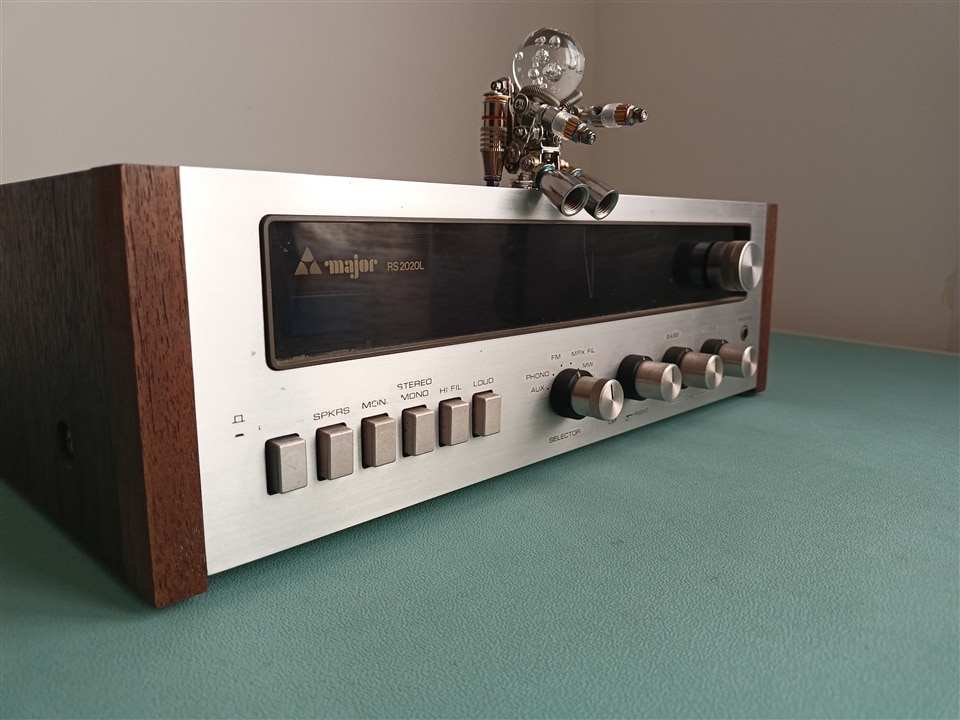 The radio, ready to be repaired. I brought with me a little helper!
The radio is a Major RS2020L, apparently from the 1980s. This thing is almost 15 years older than I am, but it looks pretty well maintained, especially the front panel, which is clean and shiny. This radio was handed to me with no more information than "It doesn't work, please check if you can fix it". After checking the fuse (which was fine), I decided to plug it in to see if there was something obviously wrong. To my surprise, the front panel lit up as supposed and nothing else happened. Looking from outside, the radio seemed fine. Time to dig deeper!
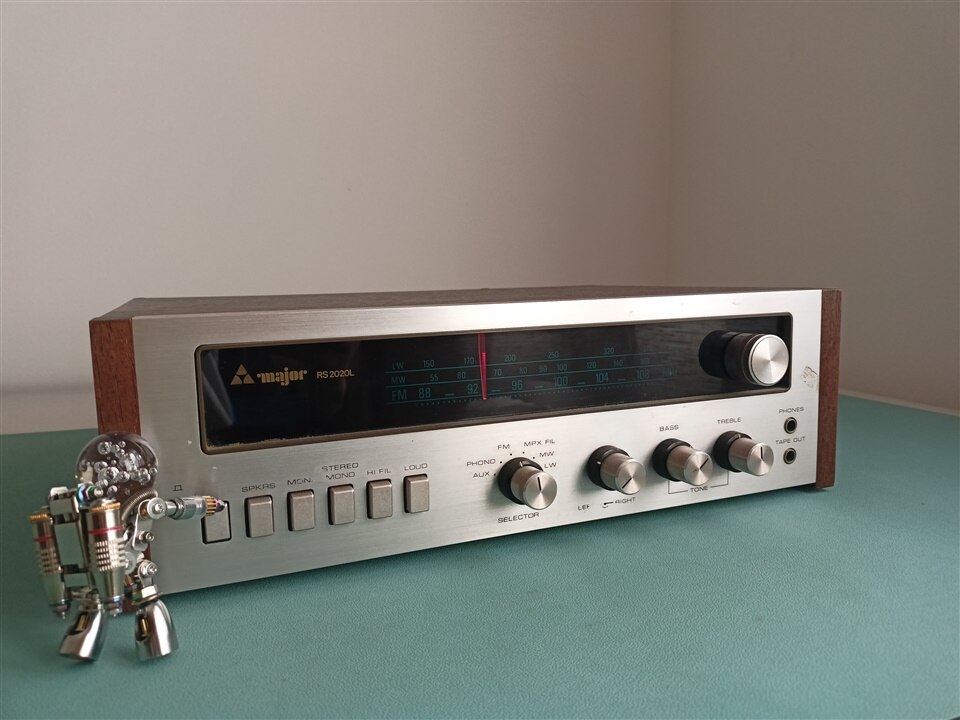
The radio turned on and lit up correctly. In the photo looks dimmer compared to real life.
Opening it up
After removing four screw and lifting up the wooden cover, the inner work of the radio showed to me. At first glance all components seemed fine: no burn marks, no smell, hardly any dust deposit.
I took a moment to observe some particulars I'm not used to in modern electronics. I like the variable capacitor and all the mechanisms used to tune it. They apparently also added some weight on the knob shaft supposibly to give a different feeling (I'm not going to remove that to see how the feeling changes, not at the moment, at least  ).
).
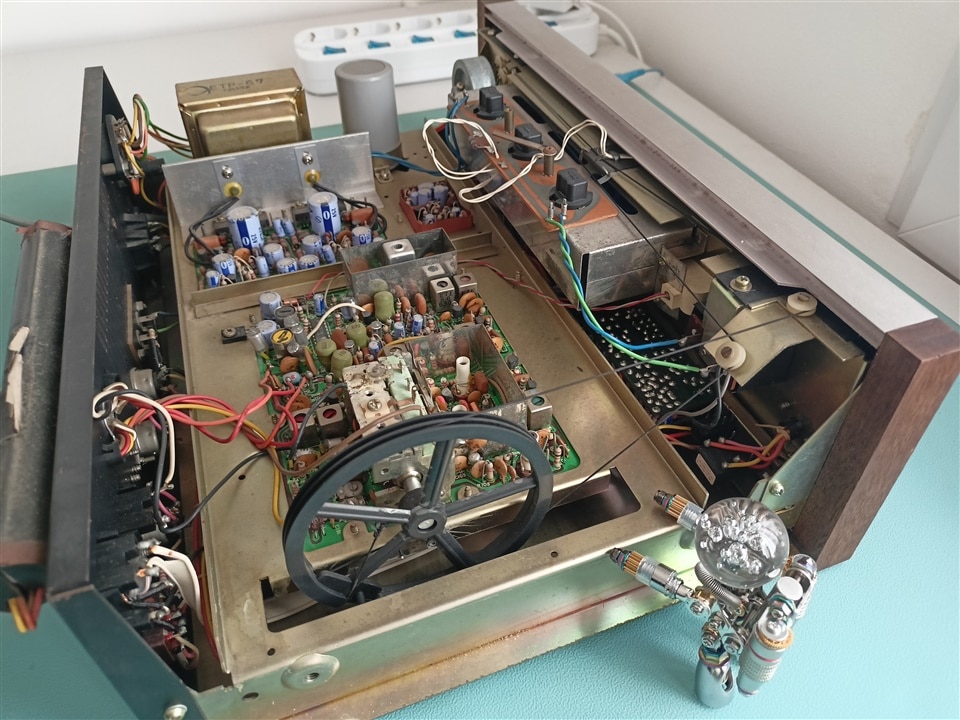
I then turned it upside down and... oh! Somebody had fun with cable management!
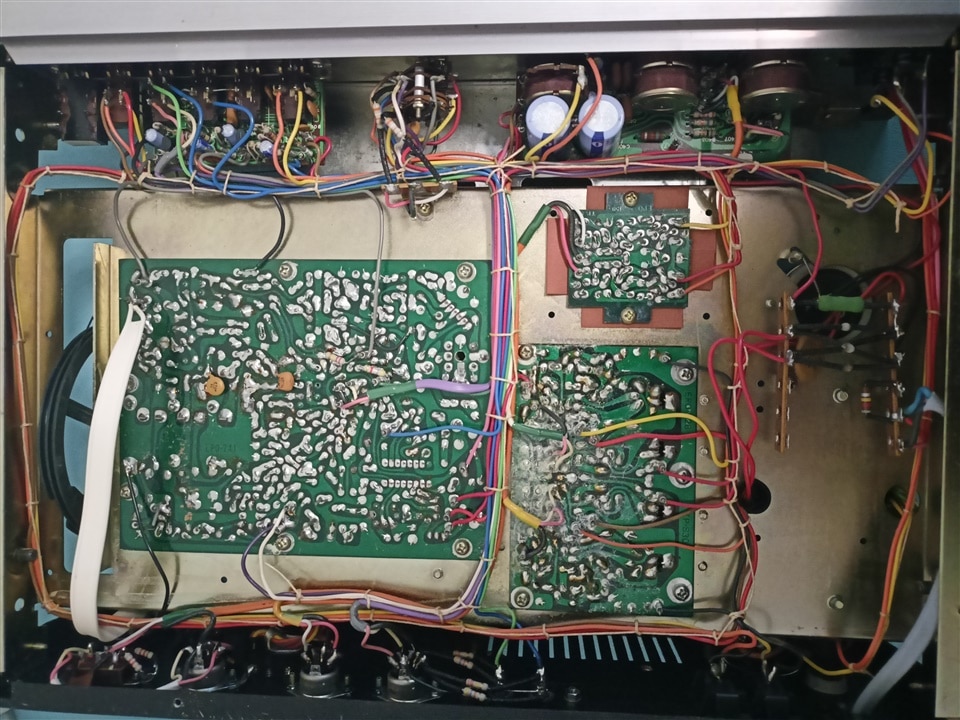
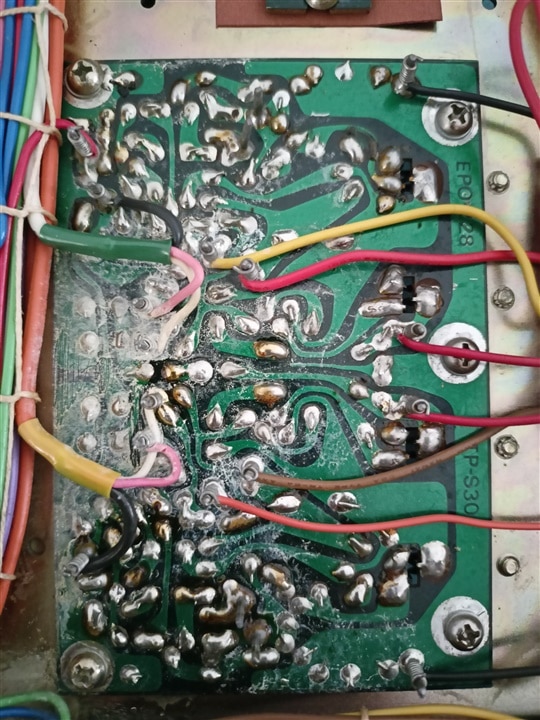
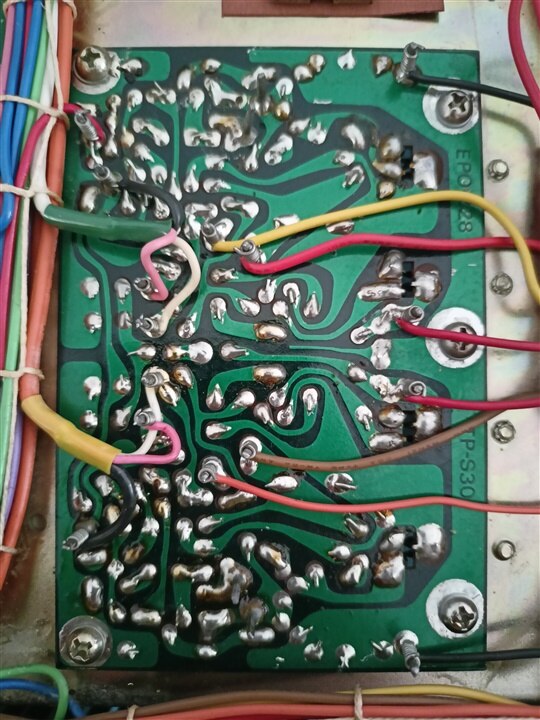
One of the boards (the amplifier board) had some strange white residue on it, but it came off easily with just a bit of IPA.
| {gallery}Board cleanup |
|---|
|
|
|
|
Let's start debugging
As very first step, I set up a quick measure to check the current/voltage at the transformer output. The "big cap" sits at 40V and the current waveform is exactly what one would expect from a full bridge rectifier + capacitor. From now on, I'm going to provide the supply with my bench power supply, so I don't need to worry about being plugged into mains voltage.
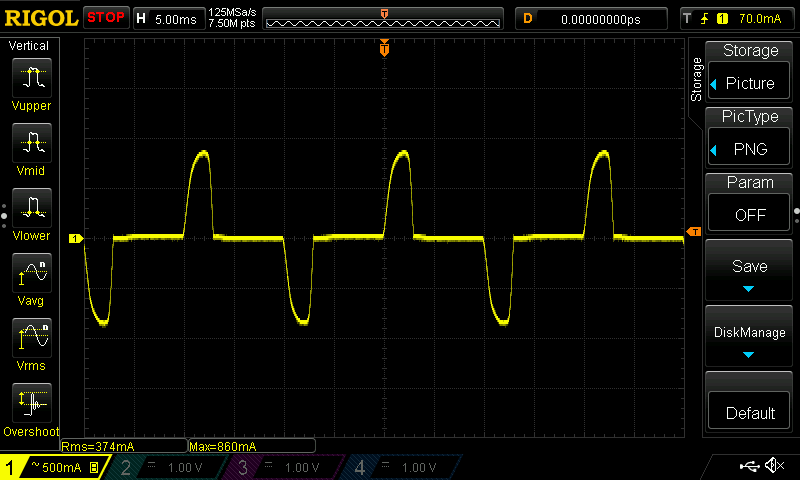
Input current. Supply circuits seems fine.
After fiddling a little around, I managed to set the RS2020L in "radio mode", while observing speaker outputs with my oscilloscope. Moving the tuning knob back and forth seemed like that one channel had some activity, while the other was silent. Knowing that, I decided to exclude the radio board from my initial investigation (as it seemed fine) and concentrate my effort on the rest of the circuitry.
Starting from the back aux connector, I managed to trace the signal path from that connector through the boards up to the outputs.
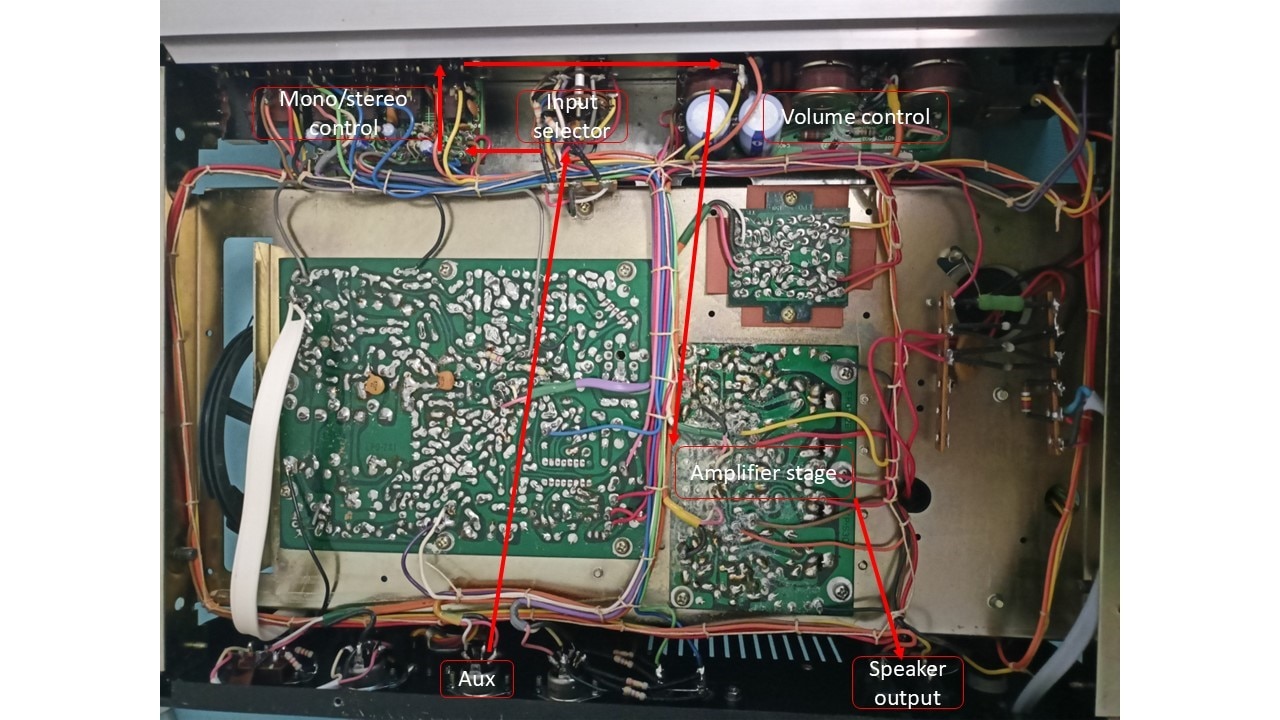
I then proceeded by injecting a small signal in the L/R aux channels, measuring it at different points to see where it disappears. Turned out that the probable cause of the fault is the last stage: the amplifier board. Signals arrives to it correctly but on one channel nothing comes out.
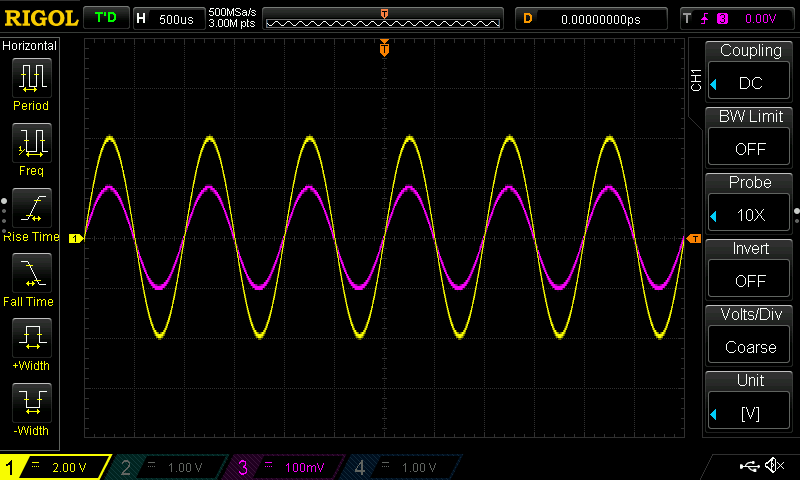
Input and output signal on the working channel.
I searched the internet for some schematics but had no luck in finding anything. I then proceeded by desoldering all active components and checking them for damage. All transistors (a mixture of npn and pnp bjts) in the "bad" channel seemed fine after testing them with a multimeter.
I wasn't particularly keen on desoldering and checking every single component on the board, so I decided to change my approach. Having a functional channel, I started measuring bias points on every transistor on the working side and then checking the same transistor on the bad side. The layout of the second channel is pretty much the mirrored copy of the first one, so I was able to complete this operation even without the board schematic.
And then...
... I got stuck again! It has been almost three weeks since last time I worked on the radio due to personal and work commitments.
But wait, there's more! While working on it, I received other requests for repair! I started with the radio but I ended up with the radio, a small UPS and an electronic speed controller to repair. These are not "my faults", but I have to take the blame for another reason: just a couple of days ago I got back from work with a bag full of old unused equipment that was going to be thrown away. How could I possibly have resisted taking them back home with me?
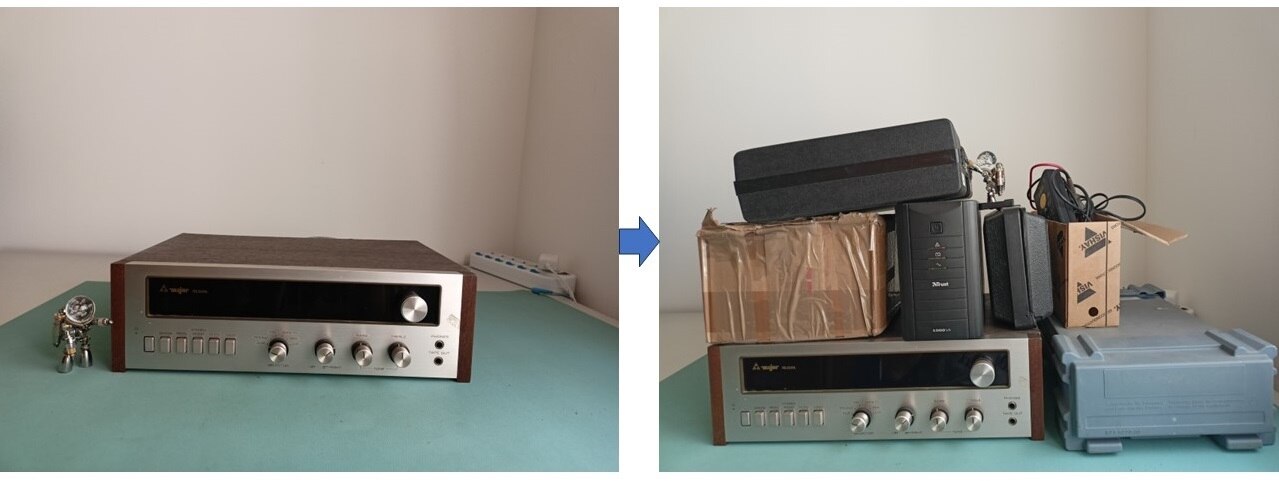
Before and after Spring Cleaning. Clearly something has gone wrong in the process!
And this is how my story ends for this year's Spring Clean competition. Time is running out and the next week is already fully scheduled, so no chance to get back on the radio before the competition ends.
Thanks a lot to the e14 staff that organizes this kind of events and thanks to the members who tried helping me here.
Happy life to you all and enjoy this last Spring Clean week!
Top Comments