element14 Community
element14 Community
    Register Log In
  • Site
  • Search
  • Log In Register
  • Community Hub
    Community Hub
    • What's New on element14
    • Feedback and Support
    • Benefits of Membership
    • Personal Blogs
    • Members Area
    • Achievement Levels
  • Learn
    Learn
    • Ask an Expert
    • eBooks
    • element14 presents
    • Learning Center
    • Tech Spotlight
    • STEM Academy
    • Webinars, Training and Events
    • Learning Groups
  • Technologies
    Technologies
    • 3D Printing
    • FPGA
    • Industrial Automation
    • Internet of Things
    • Power & Energy
    • Sensors
    • Technology Groups
  • Challenges & Projects
    Challenges & Projects
    • Design Challenges
    • element14 presents Projects
    • Project14
    • Arduino Projects
    • Raspberry Pi Projects
    • Project Groups
  • Products
    Products
    • Arduino
    • Avnet & Tria Boards Community
    • Dev Tools
    • Manufacturers
    • Multicomp Pro
    • Product Groups
    • Raspberry Pi
    • RoadTests & Reviews
  • About Us
  • Store
    Store
    • Visit Your Store
    • Choose another store...
      • Europe
      •  Austria (German)
      •  Belgium (Dutch, French)
      •  Bulgaria (Bulgarian)
      •  Czech Republic (Czech)
      •  Denmark (Danish)
      •  Estonia (Estonian)
      •  Finland (Finnish)
      •  France (French)
      •  Germany (German)
      •  Hungary (Hungarian)
      •  Ireland
      •  Israel
      •  Italy (Italian)
      •  Latvia (Latvian)
      •  
      •  Lithuania (Lithuanian)
      •  Netherlands (Dutch)
      •  Norway (Norwegian)
      •  Poland (Polish)
      •  Portugal (Portuguese)
      •  Romania (Romanian)
      •  Russia (Russian)
      •  Slovakia (Slovak)
      •  Slovenia (Slovenian)
      •  Spain (Spanish)
      •  Sweden (Swedish)
      •  Switzerland(German, French)
      •  Turkey (Turkish)
      •  United Kingdom
      • Asia Pacific
      •  Australia
      •  China
      •  Hong Kong
      •  India
      • Japan
      •  Korea (Korean)
      •  Malaysia
      •  New Zealand
      •  Philippines
      •  Singapore
      •  Taiwan
      •  Thailand (Thai)
      • Vietnam
      • Americas
      •  Brazil (Portuguese)
      •  Canada
      •  Mexico (Spanish)
      •  United States
      Can't find the country/region you're looking for? Visit our export site or find a local distributor.
  • Translate
  • Profile
  • Settings
STEM Academy
  • Learn
  • Learning Center
  • STEM Academy
  • More
  • Cancel
STEM Academy
Blog TI-PMLK Buck Experiment Board - part 1b: 1st Experiment Lab Setup
  • Blog
  • Forum
  • Documents
  • Events
  • Polls
  • Files
  • Members
  • Mentions
  • Sub-Groups
  • Tags
  • More
  • Cancel
  • New
Join STEM Academy to participate - click to join for free!
  • Share
  • More
  • Cancel
Group Actions
  • Group RSS
  • More
  • Cancel
Engagement
  • Author Author: Jan Cumps
  • Date Created: 24 Jun 2017 12:21 PM Date Created
  • Views 2863 views
  • Likes 7 likes
  • Comments 7 comments
  • buck
  • stem
  • tps54160
  • texas_instrments
  • road_test
  • stem projects
  • ti_rt
Related
Recommended

TI-PMLK Buck Experiment Board - part 1b: 1st Experiment Lab Setup

Jan Cumps
Jan Cumps
24 Jun 2017

I am a Road Tester of the TI-PMLK Buck Experiment Board: TPS54160 & LM3475.

It's an educational kit - board and book - to learn buck converter theory and practice.

Because it's an educational kit, I give minus points each time there's vendor lock-in image .


image


I applied for the Road Test to check the educational value of the kit. The focus in this blog series will be on the Lab Manual and exercises.

In this blog, I set up the test equipment for Experiment 1


Experiment 1: Impact of Load, Input Voltage and Switching Frequency on Efficiency


In this exercise we'll measure the efficiency a few times under changing conditions.

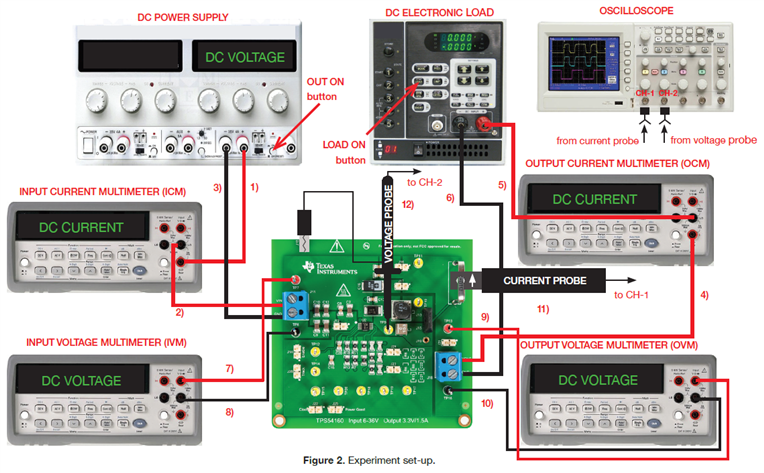
The tutorial advises this Lab setup:
image

I'm replacing the input current meter with the display of my power supply. The input voltage I've measured with the DMM.

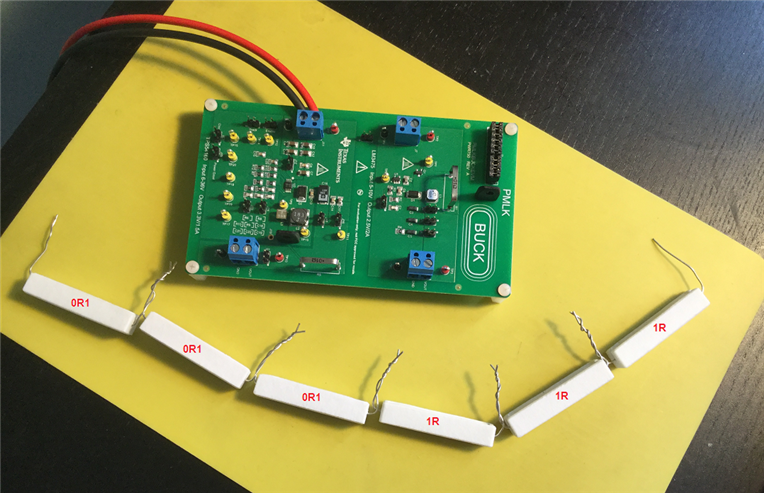
The load is a string of 0R1 and R resistors that form 3R3 in total. That's 1A of output current for this 3V3 circuit.
 

image

My biggest miss is a current probe. This is used in the circuit to measure the current racing trough the inductor.

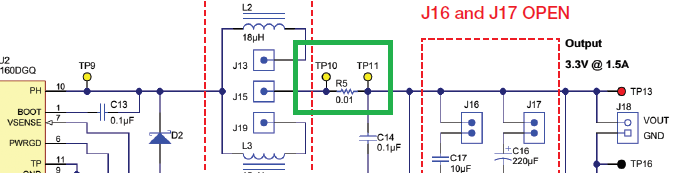
I first tried if I could put two oscilloscope probes on TP10 and TP11 of the circuit.
 

image

Then I tried to use the Math function of my scope to show the difference between the two.

It turns out (as expected really) that I don't get enough drop over 0R01 resistor R5 to get a signal that's above the noise floor.


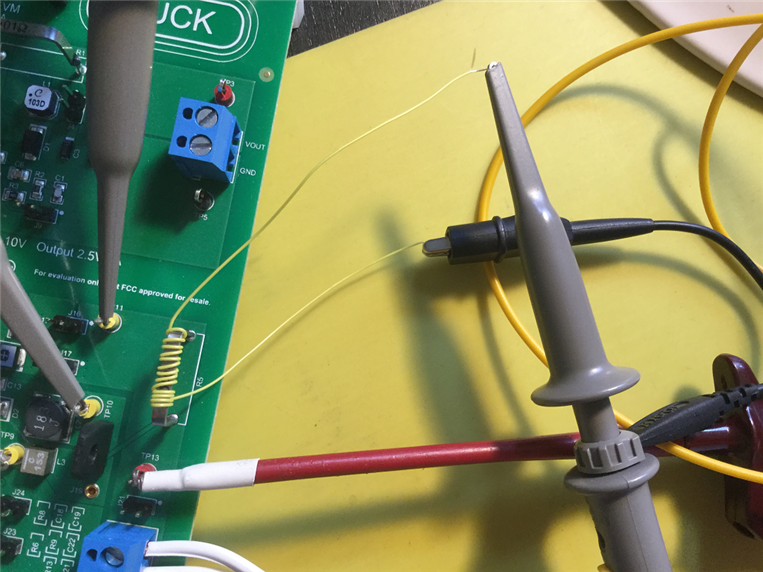
What works better is the second thing I tried: wind a coil of isolated wire around R5 and try to steal the current that way.
image

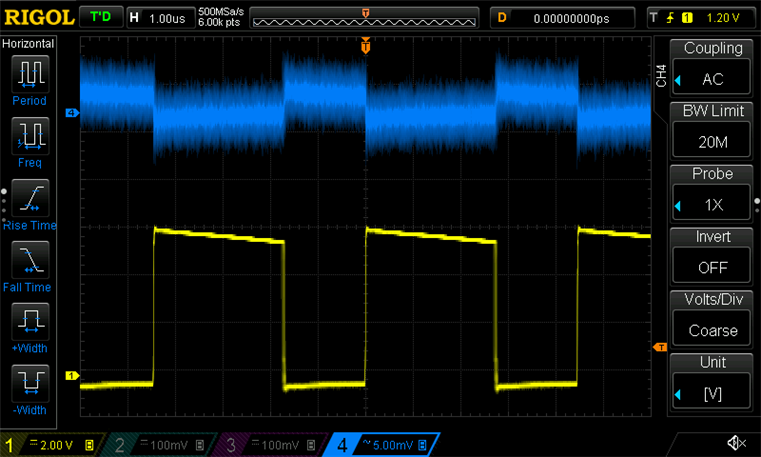
This works way better. I can get a view of the current in the circuit's switching node on my oscilloscope.

Way too course to do a good measurement but it does the job of visualising what happens.

The switch node current is the blue trace on the capture below:
image

If you have a better idea on how I can show the switch node current, please comment below.


I measure output voltage with the DMM, and output current by putting my DMM over one of the load resistors in the chain + Ohm's Law.

(in the next blog you can see that I stepped away from measuring current over a series resistor and used a current meter. See comments below)


Related Blog
1a: 1st Experiment Set-up
1b: 1st Experiment Lab Setup
1c: 1st Experiment Measure
2: Educational Value

Road Test: TI-PMLK Buck Experiment Board: TPS54160 & LM3475

  • Sign in to reply

Top Comments

  • balearicdynamics
    balearicdynamics over 8 years ago +1
    Hi Jan, my compliments! Very well documented experiment. This is perfect as STEM. I have an ignorant question. In the scheme both two input and output current multimeters have only the current signal connected…
  • Jan Cumps
    Jan Cumps over 8 years ago in reply to balearicdynamics +1
    Enrico, Enrico Miglino wrote: ... In the scheme both two input and output current multimeters have only the current signal connected and not the ground (or negative). Can you explain this detail please…
  • balearicdynamics
    balearicdynamics over 8 years ago in reply to Jan Cumps +1
    Thank you Jan. As you can see my knowledge in the powering world is really terrible ! Just a note instead. I have used 1 Ohm 150 W resistors to calculate the current. I thought that it was a very crap…
Parents
  • balearicdynamics
    balearicdynamics over 8 years ago

    Hi Jan, my compliments! Very well documented experiment. This is perfect as STEM.

    I have an ignorant question. In the scheme both two input and output current multimeters have only the current signal connected and not the ground (or negative). Can you explain this detail please?


    Enrico

    • Cancel
    • Vote Up +1 Vote Down
    • Sign in to reply
    • More
    • Cancel
  • Jan Cumps
    Jan Cumps over 8 years ago in reply to balearicdynamics

    Enrico,

    Enrico Miglino wrote:


    ... In the scheme both two input and output current multimeters have only the current signal connected and not the ground (or negative). Can you explain this detail please?


    Both current meters are in series with the positive side of the input (ICM) and output (OCM). So both sides of the current meter are drawn RED.

    image


    I think that it's OK to draw it that way. Both the input and the output of the current meters are on the positive voltage level (minus a tiny drop because of the burden voltage inside the meters).

    • Cancel
    • Vote Up +1 Vote Down
    • Sign in to reply
    • More
    • Cancel
  • balearicdynamics
    balearicdynamics over 8 years ago in reply to Jan Cumps

    Thank you Jan. As you can see my knowledge in the powering world is really terrible !


    Just a note instead. I have used 1 Ohm 150 W resistors to calculate the current. I thought that it was a very crap method instead I see that you too are using something similar. So is it reliable ? It seems I have not adopted a so bad solution...


    Enrico

    • Cancel
    • Vote Up +1 Vote Down
    • Sign in to reply
    • More
    • Cancel
  • Jan Cumps
    Jan Cumps over 8 years ago in reply to balearicdynamics

    Enrico Miglino wrote:


    Thank you Jan. As you can see my knowledge in the powering world is really terrible !


    Just a note instead. I have used 1 Ohm 150 W resistors to calculate the current. I thought that it was a very crap method instead I see that you too are using something similar. So is it reliable ? It seems I have not adopted a so bad solution...


    Enrico

    In the next blog you can see that I stepped away from this method and used a current meter in series with the output. The drift of my resistors was way too high to get a decent current sample..

    After running warm (not even hot) my 1R power resistor measured up to 2R. So I had to change strategy.

    • Cancel
    • Vote Up +1 Vote Down
    • Sign in to reply
    • More
    • Cancel
  • balearicdynamics
    balearicdynamics over 8 years ago in reply to Jan Cumps

    Jan, I saw. This depends on the power level range I suppose. With low powering the method seems working as there is not the heating risk. I have not cited this aspect but iti s true what you say about the dramatic temperature influence. I was thinking on few mA order. Or this occurs anyway?


    Enrico

    • Cancel
    • Vote Up +1 Vote Down
    • Sign in to reply
    • More
    • Cancel
Comment
  • balearicdynamics
    balearicdynamics over 8 years ago in reply to Jan Cumps

    Jan, I saw. This depends on the power level range I suppose. With low powering the method seems working as there is not the heating risk. I have not cited this aspect but iti s true what you say about the dramatic temperature influence. I was thinking on few mA order. Or this occurs anyway?


    Enrico

    • Cancel
    • Vote Up +1 Vote Down
    • Sign in to reply
    • More
    • Cancel
Children
No Data
element14 Community

element14 is the first online community specifically for engineers. Connect with your peers and get expert answers to your questions.

  • Members
  • Learn
  • Technologies
  • Challenges & Projects
  • Products
  • Store
  • About Us
  • Feedback & Support
  • FAQs
  • Terms of Use
  • Privacy Policy
  • Legal and Copyright Notices
  • Sitemap
  • Cookies

An Avnet Company © 2025 Premier Farnell Limited. All Rights Reserved.

Premier Farnell Ltd, registered in England and Wales (no 00876412), registered office: Farnell House, Forge Lane, Leeds LS12 2NE.

ICP 备案号 10220084.

Follow element14

  • X
  • Facebook
  • linkedin
  • YouTube