


The Z80 is still manufactured today and I was wondering whether there is any interest for a community or discussion group.
The Z80 is still manufactured today and I was wondering whether there is any interest for a community or discussion group.
I worked at Mostek maintaining the Fairchild Sentry testers used to test the Z80s when they first began to manufacturer them. The second computer I every
built (parts, pcb, solder) was the SDB-80 which was the Mostek Software Development Board for the Z80 with 16K bytes (8 - MK4116 16K bit) dynamic RAMs
which Mostek also made. The first wire wrap board I ever made was a 48K byte dynamic RAM board also using MK4116s that worked with the SDB-80. I can
tell you there were a bunch of happy technicians when we were told that Mostek would be second sourcing the Z-80 and even happier when we were told we
could buy SDB-80 kits and build them ourselves! Those were really fun days. I still have a Zilog Z80 in a ceramic package that says it was manufactured in
Dallas even though Mostek was actually in Carrollton a suburb in Dallas County just north of north-west Dallas.
Wow! that's amazing that you got such a large DRAM board working with Wire-wrap.
Do you still have any photos or schematics of it?
It was quite rare to come across Mostek parts in Australia. We usually got Zilog, SGS and Sharp.
And from memory the SGS parts didn't support the undocumented instructions.
Hi Ray,
The Nestlé project sounds fascinating.
You'd expect the LH-5801 to be superior to the Z80 for its designated applications. The designers could pick, choose, optimise and add the features that they wanted.
It is was unlikely that a LH-5801 device needed to have the DRAM memory and 8080 legacy support because it was for low power consumption devices such as battery powered calculators.
Itsinbuilt timer is very handy. The Z80 required the addition of a CTC (Counter Timer Counter) or similar to do this.
There's nothing wrong about creating a CPU that's lacking the Z80's index registers. If fact these index registers can be a pain to use. The Game Boy version of the Z80 is also missing these index registers and look at the quality of the software for that.
If you look at most Z80 code, the IX and IY index registers if used, were seemingly used as a last resort. This is because the Index Register op codes need an 8 bit offset to be specified within the instruction.
It's also interesting to note that Cristophe Gottheimer's assembler for the LH-5801 uses the Z80 JR (jump relative) and mnemonics instead official Bcc (Branch) mnemonics. A clue to the LH-5801's origins perhaps?
One thing people always seem to overlook is that the Z80 limitations were set by the memory device performance limitations of the day. The designers at Zilog even incorporated inbuilt wait state support to handle slower memories and DRAM refresh support.
This this in mind the Zilog designers worked out that they could use a 4-bit accumulator and run it twice for 8 bit results in the time taken for a single memory fetch.
At the time common memory devices were small with 1K * 1 Static and 4K * 1 Dynamic RAMs being the most affordable. The larger and faster ones came years later.
Cheers and welcome to the community.
Very!
Hi Shabaz,
Let me try to recapture the lost part of my post with the Nestlé story first.
I meant to argue that your and COMPACT's reply suggested the LH-5801 had less hardware facilities than the Z80:
- "the PC-1500's CPU only has three registers" (you)
- "a Z80 inspired CPU with the index registers missing " (C)
For me this makes it a bit hard to understand, how a pocket computer with this CPU has been able to achieve such extraordinary results
in numerous high-level applications. Or is this just a matter of clever trickery by the application programmers ?
First of all (as far as I know), other than Z80, LH-5801 had 8-bit (full-width) registers - esp. in the accumulator.
Program counter and stack pointer were even 16 bit.
Secondly some items from the feature list of the Sharp CPU:
- (3) Use of a 6-byte general purpose register. in addition to the accumulator. allows to comprise three pairs of 2-byte date pointers. (misspelling Sharp)
- (12) Reducing program steps by means of 28-kind single step vector subroutine jurnp
If only there were a feature-by-feature or architecture comparison of the two microprocessors ...
Judging from the applications side (remember I lack sufficient knowledge of micoprocessors), I would say, LH-5801 was - maybe inspired by some
standard Z80, 6502, or even 6800 - yet an advanced proprietary design with a remarkable number of on-chip peripheral facilities. Your and COMPACT's
observations concerning family traits, in one way or another, are very interesting and seem to confirm my assumption all along, that LH-5801 was just not
your run-off-the-mill Z80 clone.
As stated before, the Nestlé project utilized a MUX. Later someone else devised real multi-tasking software for the PC-1500A. I suppose that requires
a quite sophisticated interrupt scheme/structure (esp. at a clock rate of only little more than 1 MHz), or can one do this by clever programming via a
high-level language ?
Last but not least: thank you all for a friendly welcome into this community !
Cheers
Ray
Hi Ray,
That's interesting that it was used to control part of a Nestle production line. I do recall an episode on TV of 'How It's Made', which showed a production line in a factory which made piano music rolls, and part of it was controlled by an ancient Apple IIe machine. Since it worked, I guess the factory felt no need to port the code to anything more modern. Better to trust what is working : )
Into modern times, and a lot of retail stores in my area run very suboptimal hardware - consumer PCs! - always clogging up with dust from the Manager's office, running slow, and on the floor getting kicked around.
Hi Shabaz,
Thank you for your reply. This was actually the first time ever (I'm 73) I participated in any professional community discussion on the Net.
So please don't mind my many newbie mistakes - one of them not being a prompt replier.
For everyone else here, interested in the Sharp PC-1500(A), your link to the pc-1500.info site is spot on, as this site offers the best,
i.c. most comprehensive info there is.
The LH-5801 microprocessor turned out to be a very powerful tool indeed in many applications of this pocket computer.
One of the projects I've been involved in was at a Nestlé plant for the production of powdered milk. The Swiss manufacturer
of the 5 parallel operating in-stream weighing-doseing units to be installed, required 5 full-fledged PCs as controllers - the chosen
brand being Commodore. The engineer in charge however judged this brand to be below industrial reliability standards, and
proposed the PC-1500A instead, i.e. 1 pocket computer instead of 5 PCs ! (a printer - not its 4-color plotter mate, CE-150 - was added).
Later system SW for real multi-tasking was developped by a third party - we utilized a MUX.
Before the mid-eighties there was also assembler/disassembler, hexmonitor, etc. software available; furthermore a C-compiler was offered,
along with Forth and several extended BASICs.
From your and Compacts reply it would seem the LH-5801 had only
(continued in post nr. 106)

The CPU used for the PC-1500 is the LH5801. The native mnemonics have been made to look like 6800/6500 style ones.
Here is a quick partial cross reference between its mnemonics and Z80 equivalents.
http://www.pc-1500.info/Data/LH5801-ASMCodes_Sharp.htm
That's only a partial list of undocumented instructions. There are various sets posted around the Internet including Z80 Undocumented Instructions .
Also be aware that some instructions are used for alternate purposes of later generation Z80s and derivatives such as the Rabbit 2000, Z180, ez80 etc.
For example the relatively useless LD L,L (0x6D) is not supported by the eZ80.

I concur those don't look like Z80 comands.
As an aside, when playing with my ZxSpectrum I found an interesting scenario when I was stepping through some code. It ran fine at full speed but errored in the debugger. There turned out to be a couple of commands that the chip knew about but the debugger (and documentation) did not.
Turns out that the undocmented commands are now documented
http://www.worldofspectrum.org/z88forever/dn327/z80undoc.htm
One also has to remember that R650x and Z80 had altered instruction sets to evade intellectual property claims.
Sharp did make Z80 products and to me the PC-1500 looks like a Z80 inspired CPU with the index registers missing (like the gameboy CPU) and altered object code and a disguised instruction set.
e.g. BC = X pair and DE= Y pair.
The Texas Instruments TI-84 Plus CE Calculator that does have a eZ80 (a Z80 derivative) in it. With it one can play Gameboy and other games with it.
The processor itself is running at 48MHz but is using wait states to interface its slower memory and i/o.
If you do have one, don't upgrade to the latest firmware because it places unwanted scholastic restrictions upon it.
You don't have permission to edit metadata of this video.
Hi Ray,
I've not looked at Z80 for an extremely long time, so I could be wrong, but looking at this PC1500 machine code article (PDF) the instructions do not look like Z80.
For instance, on the last page of the PDF, there is this example program:
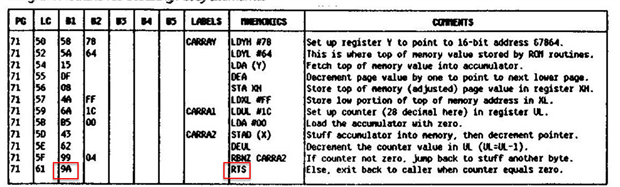
Taking an example, the red instruction, the Z80 does not have an RTS instruction according to here: Z80 / R800 instruction set
There's a RET instruction for the Z80, but it has a different opcode too (0xC9, not 0x9A).
Also, according to here: Frank C. Odds : Probe! a disassembler for the Sharp PC-1500 - PC-1500.info
the PC-1500's CPU only has three registers.
So, I believe that while it may have similarities to CPUs such as the Z80 or indeed any other CPU from the time, it's not a Z80 derivative (or not a very close one), nor compatible with z80 at mnemonic or opcode level.
COMPACT wrote:
It was quite rare to come across Mostek parts in Australia. We usually got Zilog, SGS and Sharp.
And from memory the SGS parts didn't support the undocumented instructions.
The latest post in this thread was recent enough for me to dare 'reply' to this 2016 entry - hope that's OK with you ?
During the '80s I've been professionally involved in a number of commercial projects, built around the PC-1500A pocket computer from Sharp.
This was often referred to then as a 'BASIC programmable calculator', though its functionality, capabilities, and the actual applications surpassed
that status by far.
With only superficial knowledge of microprocessors, I've always wondered about Sharp's own LH-58xx family. As far as I know, it has only been
utilized in the PC-1500 and its successor, the PC-1600. It wasn't until recently that I learned that Sharp had (and still has) its own line of OEM
4 and 8 bit microprocessors. The LH-5080 e.g. is offered as a member of the Sharp Z80 family, LH-0080.
For me this raises several questions:
- Is the LH-5801 really a Z80 derivative, as most sources over time have stated ? Doesn't the model number, 5800, seem odd, even peculiar,
when one realizes the importance of the Motorola 6800 in those days ?! In other words: LH-0080 makes sense, better still: is clear - LH-5800
is confusing. The only explanation I could think of, would be, Sharp meaning to discern her OEM products from her microprocessors intended
only for use in her own apparati - i.c. her line of pocket computers. Btw Sharp herself makes no mention of the Z80 (nor any other microprocessor
for that matter) in her Technical Reference Manual. (http://www.pc-1500.info/Data/Service_Manuals/PC-1500_Technical_Reference_Manual.pdf )
- Anybody has a clue as to what the letters, LH, stand for, and what the 5 might refer to ?
(Sharp being proud of her early chip design and production capabilities, called one of her seventies calculator lines: Elsi Mate, where Elsi stands
for ELSI - Extra Large Scale Integration)
- The CMOS LH-5801 had an impressive number of on-chip facilities/peripherals - probably more than the (standard ?) Z80.
I have not been able to find a (useful*) comparison with the Z80 itself, derivatives, or other microprocessors from the same era. Anybody ?
*(cpu-world hasn't brought me any further).
Thanks or answering !
Ray
COMPACT wrote:
It was quite rare to come across Mostek parts in Australia. We usually got Zilog, SGS and Sharp.
And from memory the SGS parts didn't support the undocumented instructions.
The latest post in this thread was recent enough for me to dare 'reply' to this 2016 entry - hope that's OK with you ?
During the '80s I've been professionally involved in a number of commercial projects, built around the PC-1500A pocket computer from Sharp.
This was often referred to then as a 'BASIC programmable calculator', though its functionality, capabilities, and the actual applications surpassed
that status by far.
With only superficial knowledge of microprocessors, I've always wondered about Sharp's own LH-58xx family. As far as I know, it has only been
utilized in the PC-1500 and its successor, the PC-1600. It wasn't until recently that I learned that Sharp had (and still has) its own line of OEM
4 and 8 bit microprocessors. The LH-5080 e.g. is offered as a member of the Sharp Z80 family, LH-0080.
For me this raises several questions:
- Is the LH-5801 really a Z80 derivative, as most sources over time have stated ? Doesn't the model number, 5800, seem odd, even peculiar,
when one realizes the importance of the Motorola 6800 in those days ?! In other words: LH-0080 makes sense, better still: is clear - LH-5800
is confusing. The only explanation I could think of, would be, Sharp meaning to discern her OEM products from her microprocessors intended
only for use in her own apparati - i.c. her line of pocket computers. Btw Sharp herself makes no mention of the Z80 (nor any other microprocessor
for that matter) in her Technical Reference Manual. (http://www.pc-1500.info/Data/Service_Manuals/PC-1500_Technical_Reference_Manual.pdf )
- Anybody has a clue as to what the letters, LH, stand for, and what the 5 might refer to ?
(Sharp being proud of her early chip design and production capabilities, called one of her seventies calculator lines: Elsi Mate, where Elsi stands
for ELSI - Extra Large Scale Integration)
- The CMOS LH-5801 had an impressive number of on-chip facilities/peripherals - probably more than the (standard ?) Z80.
I have not been able to find a (useful*) comparison with the Z80 itself, derivatives, or other microprocessors from the same era. Anybody ?
*(cpu-world hasn't brought me any further).
Thanks or answering !
Ray
(addendum to audio discussion)
It would seem that I was not right after all in stating that various audio debates have become a thing of the past.
(while visiting him, my son pointed this out to me:)
- (as to the objectivists vs. subjectivists debate) a class-D* power amp has been presented at recent Munich High-End Show**,
which is said to be "100% mathematically correct". The following statement, however, is the relevant one in our issue:
"We build what we simulate and simulate what we build. ... We believe that all matters for the sound quality can be measured
although we often have to develop new measurement methods that are indicative of the subjective sound quality. We direct
all R&D efforts on such measurable metrics. If this does not agree with the listening results we improve our objective metrics."
For all interested: https://www.audioxpress.com/news/purifi-audio-promises-to-reduce-distortion-in-speakers-and-amplifiers .
For all not versed in audio who-is-who: the people behind Purifi are leading developpers in their field.
- (as to the being there - at recording - experience) Dr. Edgar Choueiri, professor of applied physics at Princeton University,
has developped a 3D audio processor, enabling the listener to enjoy his records in 3D via a normal stereo set: BACCH SP.
All we can do is hope and pray that MS will leave this alone, to prevent it from suffering the same fate as HDCD ...
Ray
*for all not versed in audio: the D does not stand for digital; class D means switching amps.
**once again: HD Vinyl nowhere to be seen (heard), no news, no nothing - a hoax ... ?
COMPACT wrote:
Take a look at this - I think it is impressive!
Sorry for this late response, COMPACT (seen too many doctors lately) !
Thanks for sharing this fascinating, illustrated time-line through the life and works of one of the key figures in (micro)computer history.
I knew most of the facts and figures, but getting everything presented from the horse's mouth really is something else.
From the many things that caught my eye, let me comment on a few:
- (1965) "The Olivetti Programma 101 ... contained a small computer made of discrete components ... ". However much my admiration for the
development of the IC, I've never been able to commit myself to applying them in my designs, still (since the sixties) preferring hand-picked
discrete components over 'black boxes'. That way I feel full freedom and more in control of things, although I'm aware of the drawbacks; so
call me oldfashioned ...
- (1970) "The layout of the Z80-CPU. Handdrawn by Federico (by two thirds) ... ". "Those were the days !" - no CAD-CAM. Has anybody ever
assessed the error rate in both cases ?
Having written this, I wonder: wouldn't we have been better off here, sticking to your original question and everything directly related, than
wandering off(-topic) to audio nirvana ... ?
Cheers
Ray
The questions you've raised are certainly worthwhile, albeit far from new ...
First of all, there is broad consensus, that audio is the art of reproducing sounds, recorded in one acoustic environment, in an other - usually totally
different. As a (recent) result, room acoustics have become a hot item; with DSP prices coming down, ever more components in the reproduction
chain - both amps and active speakers e.g. - are equipped with some form of electronic adaptation. While this may seem progress, oldtimer audio
buffs (like us ?) probably wonder, what has become of good (?) old tone controls, or - a bit more sophisticated - equalizers ? The 'tilt control' on the
QUAD 34 pre-amp, beloved in the eighties (and not much unlike RIAA equalization, COMPACT), springs to mind. DSP-based room-correction
circuitry is said to spare you fysical adjustments, like COMPACT described; I don't think I'm convinced.
As to equalizers, in the nineties we were allowed one afternoon to 'play' with the famous Cello Audio Palette, originally intended for studio-use, and
the wet dream of many an audiophile. Although we really had a great time at the circular controls of that gem, we had second thoughts afterwards:
had we not in fact been indulging ourselves in 'bettering' recordings of top-notch mastering engineers ? Who did we think we were ?! Our host had
'encoded' the favourite tracks on his discs with the letters of the controls and the corresponding numbers of the scale settings ... (audiot).
Live vs. recorded comparisons were popular in both the UK and USA during the fifties, aiming at answering the question: how close have we come
with HiFi ? It was reported frequently that even highly experienced audiences (regular concert visitors) sometimes had trouble discerning one from
the other. But this only works in the same room, with the speakers exactly positioned, where the instruments/vocalists were before (and everything
else also kept constant, preferably). So there's not much hope of ever bridging the gap from concert hall/studio to listening room ... And "Bringing
the concert hall to your living room" a bluddy (marketing) lie !
The 'being there (present)' experience /illusion is in fact the last frontier in high-end audio. When auditioning a Cello set with Martin Logan CLS,
a much more experienced audiophile commented: "Ah, this is precisely the sort of set that enables you to hear a fly fart on the rear wall of the
recording studio !". That made us think: are we chasing ultra resolution in sound reproduction, or is our real aim musical satisfaction ? It took some
time to cure ourselves of 'audiophilia nervosa', but we have since been enjoying our music via much more down-to-earth equipment.
Stereo is btw. as much an illusion (and this goes as well for 'glued-together-again' digital signal samples, in an attempt to mimic analog sound).
I believe, though, ultimately most people do not care that they are listening to illusions, nor how far off they are from reality - they've simply come
to like them !
I hope you see my point: this kind of discussions is in fact a thing of the past, and when repeated all the same, bound to be ... pointless.
"The whole audiophile experience is subjective."
That was exactly my point, aimed directly at Ray. The problem with subjective interpretation of audio reproduction is
that it is always "in the ear of the beholder".
"and audiophiles are passionate of what constitutes a great sound"
They just can't explain in objective terms what constitutes that great sound. And there is clearly such a thing as being
too passionate. That is one reason why the ear of the beholder is not a good thing.
"The recorded sound may not be technically perfect but it sure does sound crisp and clear."
There are a few acoustic instruments that produce sound that is not crisp and clear, a muted horn is a good
example. Various kinds of distortion are widely used with electronic instruments and some of these also produce
sound that is not crisp and clear. Does a crisp and clear reproduction of these instruments constitute great sound?
It does not represent a faithful reproduction of the instrument's sound in the acoustic environment where it was
made (being there as you previously put it). And to me that faithful reproduction is what constitutes a "great sound".
It's just not possible to do, at least for now, no matter how much technology, subjective audiophile BS, or money
thrown at it.
The whole audiophile experience is subjective.
Our universe conspires to prevent perfect recording and playback and audiophiles are passionate of what constitutes a great sound.
I wish that some Astronauts would set up some speakers and microphones outside the International Space Station to see how well they work.
Here is one audiophile's take on things. Have a listen for 90 seconds.
This video is unavailable.
You don't have permission to edit metadata of this video.
The Australian company RODE is successful making microphones and associated paraphernalia. The recorded sound may not be technically perfect but it sure does sound crisp and clear.
Their latest offering is a wireless Lavalier microphone transmitter receiver combination for digital cameras. ("Go") which is very convenient.
Sorry but those are easily provable deficiencies in vinyl recordings/turntables.
COMPACTS claim that audiophiles want the sense of being there at the original recording is a classic example of subjective.
How do they have the slightest idea of what the acoustics were at the original recording without actually being there? How
do you objectively reproduce something you've never heard?
I do like your down-to-earth way of enjoying your music, COMPACT !
As audio advisors, we've always aimed at improving someone's music enjoyment for reasonable money. In the age of streaming, and what have you,
it's hard to pin-point that to a fixed amount, but in the nineties we felt, you could not expect the average customer to be willing to spend more than say
$ 5.000 on a decent player, amp, and pair of speakers (cable-mania was not yet wide-spread then). Of course, this statement immediately raises the
question: what is 'decent' ?
Objectively: equipment, apart from reliable and user-friendly, should be free of apparent flaws like hum/hiss, disturbing 'plops', or distortion levels that
were considered acceptable before the seventies. Furthermore limited performance is less of a problem than a lack of balance*.
Subjectively: equipment should raise the enjoyment level of the customer at least to 'content', but we were only really satisfied, when he reported
"having heard details in his music, he had never heard before", "discovering his music anew" - that sort of thing ... (one customer even declared:
"You have enriched my life" - he has become a friend). Best proof of having succeeded in improving matters came from the wife, though. If she made
a spot-on remark while removing the emptied coffee cups, we knew we had hit bull's eye. Why ? Because women just listen without any prejudice,
while men (audiophiles) are busy trying to hear what they have read ... ; sadly, didn't do much for the WAF (Wife Acceptance Factor).
Cheers
Ray
* that is a.o. why 2-way mini-monitors (not the Bose crap !) can be so very satisfying - certainly if they've been designed by Andrew Jones
P.S.: thank you for the Faggin-link, COMPACT - I'll dive into it
Hi COMPACT and Garry,
(Better late than never:) I'm sorry, if I have provoked replies that to me read like a kind of vinyl bashing ... won't go into that, because the
arguments are mostly too well-known to make a discussion in this day and age still worthwhile. I've been used to these arguments in audio
circles, but didn't expect them here, to be honest. And the worn-out objective vs. subjective discussion - culminating in head vs. heart ratings -
better be left alone, too, wouldn't you agree ?
Never mind; I was in fact just closing off some musings with an anecdote, but perhaps it would have been wise to present it with a bit more
context. Here that is yet.
The show was during the vinyl revival in the nineties, and we only had a speaker brand plus hi-grade vinyl at the time - all the rest was borrowed
from friendly colleague-importers. A high-grade CD-player was part of the demo set, but only used on request from our visitors. Btw, we didn't
do analog vs. digital comparisons.
The purpose of the shredded Mona Lisa poster was to show in a (simplified) pictorial manner, what digitizing is in essence. Apart from a good deal
of laughter, we als got recognition by colleagues referring visitors to our demo room. Only Philips was 'not amused' (and that was long before we
demoed the CD Clarifier the next year, thereby proving their slogan - "Perfect for Ever" - wrong; but that's an other story).
I also like to make an other point: as an importer of high-grade audio, I had to audition/listen to numerous gear/sets. With a few exceptions
the equipment was not 'my cup of tea', and I was pretty sure that I wouldn't be able to enjoy my music through it. Most of the time I tried to
imagine however, what enthralled the owner/seller. And by doing so, I often succeeded in 'hearing his point' ...
To prevent allegations that I'm living in the past, and that vinyl is obsolete, let me turn my eyes to the future* for a change: after virgin, HQ, and
Quiet Vinyl, vinyl lovers recently were treated to (the promise of) the Holy Vinyl Grail: HD-Vinyl. Multi millions have been invested in this project
that stems from the country where mr. Adolf H. was born, and that is frequently mixed up with your beloved 'Down Under', COMPACT. At the
risk of being judged too critical this time (and even because the concept is basically on digital), I think it's a mad men's scheme, and am certainly
not alone in that: https://www.analogplanet.com/content/hd-vinyl-exciting-concept-its-last-years-news .
Cheers
Ray
* the commercial product has been announced several times - yet have seen nothing so far ...
Hi COMPACT,
"Like oscilloscopes, sound should be sampled at about 5x or more than the desired maximum bandwidth", COMPACT wrote.
This ex-Tektronix test & calibration engineer couldn't agree more, but ... at the time of development, this was technically way out of reach for the
people working on e.g. the quadrophonic sound registration on vinyl, as well as those working on the Red Book standard.
Nowdays, cartridges with a frequency range of up to 50 kHz are available, serving people who have been convinced that they need super-tweeters
at the other end of their music reproduction chains ...
"And how does one get a speaker to playback perfect square waves?", COMPACT asked.
Peter Walker of QUAD Mfg fame came pretty close; in fact it was his ultimate way of testing (300 Hz) his almost single-handedly developped ESL
(Electrostatic LoudSpeaker; (fifties). Ever auditioned one ? You will never forget the listening experience ! We've also enjoyed Martin Logan's CLS
very much; of the electrodynamic units, Manger and Dynaudio probably have the best pulse responses. With ED speakers one tries to avoid square
waves because reproducing the top part would mean sending DC trough the poor unit(s), which very few would survive eventually. Furthermore,
audio is about reproducing natural sounds, not technical noises*; and music is the most complicated of sounds. Faithfully reproducing it means
getting the rise and fall right - these coïncide with the attaque of the musical instrument played, and the decay of the resulting sound. The most
demanding instrument attaque-wise, in terms of amplifier slew rate, turned out to be the harpsichord (& family), which is easy to understand once
you look at its playing mechanism. The same cousin who introduced me to electronics via his self-built Xtal receiver, made replicas of famous old
European harpsichords, together with his father (my godfather). I quickly grew to like the sound, that many audiophiles loathe. A possible cure might
be listening to the first chords of Bach's Italian Concerto in a harpsichord rendition (as it was meant to be) - it sings so much more that way than on
the piano ! (Try Glenn Gould's fifties recording vs. his almost anemiatic eighties registration by Sony).
(to be continued)
Ray
* I know, that same Peter Walker in an interview made a statement in relation to his ESLs that seems to argue otherwise ...


