element14 Community
element14 Community
    Register Log In
  • Site
  • Search
  • Log In Register
  • Community Hub
    Community Hub
    • What's New on element14
    • Feedback and Support
    • Benefits of Membership
    • Personal Blogs
    • Members Area
    • Achievement Levels
  • Learn
    Learn
    • Ask an Expert
    • eBooks
    • element14 presents
    • Learning Center
    • Tech Spotlight
    • STEM Academy
    • Webinars, Training and Events
    • Learning Groups
  • Technologies
    Technologies
    • 3D Printing
    • FPGA
    • Industrial Automation
    • Internet of Things
    • Power & Energy
    • Sensors
    • Technology Groups
  • Challenges & Projects
    Challenges & Projects
    • Design Challenges
    • element14 presents Projects
    • Project14
    • Arduino Projects
    • Raspberry Pi Projects
    • Project Groups
  • Products
    Products
    • Arduino
    • Avnet & Tria Boards Community
    • Dev Tools
    • Manufacturers
    • Multicomp Pro
    • Product Groups
    • Raspberry Pi
    • RoadTests & Reviews
  • About Us
  • Store
    Store
    • Visit Your Store
    • Choose another store...
      • Europe
      •  Austria (German)
      •  Belgium (Dutch, French)
      •  Bulgaria (Bulgarian)
      •  Czech Republic (Czech)
      •  Denmark (Danish)
      •  Estonia (Estonian)
      •  Finland (Finnish)
      •  France (French)
      •  Germany (German)
      •  Hungary (Hungarian)
      •  Ireland
      •  Israel
      •  Italy (Italian)
      •  Latvia (Latvian)
      •  
      •  Lithuania (Lithuanian)
      •  Netherlands (Dutch)
      •  Norway (Norwegian)
      •  Poland (Polish)
      •  Portugal (Portuguese)
      •  Romania (Romanian)
      •  Russia (Russian)
      •  Slovakia (Slovak)
      •  Slovenia (Slovenian)
      •  Spain (Spanish)
      •  Sweden (Swedish)
      •  Switzerland(German, French)
      •  Turkey (Turkish)
      •  United Kingdom
      • Asia Pacific
      •  Australia
      •  China
      •  Hong Kong
      •  India
      • Japan
      •  Korea (Korean)
      •  Malaysia
      •  New Zealand
      •  Philippines
      •  Singapore
      •  Taiwan
      •  Thailand (Thai)
      • Vietnam
      • Americas
      •  Brazil (Portuguese)
      •  Canada
      •  Mexico (Spanish)
      •  United States
      Can't find the country/region you're looking for? Visit our export site or find a local distributor.
  • Translate
  • Profile
  • Settings
Community Hub
Community Hub
Member's Forum How to detect 5V?
  • Blog
  • Forum
  • Documents
  • Quiz
  • Events
  • Leaderboard
  • Polls
  • Files
  • Members
  • Mentions
  • Sub-Groups
  • Tags
  • More
  • Cancel
  • New
Join Community Hub to participate - click to join for free!
Actions
  • Share
  • More
  • Cancel
Forum Thread Details
  • State Verified Answer
  • Replies 14 replies
  • Answers 2 answers
  • Subscribers 573 subscribers
  • Views 2609 views
  • Users 0 members are here
  • zener
  • electronics design
  • led
  • voltage detector
Related

How to detect 5V?

0phoff
0phoff over 9 years ago

Hi everyone,


I'm rather new to electronics but would love to be able to work on projects at home! (now I only do electronics at school)

As a first project, I would love to convert an old Power Supply Unit into a power bench!


I read that PSU have a line called Power Good, which outputs 5V if the PSU is working correctly. I thought it would be cool to connect an LED to this line, so I could see if everything is OK!

For this I first thought of a simple LED+resistor, but then I figured this would make the LED emit light (less bright) even when there is eg. 3V on the line.

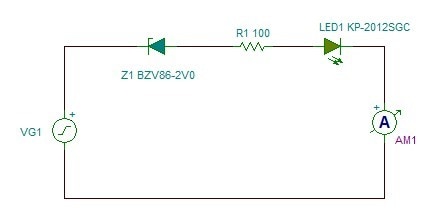
So I was thinking of a simple circuit with a zener diode with a breakdown voltage of 5V, but I'm not sure whether this would work as expected...

Since I pay for the components myself, I wanted to be sure this would work, before buying everything!


Can anyone tell me if this idea would work, and if not how to do it otherwise? I've looked on the internet and the main solution I find is with a comparator. I cannot use this because if the PG Line is wrong, I cannot know if the 5V line of the PSU is actually 5V...

What I want is an easy little circuit that has a LED emit light when there is 5V and not emit light when there is no 5V. (doesn't have to be completely exact) As far as I have found, this power good line varies between 0-5V (does not go higher).


Thanksfor your help!


Schematic of my idea:

image

  • Sign in to reply
  • Cancel

Top Replies

  • Jan Cumps
    Jan Cumps over 9 years ago in reply to 0phoff +4 suggested
    If the measure needs to be precise, there are dedicated ICs: 'Supply Voltage Supervisors'. They are 3-pin devices that can directly drive an LED if voltage is above a certain threshold. For 5 V monitoring…
  • jc2048
    jc2048 over 9 years ago in reply to 0phoff +3 suggested
    "It seems I was over-complicating things in my head!" But that's good. It lead to you asking questions, forming a specification for what you wanted to do, and then looking for a means to do it. You are…
  • 0phoff
    0phoff over 9 years ago in reply to shabaz +2
    Yeah I googled around for a bit and it seems to be like you said! Getting an old PSU in a few weeks probably so I'll make sure to read the documentation of that specific piece before buying the components…
Parents
  • shabaz
    0 shabaz over 9 years ago

    Hi,


    Are you sure the power good line isn't a logic level signal (i.e. two states, high and low)? Usually, they output something undefined when the PSU output voltage is very low (e.g. just powering up), then they indicate power bad for the milliseconds that the supply is still coming up, then they indicate power good, then they remain there unless the output voltage is not within some threshold in which case the signal indicates power bad by changing logic level again.

    So, if you have enough power to drive your circuit from the main supply, then you can trust the logic level of the power good signal.

    You could just drive an LED from the main PSU using a resistor and a transistor. Connect the Power Good output via a resistor to the transistor base. Or (even more straightforward, it should only have an extremely dim state during the undefined stage when the voltage is very low), just connect the LED directly to the Power Good line through a resistor.

    • Cancel
    • Vote Up +1 Vote Down
    • Sign in to reply
    • Verify Answer
    • Reject Answer
    • Cancel
  • 0phoff
    0 0phoff over 9 years ago in reply to shabaz

    Ow so you say the PG line would just be 0 or 1 (0 or 5V)... That would idd simplify things!

    I read somewhere that the PG line could be 3V so I guessed it was an analog signal.. Did not find anything else on it so I decided to trust that.. Might do some more research!

    If it's idd just a digital signal that simplifies everything! image

    I'll update the thread when I find out more about this!

    • Cancel
    • Vote Up 0 Vote Down
    • Sign in to reply
    • Verify Answer
    • Cancel
  • shabaz
    0 shabaz over 9 years ago in reply to 0phoff

    It is a guess, it depends on your power supply (google the part number in case you can find user documentation for it).

    It isn't necessarily 5V, but usually is a voltage, e.g. a 12V supply may output 11V if the power is good, and 0V if the power is bad.

    However, you still need to check the documentation, there is no real standard on this. Also, don't assume that the signal means that

    the output is exactly 5V or 12V or whatever your supply is rated at. It could be out by 1 volt or more. It is a crude "go/no-go" indicator.

    • Cancel
    • Vote Up +1 Vote Down
    • Sign in to reply
    • Verify Answer
    • Cancel
  • 0phoff
    0 0phoff over 9 years ago in reply to shabaz

    Yeah I googled around for a bit and it seems to be like you said!

    Getting an old PSU in a few weeks probably so I'll make sure to read the documentation of that specific piece before buying the components! image

    Thanks for your help! It seems I was over-complicating things in my head! image

    • Cancel
    • Vote Up +2 Vote Down
    • Sign in to reply
    • Verify Answer
    • Cancel
  • gadget.iom
    0 gadget.iom over 9 years ago in reply to 0phoff

    Thank you for feeding back your findings. image

    Let us know how you get on.

    • Cancel
    • Vote Up 0 Vote Down
    • Sign in to reply
    • Verify Answer
    • Cancel
Reply
  • gadget.iom
    0 gadget.iom over 9 years ago in reply to 0phoff

    Thank you for feeding back your findings. image

    Let us know how you get on.

    • Cancel
    • Vote Up 0 Vote Down
    • Sign in to reply
    • Verify Answer
    • Cancel
Children
No Data
element14 Community

element14 is the first online community specifically for engineers. Connect with your peers and get expert answers to your questions.

  • Members
  • Learn
  • Technologies
  • Challenges & Projects
  • Products
  • Store
  • About Us
  • Feedback & Support
  • FAQs
  • Terms of Use
  • Privacy Policy
  • Legal and Copyright Notices
  • Sitemap
  • Cookies

An Avnet Company © 2025 Premier Farnell Limited. All Rights Reserved.

Premier Farnell Ltd, registered in England and Wales (no 00876412), registered office: Farnell House, Forge Lane, Leeds LS12 2NE.

ICP 备案号 10220084.

Follow element14

  • X
  • Facebook
  • linkedin
  • YouTube