element14 Community
element14 Community
    Register Log In
  • Site
  • Search
  • Log In Register
  • Community Hub
    Community Hub
    • What's New on element14
    • Feedback and Support
    • Benefits of Membership
    • Personal Blogs
    • Members Area
    • Achievement Levels
  • Learn
    Learn
    • Ask an Expert
    • eBooks
    • element14 presents
    • Learning Center
    • Tech Spotlight
    • STEM Academy
    • Webinars, Training and Events
    • Learning Groups
  • Technologies
    Technologies
    • 3D Printing
    • FPGA
    • Industrial Automation
    • Internet of Things
    • Power & Energy
    • Sensors
    • Technology Groups
  • Challenges & Projects
    Challenges & Projects
    • Design Challenges
    • element14 presents Projects
    • Project14
    • Arduino Projects
    • Raspberry Pi Projects
    • Project Groups
  • Products
    Products
    • Arduino
    • Avnet & Tria Boards Community
    • Dev Tools
    • Manufacturers
    • Multicomp Pro
    • Product Groups
    • Raspberry Pi
    • RoadTests & Reviews
  • About Us
  • Store
    Store
    • Visit Your Store
    • Choose another store...
      • Europe
      •  Austria (German)
      •  Belgium (Dutch, French)
      •  Bulgaria (Bulgarian)
      •  Czech Republic (Czech)
      •  Denmark (Danish)
      •  Estonia (Estonian)
      •  Finland (Finnish)
      •  France (French)
      •  Germany (German)
      •  Hungary (Hungarian)
      •  Ireland
      •  Israel
      •  Italy (Italian)
      •  Latvia (Latvian)
      •  
      •  Lithuania (Lithuanian)
      •  Netherlands (Dutch)
      •  Norway (Norwegian)
      •  Poland (Polish)
      •  Portugal (Portuguese)
      •  Romania (Romanian)
      •  Russia (Russian)
      •  Slovakia (Slovak)
      •  Slovenia (Slovenian)
      •  Spain (Spanish)
      •  Sweden (Swedish)
      •  Switzerland(German, French)
      •  Turkey (Turkish)
      •  United Kingdom
      • Asia Pacific
      •  Australia
      •  China
      •  Hong Kong
      •  India
      • Japan
      •  Korea (Korean)
      •  Malaysia
      •  New Zealand
      •  Philippines
      •  Singapore
      •  Taiwan
      •  Thailand (Thai)
      • Vietnam
      • Americas
      •  Brazil (Portuguese)
      •  Canada
      •  Mexico (Spanish)
      •  United States
      Can't find the country/region you're looking for? Visit our export site or find a local distributor.
  • Translate
  • Profile
  • Settings
Community Hub
Community Hub
Member's Forum I think this is a buck converter, but I'm not entirely sure.
  • Blog
  • Forum
  • Documents
  • Quiz
  • Events
  • Leaderboard
  • Polls
  • Files
  • Members
  • Mentions
  • Sub-Groups
  • Tags
  • More
  • Cancel
  • New
Join Community Hub to participate - click to join for free!
Actions
  • Share
  • More
  • Cancel
Forum Thread Details
  • State Verified Answer
  • Replies 18 replies
  • Answers 3 answers
  • Subscribers 565 subscribers
  • Views 1942 views
  • Users 0 members are here
Related

I think this is a buck converter, but I'm not entirely sure.

capacitance_incarnate
capacitance_incarnate over 8 years ago

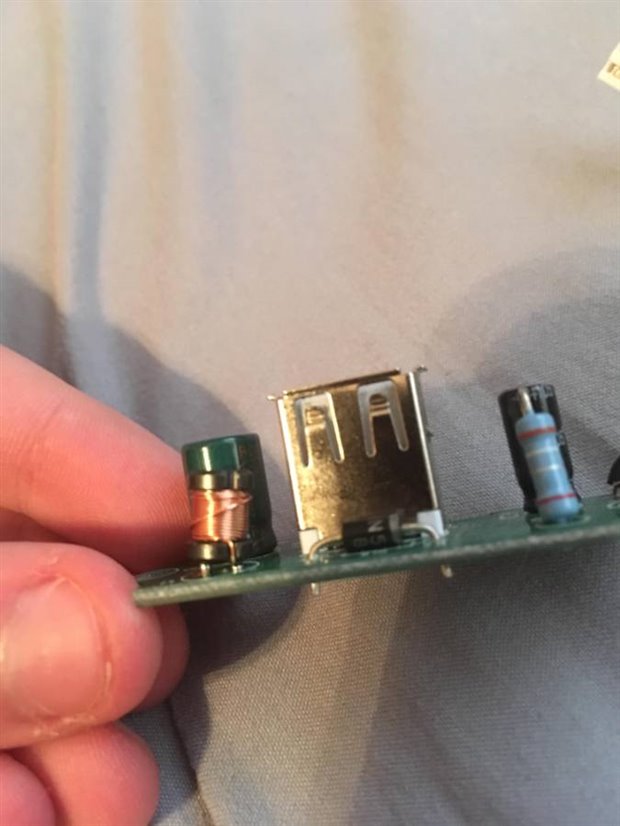
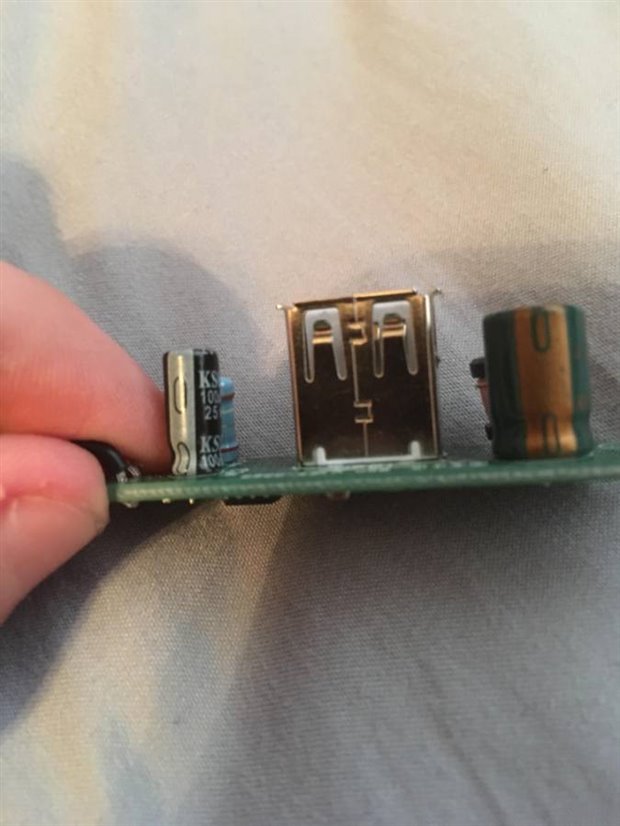
So I have this little chip here from a cigarette lighter psu, but there isn't a voltage regulator any where in it. If this is indeed a buck converter, that would explain the lack of a regulator, but I'm new to this kind of stuff, (I first got into it  while creating a project for school last year) so I would appreciate any help I can get.
imageimageimage

  • Sign in to reply
  • Cancel

Top Replies

  • rachaelp
    rachaelp over 8 years ago in reply to capacitance_incarnate +2 suggested
    Take a look at the datasheet for the controller here (assuming it is the one Shabaz is referring to): http://www.farnell.com/datasheets/1723944.pdf?_ga=1.226316314.1698039299.1446112257 If you look at…
  • shabaz
    shabaz over 8 years ago +1 verified
    Hi Jake, That is a voltage regulator, also known as a DC-DC converter or a Buck converter when it uses an inductor and switching and steps down the voltage. You could confirm by examining the part code…
  • rachaelp
    rachaelp over 8 years ago in reply to capacitance_incarnate +1
    Jake Linville wrote: ok so the big resistor up top is a 0.39 Ω ± 2%. I'm assuming thats the one that I need to replace, because there is no way I could replace the little ones on the bottom. Unfortunately…
Parents
  • shabaz
    0 shabaz over 8 years ago

    Hi Jake,


    That is a voltage regulator, also known as a DC-DC converter or a Buck converter when it uses an inductor and switching and steps down the voltage.

    You could confirm by examining the part code on the integrated circuit, and obtain the datasheet for the part online. It is extremely likely to be MC34063 (or similar) because that is common in low-cost USB car chargers (and from the photo, the pinout looks about right for that).

    • Cancel
    • Vote Up +1 Vote Down
    • Sign in to reply
    • Verify Answer
    • Reject Answer
    • Cancel
  • capacitance_incarnate
    0 capacitance_incarnate over 8 years ago in reply to shabaz

    Thanks so much! I'm assuming the input voltage would be 12v, yes? Also, is there anyway i can change the output voltage? I'd like to lower it to around 4.7 volts.

    • Cancel
    • Vote Up 0 Vote Down
    • Sign in to reply
    • Verify Answer
    • Cancel
  • shabaz
    0 shabaz over 8 years ago in reply to capacitance_incarnate

    Hi Jake,


    It will not function to produce a 5V output if you do that. In the datasheet, there is a circuit diagram for step-up mode, which is different from step-down mode. It would be awkward to try to modify to step-up mode without a new circuit board or cutting tracks etc. However, step-up devices are available from ebay etc at low cost, e.g. this one (I've not tried it, so cannot be sure it is any good, but I don't see a reason why it wouldn't work):

    8W Boost step up Adjustable Regulator Converter 5V-12V Power Supply Module | eBay

    • Cancel
    • Vote Up 0 Vote Down
    • Sign in to reply
    • Verify Answer
    • Cancel
  • capacitance_incarnate
    0 capacitance_incarnate over 8 years ago in reply to shabaz

    I'm not making it go to step up mode, it runs on 12v and I want to lower the output from 5v to 4.7v although I now know that I'm going to have to find someone to replace the surface mount resistors for me.

    • Cancel
    • Vote Up +1 Vote Down
    • Sign in to reply
    • Verify Answer
    • Cancel
  • rachaelp
    0 rachaelp over 8 years ago in reply to shabaz

    I think it's the output he want's to lower to 4.7V not the input voltage. But yes, there are limits to how the input/output can be altered without needing to change the topology of the circuit and/or a number of other components which would get difficult to achieve on a board like this.

    • Cancel
    • Vote Up +1 Vote Down
    • Sign in to reply
    • Verify Answer
    • Cancel
  • shabaz
    0 shabaz over 8 years ago in reply to rachaelp

    Hi Rachael,


    Ohh I see. I'm sorry Jake, please ignore my comment!

    • Cancel
    • Vote Up +1 Vote Down
    • Sign in to reply
    • Verify Answer
    • Cancel
  • capacitance_incarnate
    0 capacitance_incarnate over 8 years ago in reply to shabaz

    its fine. I admit I could have worded it better.

    • Cancel
    • Vote Up +1 Vote Down
    • Sign in to reply
    • Verify Answer
    • Cancel
  • rachaelp
    0 rachaelp over 8 years ago in reply to capacitance_incarnate

    Jake Linville wrote:


    ...although I now know that I'm going to have to find someone to replace the surface mount resistors for me.

    Or use it as an excuse to invest in a decent soldering station! You don't have to spend huge amounts to get something adequate for starting out and it'll prove to be exceedingly useful time and time again if you continue to pursue electronics further image

    • Cancel
    • Vote Up +1 Vote Down
    • Sign in to reply
    • Verify Answer
    • Cancel
  • shabaz
    0 shabaz over 8 years ago in reply to capacitance_incarnate

    Hi Jake,


    You didn't specify the reason for 4.7V, but if you're happy with "about 4.7V" then you could put a diode in series with the output. The output won't be accurate any more, but will be lower than 5V slightly (could vary to 4V or lower). For any accuracy you need to take the approach Rachael mentions with the resistors,but needs the steps mentioned (soldering capability, resistors purchased). If you're interested in this as a hobby, see this URL for lots of information: I Want to Do Electronics!  Where do I start?

    • Cancel
    • Vote Up +1 Vote Down
    • Sign in to reply
    • Verify Answer
    • Reject Answer
    • Cancel
  • capacitance_incarnate
    0 capacitance_incarnate over 8 years ago in reply to shabaz

    well, the reason is I'm actually trying to make an adapter for my 3ds. There was an old gameboy advance charger that hooked into both the wall or a cigarette lighter. I plan on making one of these that is fine tuned for the 3ds, as it is VERY cheaply made and will break at a little over 5 volts (it normally wants 4.6)

    • Cancel
    • Vote Up 0 Vote Down
    • Sign in to reply
    • Verify Answer
    • Cancel
  • capacitance_incarnate
    0 capacitance_incarnate over 8 years ago in reply to rachaelp

    I actually do have a soldering station. I picked it up for that project I mentioned, and have been making small circuits for fun, but because I'm a broke 15 year old, the only parts I have come from broken radios and computers. although I do have plenty of resistors.

    • Cancel
    • Vote Up +1 Vote Down
    • Sign in to reply
    • Verify Answer
    • Cancel
  • rachaelp
    0 rachaelp over 8 years ago in reply to shabaz

    shabaz wrote:


    You didn't specify the reason for 4.7V, but if you're happy with "about 4.7V" then you could put a diode in series with the output.

    Yes if you only need approximately 4.7V then this is a good idea. If you use a schottky diode then the Vf of the diode should be low enough that you'll be around the 4.5-4.7V range depending on the exact device chosen and the current being drawn.


    shabaz wrote:


    If you're interested in this as a hobby, see this URL for lots of information: I Want to Do Electronics! Where do I start?

    I'll second this, and its author (jw0752 has done a lot of other great blogs which are worth reading if you're interested.

    • Cancel
    • Vote Up 0 Vote Down
    • Sign in to reply
    • Verify Answer
    • Cancel
Reply
  • rachaelp
    0 rachaelp over 8 years ago in reply to shabaz

    shabaz wrote:


    You didn't specify the reason for 4.7V, but if you're happy with "about 4.7V" then you could put a diode in series with the output.

    Yes if you only need approximately 4.7V then this is a good idea. If you use a schottky diode then the Vf of the diode should be low enough that you'll be around the 4.5-4.7V range depending on the exact device chosen and the current being drawn.


    shabaz wrote:


    If you're interested in this as a hobby, see this URL for lots of information: I Want to Do Electronics! Where do I start?

    I'll second this, and its author (jw0752 has done a lot of other great blogs which are worth reading if you're interested.

    • Cancel
    • Vote Up 0 Vote Down
    • Sign in to reply
    • Verify Answer
    • Cancel
Children
No Data
element14 Community

element14 is the first online community specifically for engineers. Connect with your peers and get expert answers to your questions.

  • Members
  • Learn
  • Technologies
  • Challenges & Projects
  • Products
  • Store
  • About Us
  • Feedback & Support
  • FAQs
  • Terms of Use
  • Privacy Policy
  • Legal and Copyright Notices
  • Sitemap
  • Cookies

An Avnet Company © 2025 Premier Farnell Limited. All Rights Reserved.

Premier Farnell Ltd, registered in England and Wales (no 00876412), registered office: Farnell House, Forge Lane, Leeds LS12 2NE.

ICP 备案号 10220084.

Follow element14

  • X
  • Facebook
  • linkedin
  • YouTube