element14 Community
element14 Community
    Register Log In
  • Site
  • Search
  • Log In Register
  • Community Hub
    Community Hub
    • What's New on element14
    • Feedback and Support
    • Benefits of Membership
    • Personal Blogs
    • Members Area
    • Achievement Levels
  • Learn
    Learn
    • Ask an Expert
    • eBooks
    • element14 presents
    • Learning Center
    • Tech Spotlight
    • STEM Academy
    • Webinars, Training and Events
    • Learning Groups
  • Technologies
    Technologies
    • 3D Printing
    • FPGA
    • Industrial Automation
    • Internet of Things
    • Power & Energy
    • Sensors
    • Technology Groups
  • Challenges & Projects
    Challenges & Projects
    • Design Challenges
    • element14 presents Projects
    • Project14
    • Arduino Projects
    • Raspberry Pi Projects
    • Project Groups
  • Products
    Products
    • Arduino
    • Avnet & Tria Boards Community
    • Dev Tools
    • Manufacturers
    • Multicomp Pro
    • Product Groups
    • Raspberry Pi
    • RoadTests & Reviews
  • About Us
    About the element14 Community
  • Store
    Store
    • Visit Your Store
    • Choose another store...
      • Europe
      •  Austria (German)
      •  Belgium (Dutch, French)
      •  Bulgaria (Bulgarian)
      •  Czech Republic (Czech)
      •  Denmark (Danish)
      •  Estonia (Estonian)
      •  Finland (Finnish)
      •  France (French)
      •  Germany (German)
      •  Hungary (Hungarian)
      •  Ireland
      •  Israel
      •  Italy (Italian)
      •  Latvia (Latvian)
      •  
      •  Lithuania (Lithuanian)
      •  Netherlands (Dutch)
      •  Norway (Norwegian)
      •  Poland (Polish)
      •  Portugal (Portuguese)
      •  Romania (Romanian)
      •  Russia (Russian)
      •  Slovakia (Slovak)
      •  Slovenia (Slovenian)
      •  Spain (Spanish)
      •  Sweden (Swedish)
      •  Switzerland(German, French)
      •  Turkey (Turkish)
      •  United Kingdom
      • Asia Pacific
      •  Australia
      •  China
      •  Hong Kong
      •  India
      •  Japan
      •  Korea (Korean)
      •  Malaysia
      •  New Zealand
      •  Philippines
      •  Singapore
      •  Taiwan
      •  Thailand (Thai)
      •  Vietnam
      • Americas
      •  Brazil (Portuguese)
      •  Canada
      •  Mexico (Spanish)
      •  United States
      Can't find the country/region you're looking for? Visit our export site or find a local distributor.
  • Translate
  • Profile
  • Settings
Community Hub
Community Hub
Member's Forum Using a DC-DC Isolator to allow single power input to case?
  • Blog
  • Forum
  • Documents
  • Quiz
  • Events
  • Leaderboard
  • Polls
  • Files
  • Members
  • Mentions
  • Sub-Groups
  • Tags
  • More
  • Cancel
  • New
Join Community Hub to participate - click to join for free!
Actions
  • Share
  • More
  • Cancel
Forum Thread Details
  • State Verified Answer
  • Replies 40 replies
  • Answers 15 answers
  • Subscribers 619 subscribers
  • Views 6486 views
  • Users 0 members are here
Related

Using a DC-DC Isolator to allow single power input to case?

Andrew J
Andrew J over 6 years ago

I'm working on something where I use an Arduino talking via I2C to a DAC, an ADC and an RTC and I'm provisioning an I2C isolator and a digital isolator (for digital pins) to provide separation between the two.  I'm doing this to prevent blowing up the Arduino if something goes wrong and also just because I want to as part of experimenting/learning.


This only works if both power and ground on sides A and B of the isolators are separate from each other.  To complicate matters, if this all works and I encase it then I only want one power cord into the case - something like a 15V wallwart affair.  This would, inevitably, tie grounds together and the isolators won't work: not 'won't work in an isolation' sense, but not work at all - I've tried it!


So I'm wondering if I could feed the 15V supply into a 12V regulator and subsequently a 5V regulator for Side B (I need 12V and 5V on that side) and into a 12V DC-DC isolator that outputs 5V for side A which also powers the Arduino. 


Something like this Tracopower supply.  When I look at this I see that the Vin ground is connected on Side B, but the Vout -Ve is isolated for Side A so it seems like it would do the trick.  I thought I'd ask here first before committing to spending money to try it out or indeed if there were other ideas.


My main criteria are:

5V, 1A output

Clean enough to power an Arduino and 5V vin isolator (I could use a supply with a higher ouput voltage and feed through a 5V regulator)

Only 1 main power input.  If there's no solution that allows for this, I'd do away with the isolation altogether.  In reality it's not really needed.

  • Sign in to reply
  • Cancel
Parents
  • Jan Cumps
    0 Jan Cumps over 6 years ago

    i believe that the two outputs aren't isolated from each other. It's balanced out: Vmin - Common - Vplus.

    • Cancel
    • Vote Up +2 Vote Down
    • Sign in to reply
    • Verify Answer
    • Reject Answer
    • Cancel
  • jw0752
    0 jw0752 over 6 years ago in reply to Jan Cumps

    Hi Jan,


    I believe there were two models listed on the data sheet. One had +/- with a common and the other was just +/- with no common. If I read it correctly both of these options were isolated from the Input ground.


    John

    • Cancel
    • Vote Up +3 Vote Down
    • Sign in to reply
    • Verify Answer
    • Reject Answer
    • Cancel
  • Jan Cumps
    0 Jan Cumps over 6 years ago in reply to jw0752

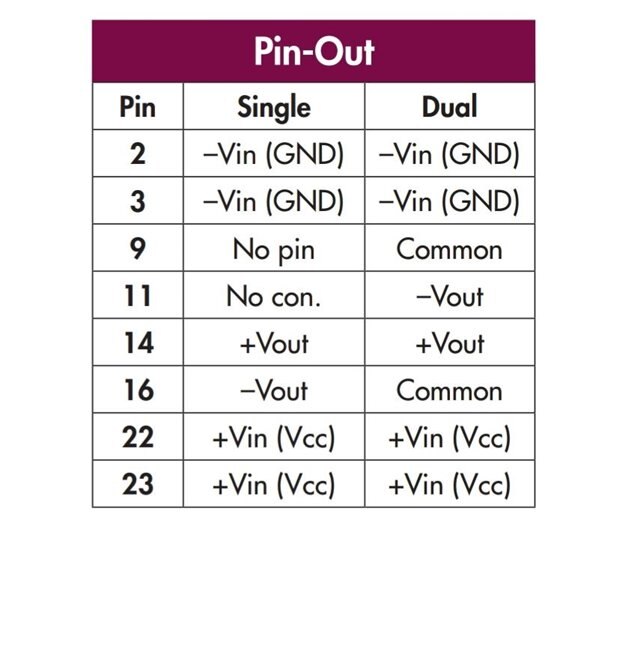
    The way I read the datasheet is that you either have a single supply, or dual with common middle point:

    image

    • Cancel
    • Vote Up 0 Vote Down
    • Sign in to reply
    • Verify Answer
    • Cancel
  • Gough Lui
    0 Gough Lui over 6 years ago in reply to Jan Cumps

    Indeed, I tested both the HVP-70 and Micsig DP10013 in this posting:

    https://goughlui.com/2018/12/16/review-eevblog-hvp-70-70mhz-micsig-dp10013-100mhz-high-voltage-differential-probes/


    You do get what you pay for to some extent ... if you need isolation for high-voltage circuit probing, these are good options. But if you're interested in low voltage, then you might want a standard differential probe otherwise the noise might cause problems for your measurement.


    As for the original query - yes, many Traco Power modules are isolated, and this is the approach taken by the Infineon Differential Gate Driver demo board as well as the B&K Precision DAS240 Multi-Channel Logger (along with a digital isolator) to provide isolation.


    - Gough

    • Cancel
    • Vote Up +2 Vote Down
    • Sign in to reply
    • Verify Answer
    • Reject Answer
    • Cancel
  • Jan Cumps
    0 Jan Cumps over 6 years ago in reply to Andrew J

    Andrew J  wrote:


    Interestingly, perhaps, Side A SDA was pulling down ok, Side B wasn't.  SCL Side B was following Side A.

    The clock does not have to negotiate, because it always comes from the master.

    It's on the data lines that there may be conflicts that need to be dealt with.

    • Cancel
    • Vote Up 0 Vote Down
    • Sign in to reply
    • Verify Answer
    • Cancel
  • Andrew J
    0 Andrew J over 6 years ago in reply to Jan Cumps

    Interestingly, perhaps, Side A SDA was pulling down ok, Side B wasn't.  SCL Side B was following Side A.

    • Cancel
    • Vote Up 0 Vote Down
    • Sign in to reply
    • Verify Answer
    • Cancel
  • shabaz
    0 shabaz over 6 years ago in reply to Andrew J

    Ah, I see.. got it.

    • Cancel
    • Vote Up 0 Vote Down
    • Sign in to reply
    • Verify Answer
    • Cancel
  • Jan Cumps
    0 Jan Cumps over 6 years ago in reply to Andrew J

    A heads-up that sharing a ground is virtually the same as sharing Vcc. It's a closed circuit: a PSU output is very low impedance.

    for the current, and for any bogus current too, it is as if your power supply is a wire between Vcc and GND.


    I may get flack for this abstraction. So be it image.

    • Cancel
    • Vote Up +1 Vote Down
    • Sign in to reply
    • Verify Answer
    • Cancel
  • Andrew J
    0 Andrew J over 6 years ago in reply to shabaz

    I think I have just confused things not actually posting in detail but I thought that would just cloud things in respect to my question!  Obviously mistaken!!


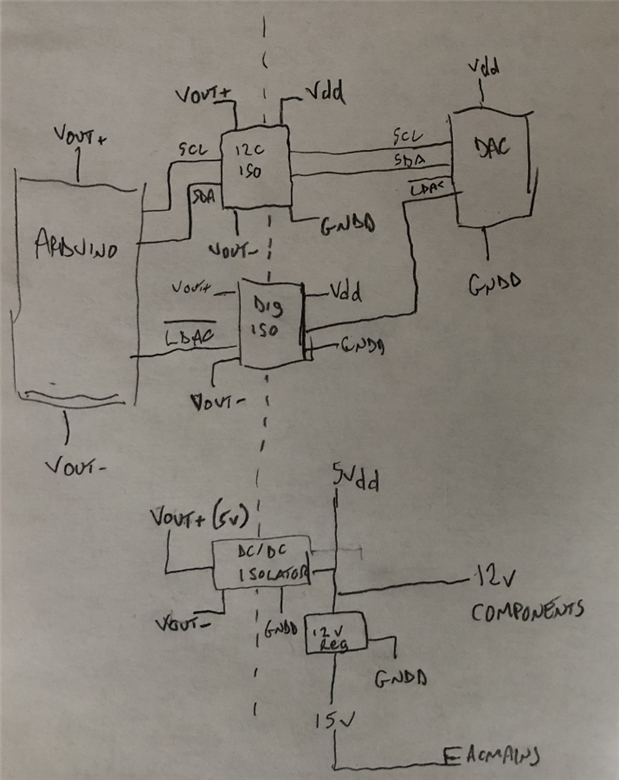
    The grounds don't need to be connected, it wasn't a specific requirement.  In an ideal isolated world they wouldn't be.  What I wanted was to try and protect the Arduino, not to have to plug it into a PC to power it, and not to have two input power supplies - a 15V and 5V as drawn on the right in the image in the post above.  I have components that require regulated 5V and regulated 12V and the 12V regulator requires a minimum 15V input.  I can't power Side A from the Arduino once encased because the Arduino needs powering and I don't want to plug it into a PC or 5V wall wart (back to two sockets!)


    My first stab at that, because I didn't know any better at the time, was to isolate just the power and signal traces and not to worry about the ground as I drew above.  So the grounds are the same purely from initial expediency - saves some money as galvanic isolation isn't really required.  That doesn't work - the I2C isolator doesn't seem to like it (perhaps just because it's on a breadboard??) - so I need to move to my next idea which is to use a DC/DC isolator.  I can use either the 15V or 12V as input to the DC/DC isolator (12V is its nominal voltage.)  Now in terms of 'saving money' I was using a LM7805 as one of the regulators, which I have to hand.  That doesn't like powering the Arduino with a voltage drop from 12V to 5V - as I expected, gets too hot and goes into thermal shutdown eventually.  Given that I'd need something like the Tracopower 5V switching regulator - the other one on my image - at around £5 - I might as well not worry about saving £10 and just get the DC/DC isolator and get proper isolation.  So my question was really just making sure I was thinking straight, before I spent that £15 to test it out.  I probably provided more information than necessary and just confused everyone.  Still, it's led to another interesting discussion!


    image

    (I forgot to draw on the 5V regulator on the right hand side where it is marked 5Vdd - imagine this is a 5V regulator!)  This then allows me to have one plug in the wall, no connection to a PC and drive both the Arduino and power components completely isolated from each other.  Again, I haven't put in all the caps, resistors, diodes etc.

    • Cancel
    • Vote Up +2 Vote Down
    • Sign in to reply
    • Verify Answer
    • Reject Answer
    • Cancel
Reply
  • Andrew J
    0 Andrew J over 6 years ago in reply to shabaz

    I think I have just confused things not actually posting in detail but I thought that would just cloud things in respect to my question!  Obviously mistaken!!


    The grounds don't need to be connected, it wasn't a specific requirement.  In an ideal isolated world they wouldn't be.  What I wanted was to try and protect the Arduino, not to have to plug it into a PC to power it, and not to have two input power supplies - a 15V and 5V as drawn on the right in the image in the post above.  I have components that require regulated 5V and regulated 12V and the 12V regulator requires a minimum 15V input.  I can't power Side A from the Arduino once encased because the Arduino needs powering and I don't want to plug it into a PC or 5V wall wart (back to two sockets!)


    My first stab at that, because I didn't know any better at the time, was to isolate just the power and signal traces and not to worry about the ground as I drew above.  So the grounds are the same purely from initial expediency - saves some money as galvanic isolation isn't really required.  That doesn't work - the I2C isolator doesn't seem to like it (perhaps just because it's on a breadboard??) - so I need to move to my next idea which is to use a DC/DC isolator.  I can use either the 15V or 12V as input to the DC/DC isolator (12V is its nominal voltage.)  Now in terms of 'saving money' I was using a LM7805 as one of the regulators, which I have to hand.  That doesn't like powering the Arduino with a voltage drop from 12V to 5V - as I expected, gets too hot and goes into thermal shutdown eventually.  Given that I'd need something like the Tracopower 5V switching regulator - the other one on my image - at around £5 - I might as well not worry about saving £10 and just get the DC/DC isolator and get proper isolation.  So my question was really just making sure I was thinking straight, before I spent that £15 to test it out.  I probably provided more information than necessary and just confused everyone.  Still, it's led to another interesting discussion!


    image

    (I forgot to draw on the 5V regulator on the right hand side where it is marked 5Vdd - imagine this is a 5V regulator!)  This then allows me to have one plug in the wall, no connection to a PC and drive both the Arduino and power components completely isolated from each other.  Again, I haven't put in all the caps, resistors, diodes etc.

    • Cancel
    • Vote Up +2 Vote Down
    • Sign in to reply
    • Verify Answer
    • Reject Answer
    • Cancel
Children
  • shabaz
    0 shabaz over 6 years ago in reply to Andrew J

    Ah, I see.. got it.

    • Cancel
    • Vote Up 0 Vote Down
    • Sign in to reply
    • Verify Answer
    • Cancel
  • Jan Cumps
    0 Jan Cumps over 6 years ago in reply to Andrew J

    A heads-up that sharing a ground is virtually the same as sharing Vcc. It's a closed circuit: a PSU output is very low impedance.

    for the current, and for any bogus current too, it is as if your power supply is a wire between Vcc and GND.


    I may get flack for this abstraction. So be it image.

    • Cancel
    • Vote Up +1 Vote Down
    • Sign in to reply
    • Verify Answer
    • Cancel
element14 Community

element14 is the first online community specifically for engineers. Connect with your peers and get expert answers to your questions.

  • Members
  • Learn
  • Technologies
  • Challenges & Projects
  • Products
  • Store
  • About Us
  • Feedback & Support
  • FAQs
  • Terms of Use
  • Privacy Policy
  • Legal and Copyright Notices
  • Sitemap
  • Cookies

An Avnet Company © 2026 Premier Farnell Limited. All Rights Reserved.

Premier Farnell Ltd, registered in England and Wales (no 00876412), registered office: Farnell House, Forge Lane, Leeds LS12 2NE.

ICP 备案号 10220084.

Follow element14

  • X
  • Facebook
  • linkedin
  • YouTube