element14 Community
element14 Community
    Register Log In
  • Site
  • Search
  • Log In Register
  • Community Hub
    Community Hub
    • What's New on element14
    • Feedback and Support
    • Benefits of Membership
    • Personal Blogs
    • Members Area
    • Achievement Levels
  • Learn
    Learn
    • Ask an Expert
    • eBooks
    • element14 presents
    • Learning Center
    • Tech Spotlight
    • STEM Academy
    • Webinars, Training and Events
    • Learning Groups
  • Technologies
    Technologies
    • 3D Printing
    • FPGA
    • Industrial Automation
    • Internet of Things
    • Power & Energy
    • Sensors
    • Technology Groups
  • Challenges & Projects
    Challenges & Projects
    • Design Challenges
    • element14 presents Projects
    • Project14
    • Arduino Projects
    • Raspberry Pi Projects
    • Project Groups
  • Products
    Products
    • Arduino
    • Avnet & Tria Boards Community
    • Dev Tools
    • Manufacturers
    • Multicomp Pro
    • Product Groups
    • Raspberry Pi
    • RoadTests & Reviews
  • About Us
  • Store
    Store
    • Visit Your Store
    • Choose another store...
      • Europe
      •  Austria (German)
      •  Belgium (Dutch, French)
      •  Bulgaria (Bulgarian)
      •  Czech Republic (Czech)
      •  Denmark (Danish)
      •  Estonia (Estonian)
      •  Finland (Finnish)
      •  France (French)
      •  Germany (German)
      •  Hungary (Hungarian)
      •  Ireland
      •  Israel
      •  Italy (Italian)
      •  Latvia (Latvian)
      •  
      •  Lithuania (Lithuanian)
      •  Netherlands (Dutch)
      •  Norway (Norwegian)
      •  Poland (Polish)
      •  Portugal (Portuguese)
      •  Romania (Romanian)
      •  Russia (Russian)
      •  Slovakia (Slovak)
      •  Slovenia (Slovenian)
      •  Spain (Spanish)
      •  Sweden (Swedish)
      •  Switzerland(German, French)
      •  Turkey (Turkish)
      •  United Kingdom
      • Asia Pacific
      •  Australia
      •  China
      •  Hong Kong
      •  India
      • Japan
      •  Korea (Korean)
      •  Malaysia
      •  New Zealand
      •  Philippines
      •  Singapore
      •  Taiwan
      •  Thailand (Thai)
      • Vietnam
      • Americas
      •  Brazil (Portuguese)
      •  Canada
      •  Mexico (Spanish)
      •  United States
      Can't find the country/region you're looking for? Visit our export site or find a local distributor.
  • Translate
  • Profile
  • Settings
Community Hub
Community Hub
Member's Forum Mains operated garage roller door position sensing mystery
  • Blog
  • Forum
  • Documents
  • Quiz
  • Events
  • Leaderboard
  • Polls
  • Files
  • Members
  • Mentions
  • Sub-Groups
  • Tags
  • More
  • Cancel
  • New
Join Community Hub to participate - click to join for free!
Actions
  • Share
  • More
  • Cancel
Forum Thread Details
  • Replies 10 replies
  • Subscribers 561 subscribers
  • Views 910 views
  • Users 0 members are here
Related

Mains operated garage roller door position sensing mystery

davebullockmbe
davebullockmbe over 1 year ago

So I have been tasked to discover how a 'roller' garage door knows when it is fully UP or Down and it is mystifying me

So here's all the information I have on the roller door controller. (pictured)

We took off the roller shutter cover inside the garage and all there is, is the skeleton roller mechanism with a square diecast looking housing that may be the motor connected to the roller at one end. 
The 4 core power cable goes into the diecast housing/body and after some searching the web I discovered that this is a 'tube motor' whose body is hidden inside the roller centre tube.
The diecast housing has a 'manual' winder loop sticking out of it with which one can manually wind the door up and down with a hooked handle, so the housing may just be gearbox and/or clutch?
So there are 4 wires going to the motor. (entering the diecast housing)
Earth, Neutral and two switched lives (UP and DOWN)
My internet trawl seems to show that the motor has two sets of 240V windings in opposite arrangement to allow it to reverse.
As far as I can tell only one live wire is energised at a time. (one going up and the other for coming down).image
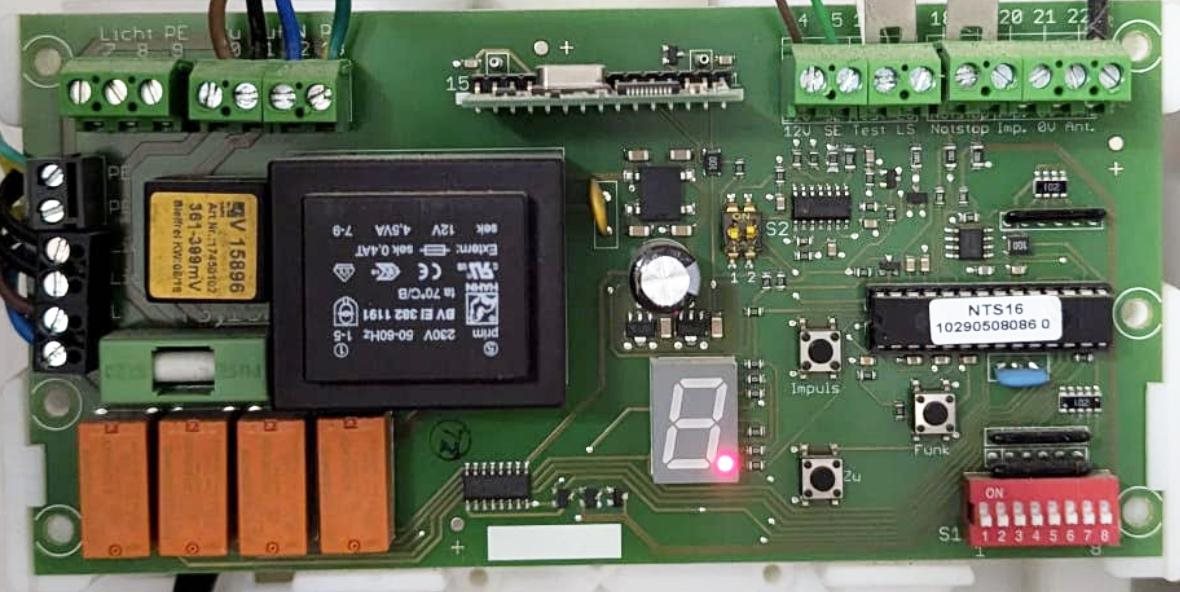
The up and down are controlled by two of those four orange relays bottom left on the controller pcb.
A third relay seems to disable all motor power, (or to make sure both up and down can't be on together?)
The fourth operates the lightbulb on top of the controller box!
All the relays seem to be driven via relay drivers directly from the microcontroller.
There are NO other wires coming from outside the controller other than the rubber pressure sensor at the bottom of the door.
Which does work!
So NO visible limit switches
No shaft encoders or extra wires from the motor housing etc.
So how does it know to stop at the top and bottom?
Could it be simply 'timing' based?
Well I don't think so as clearly IF the door ONLY went fully up and then fully down then this may be feasible.
However one can stop the door anywhere and reverse it several times and it still doesn't lose its sense of fully up or down or where it is!
Also It can't use the pressure sensor as yes this would work for fully down, but what about fully at the top?
Current sensing?
Well we tried monitoring the running current and it was 1.4A a.c. and this didn't seem to increase when the door hit the floor. However this was with a DVM which may not have been quick enough)
Will take my AVOmeter next time.
A (I don't know which) relay clicks OFF just after the door is fully closed, but the sequence is - it closes, all the slats squeeze up and then a relay can be heard to click and stops the motor.
There doesn't seem to be any evidence of current sensing wire shunts (at least on the face of the pcb) which detracts from the current sensing theory. But there could be something on the back of the board.
I may have to strip it out to investigate further but before I dismantle the whole thing someone just may save me a whole lot of investigation by knowing the secret and would kindly share the 'spell'?
Thanks in anticipation
Dave
  • Sign in to reply
  • Cancel

Top Replies

  • davebullockmbe
    davebullockmbe over 1 year ago in reply to javagoza +2
    Hi and a BIG thank-you to all respondents the mystery is solved. Whilst I was fully expecting any 'end of travel' limits to be relayed back to the controller, and the total lack of any evidence of limit…
  • kmikemoo
    kmikemoo over 1 year ago +1
    davebullockmbe This video will probably help. https://www.youtube.com/watch?v=Oii3L1Uw_XU Looks like he could use a few likes. 2:10 to 2:50 Not a bad teardown video.
  • shabaz
    shabaz over 1 year ago in reply to electronicbiker +1
    That thing with the yellow label on it is probably a current transformer, since as you suggest, overcurent protection would be needed anyway. It also looks like the fat traces pass through there, adding…
Parents
  • dougw
    dougw over 1 year ago

    To test the current sense theory you could try stalling the door half way...not too long though - incase it is an unacceptable overload.

    • Cancel
    • Vote Up 0 Vote Down
    • Sign in to reply
    • Cancel
Reply
  • dougw
    dougw over 1 year ago

    To test the current sense theory you could try stalling the door half way...not too long though - incase it is an unacceptable overload.

    • Cancel
    • Vote Up 0 Vote Down
    • Sign in to reply
    • Cancel
Children
  • electronicbiker
    electronicbiker over 1 year ago in reply to dougw

    Hello Dave, I don't know why I am replying to dougw but there you go...

    I once had a 12v 4A DC PSU with a very crude overcurrent protection system built in. This consisted of a DPDT relay that was connected in such a way that when the power came on nothing happened. A small normally-open push-button was then pressed to make the relay switch and one of the contact pairs made contact, thus latching the relay into the energised state. The other pair of contacts was connected in series with the 12v DC and the back of the red output terminal, so that (at last!) 12v DC appeared on the output terminals.

    Here's the tricky bit. The latch part of all this had a carefully-selected resistor connected such that the current through the coil was only just enough to hold the relay in the energised state. The power supply output volyage was not particularly well regulated, so if the load on the output became too much the voltage would drop. This reduced voltage caused the coil to allow the latch to drop out and the whole thing would cease to function. Until the overload was sorted and the push-button pressed again.

    Looking at the photo of your board it is obvious that the big black square thing is a transformer. The little square thing mounted close to it's left side and with a yellow label on it is intriguing. It has a rating on it measured in millivolts. This could mean all sorts of things, but it could be a far more sophisticated version of my overcurrent protection system whereby the quoted millivolts is the operating range? I can't read much of the printing on the label, but it might be worth typing some of it into a search engine and see what you get. Be very careful poking around with meter probes in that area, some of that wiring looks mighty powerful to me...

    Because the smaller square thing with the  yellow label is mounted so close to the transformer it could be some sort of heat sensor or maybe an inductive device that could measure the transformer current without any electrical connection. The green thing below it with the white bar across looks like a fuse in a green holder.

    Where did you measure the running current? I would have expected the motor current to drop to zero when the door hit the floor - and what is the control system? Pushing a button might be engaging a latch at the same time as powering the motor, presumably one for each direction. As there are no semiconductors involved the latch and the relays would operate no matter which direction the current was flowing.

    Good luck, and pleeeease don't electrify yourself.

    • Cancel
    • Vote Up 0 Vote Down
    • Sign in to reply
    • Cancel
  • shabaz
    shabaz over 1 year ago in reply to electronicbiker

    That thing with the yellow label on it is probably a current transformer, since as you suggest, overcurent protection would be needed anyway. It also looks like the fat traces pass through there, adding more weight to that idea.

    I've never looked at a garage door opener so I don't know if they would do anything additional, but definitely seems plausible that current sensing could play a role in detecting when to stop the motor as it approaches the limit (e.g. more friction). Or (apparently) you can detect how close to stalled you are, by monitoring the phase difference between the two windings (since a voltage appears across the unpowered winding). I don't know if it is that sophisticated though.

    • Cancel
    • Vote Up +1 Vote Down
    • Sign in to reply
    • Cancel
element14 Community

element14 is the first online community specifically for engineers. Connect with your peers and get expert answers to your questions.

  • Members
  • Learn
  • Technologies
  • Challenges & Projects
  • Products
  • Store
  • About Us
  • Feedback & Support
  • FAQs
  • Terms of Use
  • Privacy Policy
  • Legal and Copyright Notices
  • Sitemap
  • Cookies

An Avnet Company © 2025 Premier Farnell Limited. All Rights Reserved.

Premier Farnell Ltd, registered in England and Wales (no 00876412), registered office: Farnell House, Forge Lane, Leeds LS12 2NE.

ICP 备案号 10220084.

Follow element14

  • X
  • Facebook
  • linkedin
  • YouTube