element14 Community
element14 Community
    Register Log In
  • Site
  • Search
  • Log In Register
  • Community Hub
    Community Hub
    • What's New on element14
    • Feedback and Support
    • Benefits of Membership
    • Personal Blogs
    • Members Area
    • Achievement Levels
  • Learn
    Learn
    • Ask an Expert
    • eBooks
    • element14 presents
    • Learning Center
    • Tech Spotlight
    • STEM Academy
    • Webinars, Training and Events
    • Learning Groups
  • Technologies
    Technologies
    • 3D Printing
    • FPGA
    • Industrial Automation
    • Internet of Things
    • Power & Energy
    • Sensors
    • Technology Groups
  • Challenges & Projects
    Challenges & Projects
    • Design Challenges
    • element14 presents Projects
    • Project14
    • Arduino Projects
    • Raspberry Pi Projects
    • Project Groups
  • Products
    Products
    • Arduino
    • Avnet & Tria Boards Community
    • Dev Tools
    • Manufacturers
    • Multicomp Pro
    • Product Groups
    • Raspberry Pi
    • RoadTests & Reviews
  • About Us
  • Store
    Store
    • Visit Your Store
    • Choose another store...
      • Europe
      •  Austria (German)
      •  Belgium (Dutch, French)
      •  Bulgaria (Bulgarian)
      •  Czech Republic (Czech)
      •  Denmark (Danish)
      •  Estonia (Estonian)
      •  Finland (Finnish)
      •  France (French)
      •  Germany (German)
      •  Hungary (Hungarian)
      •  Ireland
      •  Israel
      •  Italy (Italian)
      •  Latvia (Latvian)
      •  
      •  Lithuania (Lithuanian)
      •  Netherlands (Dutch)
      •  Norway (Norwegian)
      •  Poland (Polish)
      •  Portugal (Portuguese)
      •  Romania (Romanian)
      •  Russia (Russian)
      •  Slovakia (Slovak)
      •  Slovenia (Slovenian)
      •  Spain (Spanish)
      •  Sweden (Swedish)
      •  Switzerland(German, French)
      •  Turkey (Turkish)
      •  United Kingdom
      • Asia Pacific
      •  Australia
      •  China
      •  Hong Kong
      •  India
      • Japan
      •  Korea (Korean)
      •  Malaysia
      •  New Zealand
      •  Philippines
      •  Singapore
      •  Taiwan
      •  Thailand (Thai)
      • Vietnam
      • Americas
      •  Brazil (Portuguese)
      •  Canada
      •  Mexico (Spanish)
      •  United States
      Can't find the country/region you're looking for? Visit our export site or find a local distributor.
  • Translate
  • Profile
  • Settings
Personal Blogs
  • Community Hub
  • More
Personal Blogs
Legacy Personal Blogs ADSL modem repair: mission failed
  • Blog
  • Documents
  • Mentions
  • Sub-Groups
  • Tags
  • More
  • Cancel
  • New
  • Share
  • More
  • Cancel
Group Actions
  • Group RSS
  • More
  • Cancel
Engagement
  • Author Author: koudelad
  • Date Created: 10 Jan 2018 10:23 PM Date Created
  • Views 1885 views
  • Likes 7 likes
  • Comments 8 comments
  • aluminium_electrolytic_capacitor
  • desoldering
  • soldering
Related
Recommended

ADSL modem repair: mission failed

koudelad
koudelad
10 Jan 2018

Hello,


Last time I wrote about a successful repair: Repair of a CNG boiler control board . This time, the repair didn't go well.


After about 12 years, our ADSL modem ASUS TI4631 stopped working. The ADSL connection didn't work and it was only possible to open the web management console, log in and see the home screen (with no useful information). All attempts to see the configuration, reset it (both software and hardware) didn't make the web interface to work.


So I opened the box and saw a few electrolytic capacitors inflated.
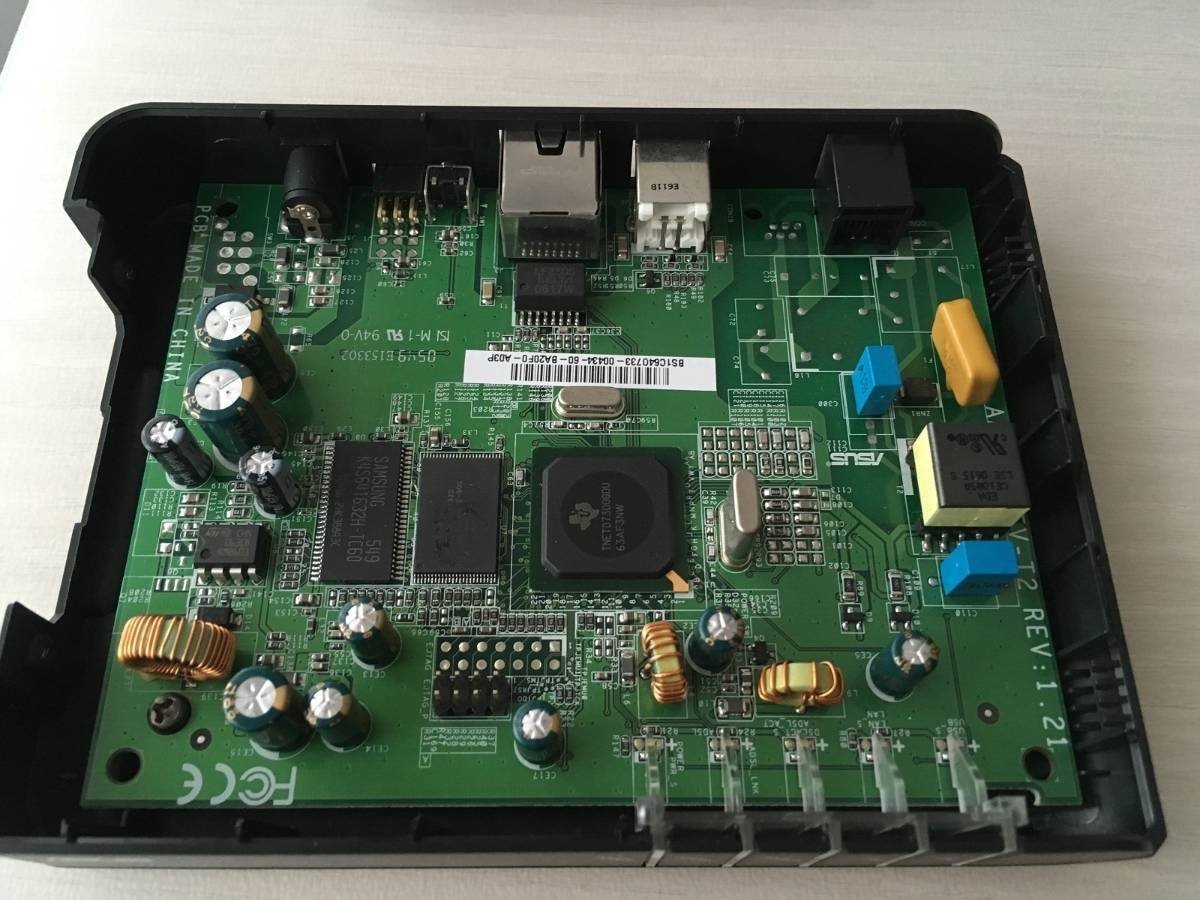
image


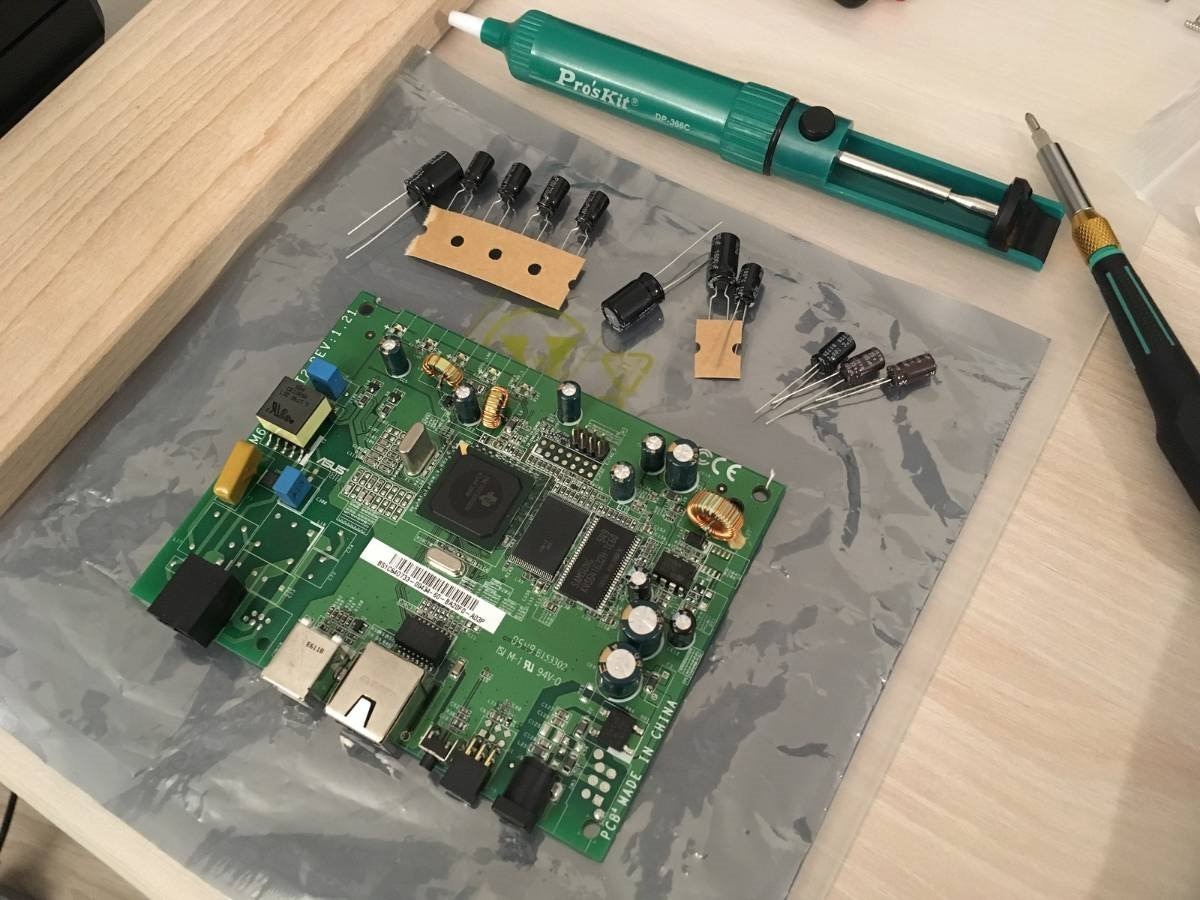
All capacitors were made by Teapo and were of SC series (low impedance, high ripple) and SY series (low impedance, long life series).The most inflated were the SC ones, used near a switching power supply, I guess.


Here is the complete list:

2x 470uF 35V 105C LI HR 10 * 20 mm

2x 100uF 35V 105C LL LI 8 * 11 mm

1x 1500uF 6.3V 105C LI HR 8 * 15 mm

4x 220uF 10V 105C LI HR 6,3 * 11 mm

1x 100uF 25V 105C LI HR 6,3 * 11 mm


LL = long life (6000 h)

LI = LOW impedance

HR = high ripple series


As you might notice, I wrote down everything I could see on the capacitors and also measured them physically.


Lesson nr. 1: Datasheets sometimes contain errors.

I just wanted to make sure I identified the capacitors correctly so I double checked some values with the datasheet. Surprise, two capacitor types have different physical values compared to the datasheet. Ordering a higher capacitor could result in a problem - it might not have been possible to close the box.

10 * 20 mm according to datasheet was in reality 10 * 15 mm.

8 * 11 mm according to datasheet was in reality 6,3 * 11 mm.


Lesson nr. 2: Catalogs of component distributors sometimes contain errors.

I love the possibility to filter products. There are 150 000 different capacitors. 2 000 with the same capacity, 50 with the same voltage and temperature, 10 with the same impedance and  5 with the same size etc.

BUT, the same errors as in the datasheets might happen. I completely understand it - no one (hopefully) adds and checks every single item manually. Instead, thousands of items are imported at once.

So I checked every single datasheet to check with the product parameters in e-shop.


Lesson nr. 3: Quality components cost more

I don't like people around me talking about how they bought something great for so low on some Chinese web market. The joy usually lasts the same period as the worst quality electronic component in it.

I am also sad that local electronic component stores (in my country) only offer cheap electrolytic capacitors, LEDs, IOs, because only a few people would probably buy better ones.

Quality components just cost 2-100x more than no name ones. It has reasons image


image


Lesson nr. 3: It is very hard to desolder the old capacitors

Industrially soldered products have only a little solder in the joints compared to joints made by amateurs. I couldn't even suck the solder from joints, so I had to pull all the capacitors legs one by one. Desoldering 2 legs at once was hard.


Lesson nr. 4: It is even harder to solder new capacitors back

I tried 3 soldering irons (1 temperature controlled SL30-CMC and two not), ruined a soldering tip and got angry. The solder doesn't want to attach to the original joints. This creates lots of awful joints. The longer time is spent trying to heat the solder and fix the situation, the more is the solder and the whole joint burnt.
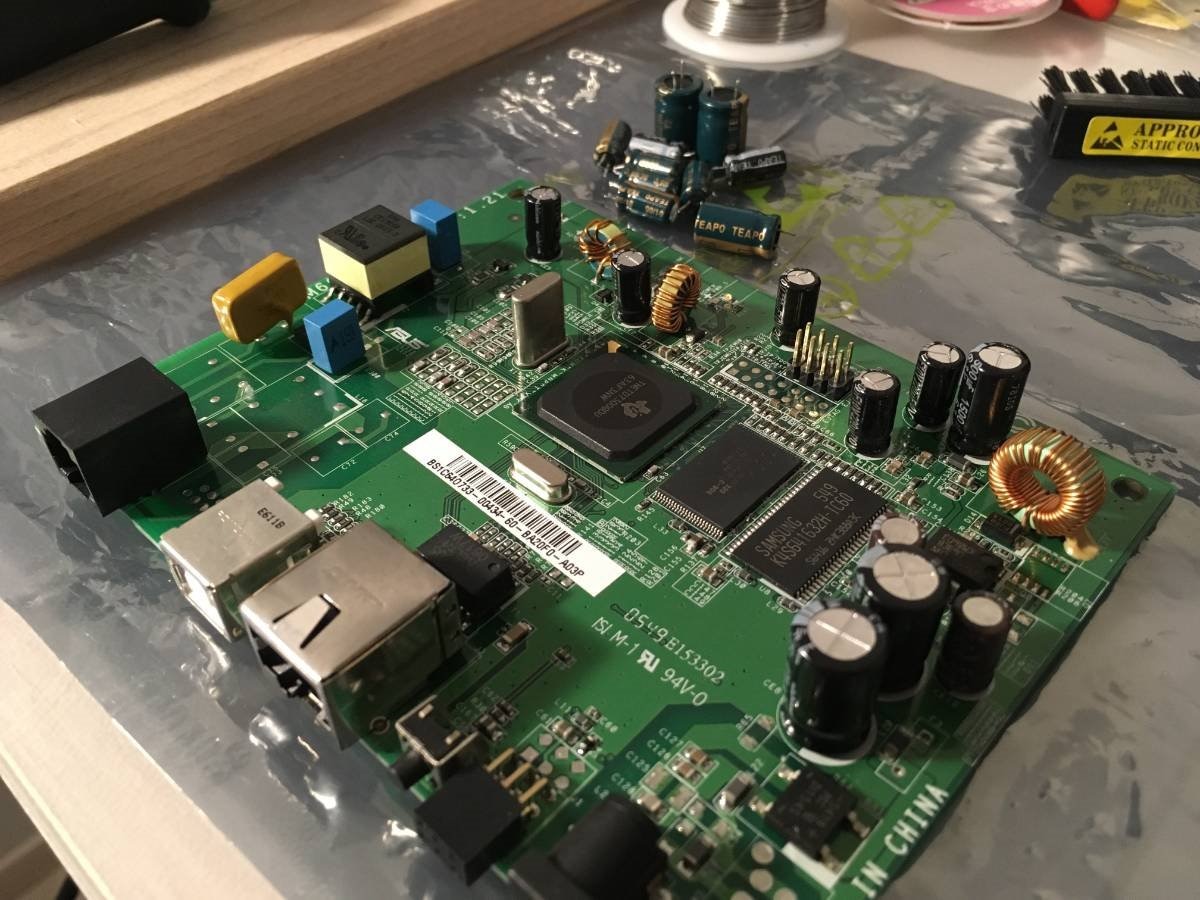
 

image


I guess you will easily spot the original and new joints:
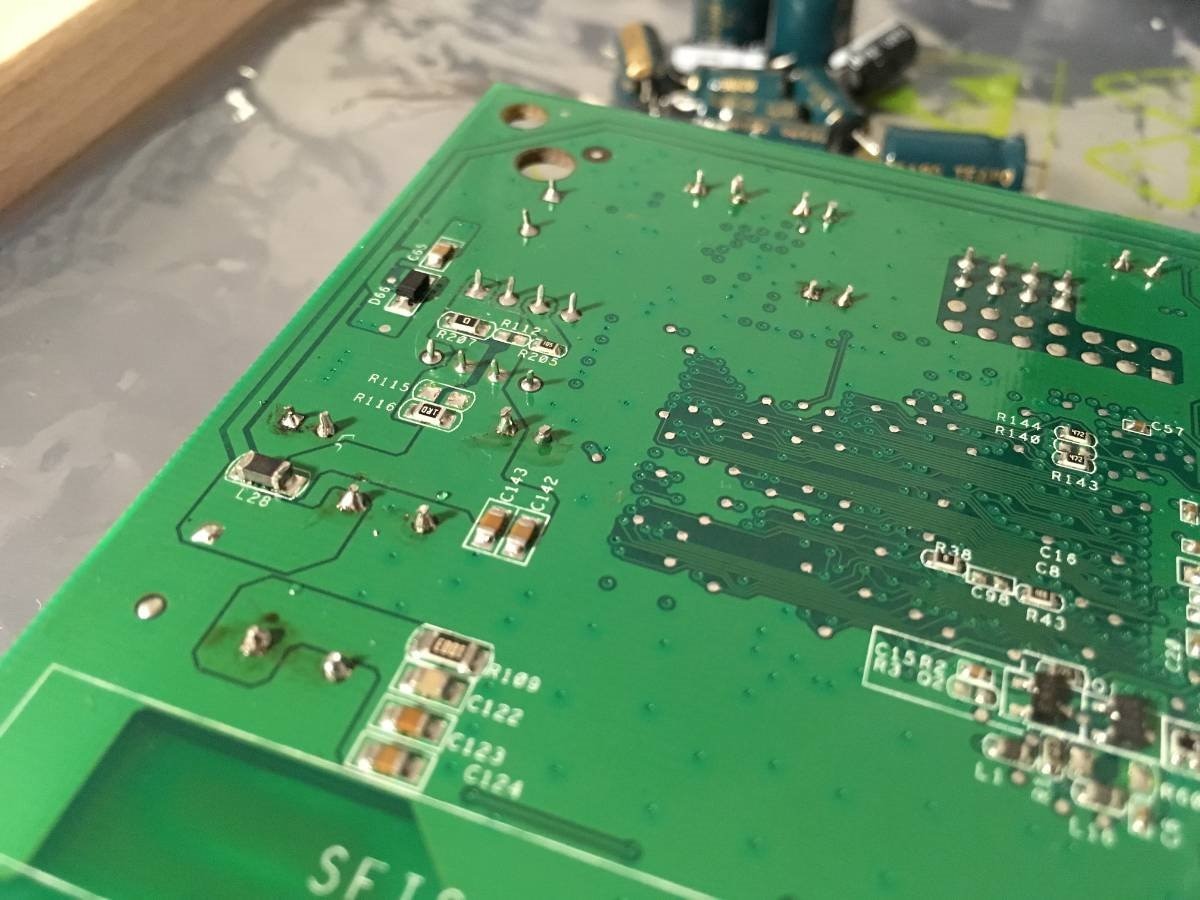
image


Lesson nr.5: It wasn't only the capacitors.

After assembling everything back together and powering the modem, I found out that the behavior is similar. It seems that something has improved, the web configuration can be accessed, but stops responding after a while.


So this repair is "mission: failed".


Do you have any tips for repairing commercial products and replacing components? Do you use any special equipment? Or are just my hands clumsy?

I would be grateful for your comments.


Thank you,

David

  • Sign in to reply

Top Comments

  • jw0752
    jw0752 over 8 years ago +3
    Hi David, Thanks for sharing your attempted fix. I often learn much more from my failures than I do from the successes. I have a trick that I use some times to remove capacitors or other two legged vermin…
  • mcb1
    mcb1 over 8 years ago +3
    It has a console port available, and you may be able to connect a serial terminal session to it. It may have lost it's configuration, so have a hunt around about reflashing the firmware. You have nothing…
  • mcb1
    mcb1 over 8 years ago in reply to koudelad +3
    Most of these are flow soldered and using lead free solder. Best idea is add more solder, then try the sucking. The black is usually burnt flux, and will occur when it is overheated. edit .... You should…
Parents
  • mcb1
    mcb1 over 8 years ago

    It has a console port available, and you may be able to connect a serial terminal session to it.


    It may have lost it's configuration, so have a hunt around about reflashing the firmware.

    You have nothing to lose.


    Mark

    • Cancel
    • Vote Up +3 Vote Down
    • Sign in to reply
    • More
    • Cancel
  • koudelad
    koudelad over 8 years ago in reply to mcb1

    Good idea, Mark, probably the last thing to try (with my level of experience). I usually download and archive the latest available firmware for all devices, especially to those, that are not updated anymore.

    There were many problems in the era of portable MP3 players that somehow got corrupted their firmware after a few months of usage. Reflashing to get it back to work.

    • Cancel
    • Vote Up 0 Vote Down
    • Sign in to reply
    • More
    • Cancel
Comment
  • koudelad
    koudelad over 8 years ago in reply to mcb1

    Good idea, Mark, probably the last thing to try (with my level of experience). I usually download and archive the latest available firmware for all devices, especially to those, that are not updated anymore.

    There were many problems in the era of portable MP3 players that somehow got corrupted their firmware after a few months of usage. Reflashing to get it back to work.

    • Cancel
    • Vote Up 0 Vote Down
    • Sign in to reply
    • More
    • Cancel
Children
No Data
element14 Community

element14 is the first online community specifically for engineers. Connect with your peers and get expert answers to your questions.

  • Members
  • Learn
  • Technologies
  • Challenges & Projects
  • Products
  • Store
  • About Us
  • Feedback & Support
  • FAQs
  • Terms of Use
  • Privacy Policy
  • Legal and Copyright Notices
  • Sitemap
  • Cookies

An Avnet Company © 2026 Premier Farnell Limited. All Rights Reserved.

Premier Farnell Ltd, registered in England and Wales (no 00876412), registered office: Farnell House, Forge Lane, Leeds LS12 2NE.

ICP 备案号 10220084.

Follow element14

  • X
  • Facebook
  • linkedin
  • YouTube