element14 Community
element14 Community
    Register Log In
  • Site
  • Search
  • Log In Register
  • Community Hub
    Community Hub
    • What's New on element14
    • Feedback and Support
    • Benefits of Membership
    • Personal Blogs
    • Members Area
    • Achievement Levels
  • Learn
    Learn
    • Ask an Expert
    • eBooks
    • element14 presents
    • Learning Center
    • Tech Spotlight
    • STEM Academy
    • Webinars, Training and Events
    • Learning Groups
  • Technologies
    Technologies
    • 3D Printing
    • FPGA
    • Industrial Automation
    • Internet of Things
    • Power & Energy
    • Sensors
    • Technology Groups
  • Challenges & Projects
    Challenges & Projects
    • Design Challenges
    • element14 presents Projects
    • Project14
    • Arduino Projects
    • Raspberry Pi Projects
    • Project Groups
  • Products
    Products
    • Arduino
    • Avnet & Tria Boards Community
    • Dev Tools
    • Manufacturers
    • Multicomp Pro
    • Product Groups
    • Raspberry Pi
    • RoadTests & Reviews
  • About Us
  • Store
    Store
    • Visit Your Store
    • Choose another store...
      • Europe
      •  Austria (German)
      •  Belgium (Dutch, French)
      •  Bulgaria (Bulgarian)
      •  Czech Republic (Czech)
      •  Denmark (Danish)
      •  Estonia (Estonian)
      •  Finland (Finnish)
      •  France (French)
      •  Germany (German)
      •  Hungary (Hungarian)
      •  Ireland
      •  Israel
      •  Italy (Italian)
      •  Latvia (Latvian)
      •  
      •  Lithuania (Lithuanian)
      •  Netherlands (Dutch)
      •  Norway (Norwegian)
      •  Poland (Polish)
      •  Portugal (Portuguese)
      •  Romania (Romanian)
      •  Russia (Russian)
      •  Slovakia (Slovak)
      •  Slovenia (Slovenian)
      •  Spain (Spanish)
      •  Sweden (Swedish)
      •  Switzerland(German, French)
      •  Turkey (Turkish)
      •  United Kingdom
      • Asia Pacific
      •  Australia
      •  China
      •  Hong Kong
      •  India
      • Japan
      •  Korea (Korean)
      •  Malaysia
      •  New Zealand
      •  Philippines
      •  Singapore
      •  Taiwan
      •  Thailand (Thai)
      • Vietnam
      • Americas
      •  Brazil (Portuguese)
      •  Canada
      •  Mexico (Spanish)
      •  United States
      Can't find the country/region you're looking for? Visit our export site or find a local distributor.
  • Translate
  • Profile
  • Settings
Personal Blogs
  • Community Hub
  • More
Personal Blogs
Legacy Personal Blogs Hercules LaunchPad and GaN FETs - Side Note B: Look at the PCB
  • Blog
  • Documents
  • Mentions
  • Sub-Groups
  • Tags
  • More
  • Cancel
  • New
  • Share
  • More
  • Cancel
Group Actions
  • Group RSS
  • More
  • Cancel
Engagement
  • Author Author: Jan Cumps
  • Date Created: 6 Dec 2016 8:12 PM Date Created
  • Views 6005 views
  • Likes 7 likes
  • Comments 29 comments
  • kicad
  • seeed
  • pcb_layout
  • texas_instruments
  • gan
Related
Recommended

Hercules LaunchPad and GaN FETs - Side Note B: Look at the PCB

Jan Cumps
Jan Cumps
6 Dec 2016

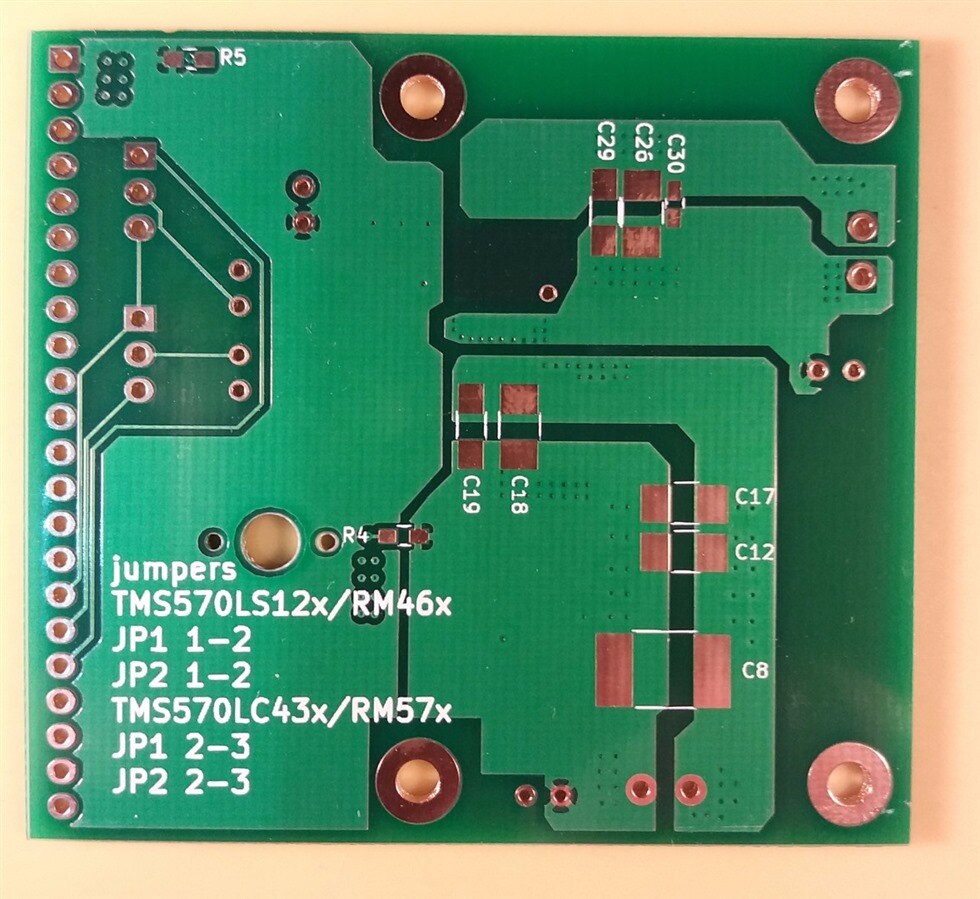
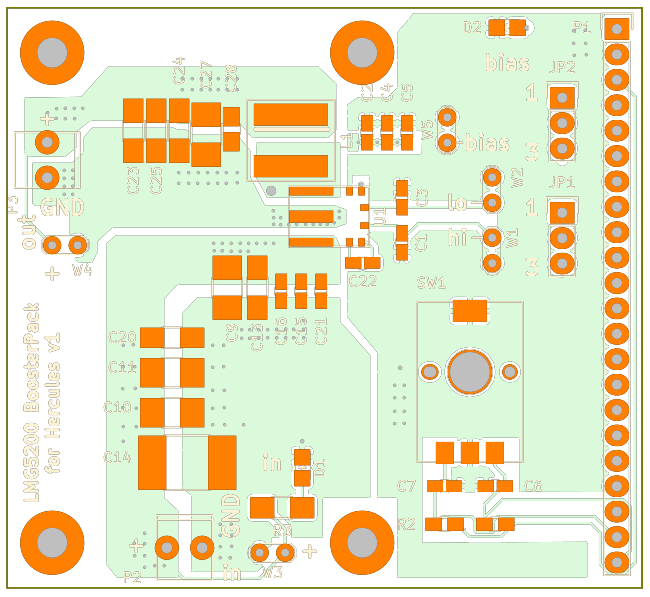
I'm designing a BoosterPack to evaluate GaN devices with the help of a microcontroller.

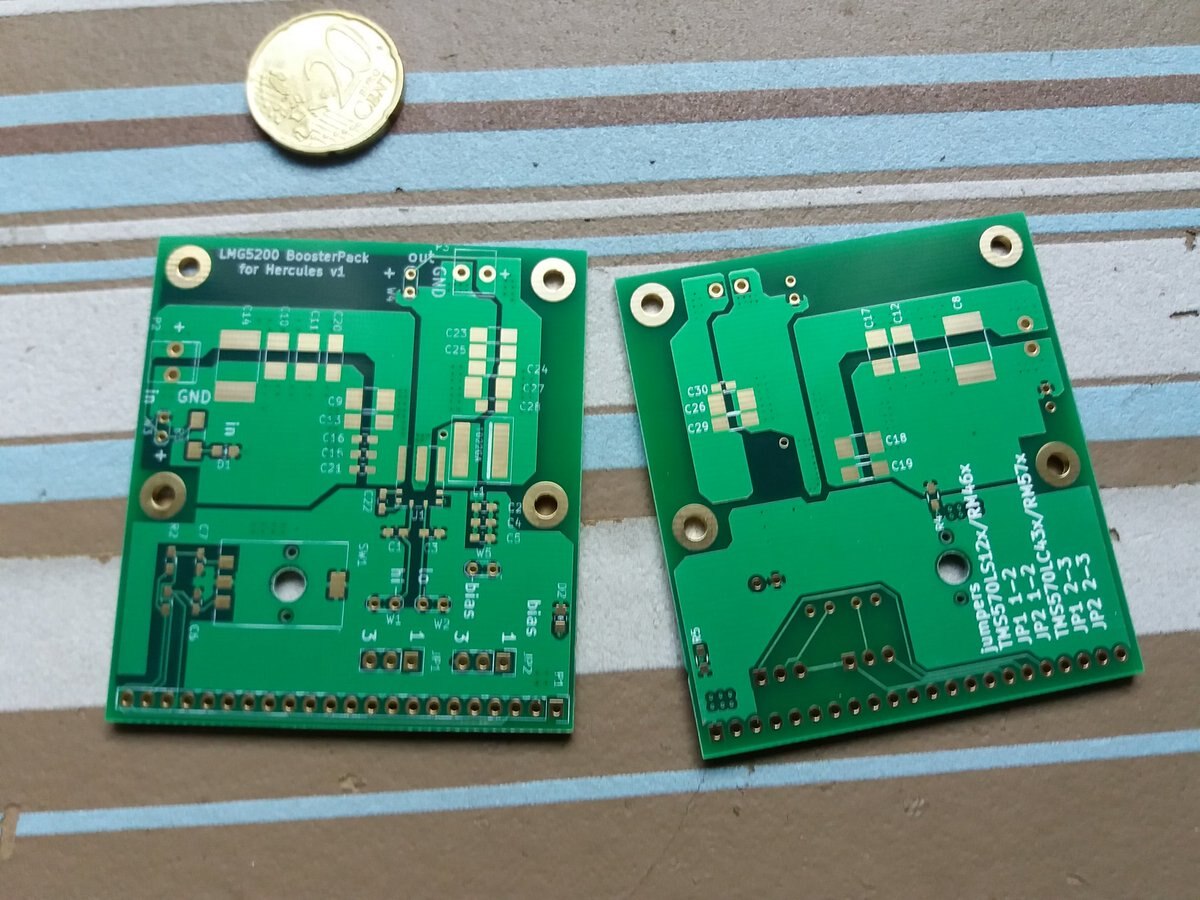
I've received PCBs from Seeed. Let's have a look ...

image


This is my first Seeed order (a kind element14 community member gave me a rebate coupon that I happily used).

Board specifications:


  • PCB Dimension - 10cm Max*10cm Max
  • Layer - 4
  • PCB Thickness - 1.6mm
  • PCB Qty. - 5
  • PCB Color - Green
  • Surface Finish - ENIG
  • Copper Weight - 1oz.
  • Panelized PCBs - 1
  • Expedited Option - NO


The price without shipment for this board is 65.12€. Shipping was 7.37€. The coupon got me 9.15€ off ($ 10). Totals to 63.97€

image

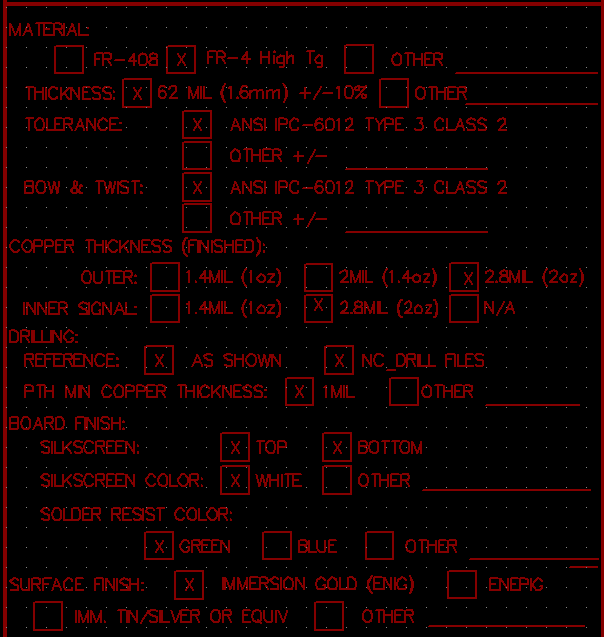
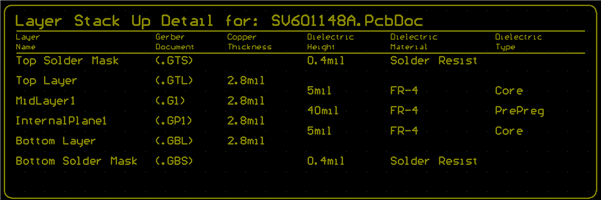
This design requires 2oZ copper layers. My budget can't carry the cost of such a board - so I will not be able to draw full current out of my design.

This is a compromise, one of the many I had to make. I tried to avoid compromises in the design, but did make them when ordering.

Getting a board that has enough copper on it will not require a design change. It's just ticking a different option when ordering and coughing up the monies.

I'd rather do that after I validated that I didn't make mistakes in the PCB layout.
image

image

Just like previous designs I did with OSHPark, the Seeed boards look very good at first inspection.

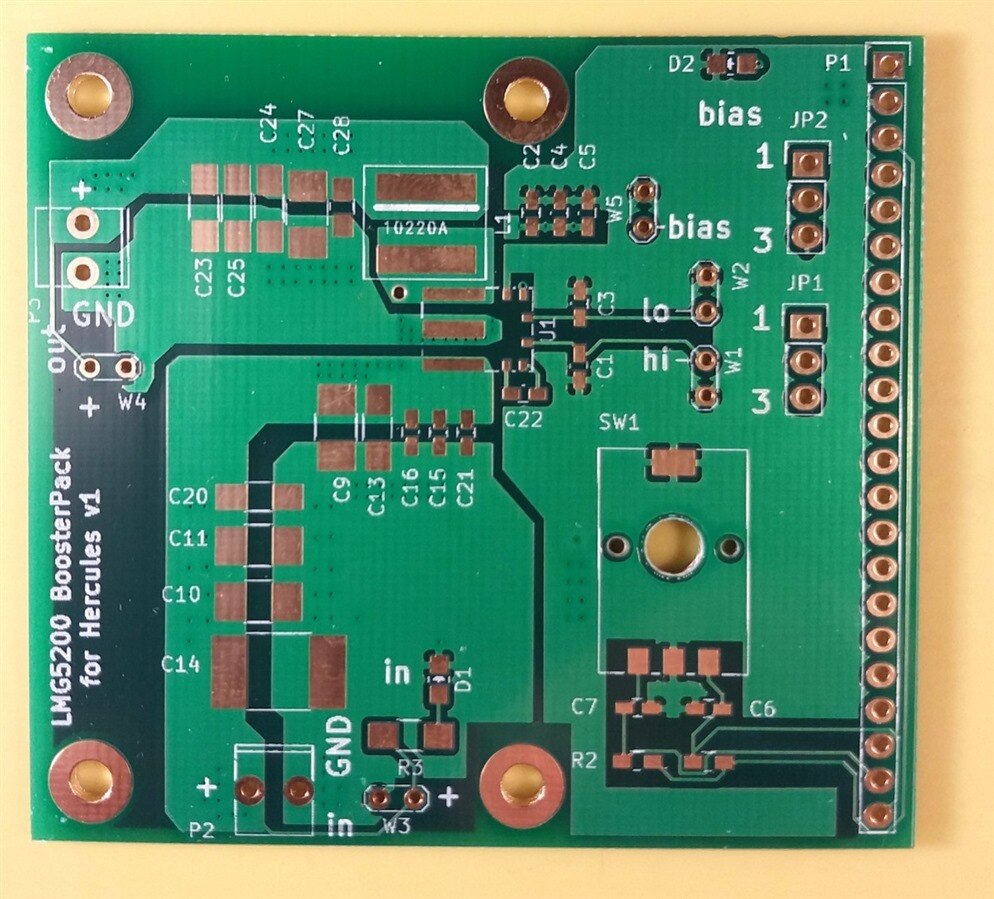
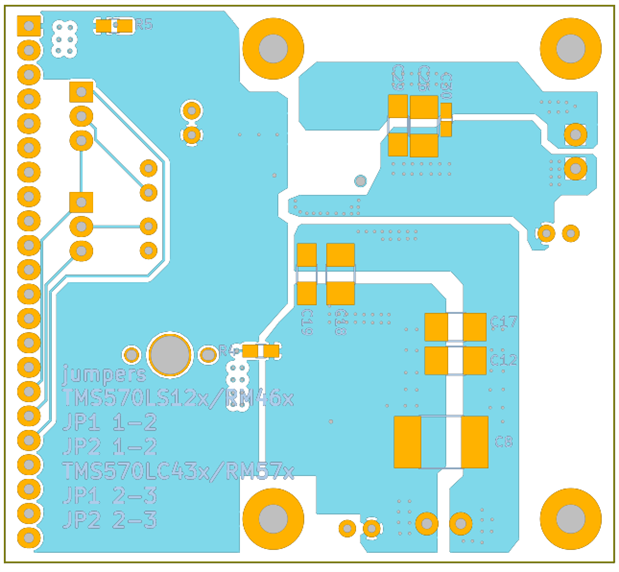
This design is 4 layers, so I have no mechanism to look at the two inner layers. The top and bottom layer look very nice, so that's a good sign.


In the images below, the artist renditions on the left side are generated by the Seeed portal.

The photos on the right side are the actual thing. Click on them to get a detailed view.
 

imageimage
imageimage


Populate Order

This is the first time I'll populate a two-sided board. I'll use hot air for the smd components.This is how I plan to approach it:

  1. solder the GaN IC and the inductor. These two have the pins under the device. I'll have to massively bombard them with heat to transfer the energy underneath where the solder paste is.
    I'll use the pre-heater that shabaz gave  me to get the whole board to a close-to-reflow temperature.
  2. then all the smd components on the bottom side. If they fll of later, that's not a big deal, because the are only few.
    I'll also use the pre-heater but on lower temperature, because its heat will be radiating on the inductor and GaN chip.
  3. Then I'll do the remaining top smd components.
    The pre-heater again on a temperature low enough to not desolder the bottom components.
  4. the trough-hole components by hand


It is my first time. I'd be happy to take your advice on the preferred order to solder the components.

The tools I have at hand:

  • hot air
  • soldering iron
  • pre-heater


You don't have permission to edit metadata of this video.
Edit media
x
image
Upload Preview
image


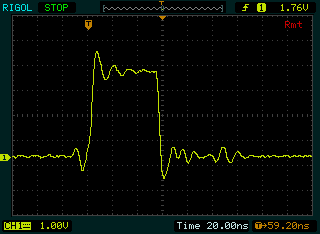
edit: I've attached the waveform of one High input pulse as hi01.wfm.

If you have a Rigol DS1052E you can upload that to your scope and examine the ringing with cursors.
image


Related Blogs
Hercules LaunchPad and GaN FETs - Part 1: Control Big Power with a Flimsy Mouse Scroll Wheel
Hercules LaunchPad and GaN FETs - Part 2: Make a BoosterPack
Hercules LaunchPad and GaN FETs - Part 3a: BoosterPack Layout - Reference Design
Hercules LaunchPad and GaN FETs - Part 3b: BoosterPack Layout - my version
Hercules LaunchPad and GaN FETs - Side Note A: BoosterPack Layout - Custom KiCad Parts
Hercules LaunchPad and GaN FETs - Side Note B: Look at the PCB
Rotary Encoders - Part 1: Electronics
Checking Out GaN Half-Bridge Power Stage: Texas Instruments LMG5200 - Part 1: Preview
Rotary Encoders - Part 4: Capturing Input on a Texas Instruments Hercules LaunchPad with eQEP
Vintage Turntable repair: Can I fix a Perpetuum Ebner from 1958 - part 4 - Hercules LaunchPad Enhanced PWM try-out
Attachments:
hi01.zip
  • Sign in to reply

Top Comments

  • michaelkellett
    michaelkellett over 9 years ago in reply to Jan Cumps +2
    Hello Jan, I do similar parts by placing the board directly onto a hotplate. I never feel sure just how hot I'm getting things if I use a hot air blower. I do use leaded solder for the lower melting point…
  • Jan Cumps
    Jan Cumps over 9 years ago +1
    The two difficult components are soldered. I've measured for solder bridges, all OK...
  • michaelkellett
    michaelkellett over 9 years ago in reply to Jan Cumps +1
    I use hotplate for four and two layer boards - not had a board problem yet. It's a cheap Chinese hotplate but the temperature regulation isn't bad. MK
Parents
  • Jan Cumps
    Jan Cumps over 9 years ago

    The board is built up, not tested yet.

    Reflow worked ok, except for 0402 and some 0603s.

    C22(0402) toombstoned, I had to rework C15, C21 and LED D2 too.

    I'm happy that the (somewhat) complex footprint of quadrature encoder - with one oval and two round mounting holes fitted perfectly.


    The two screw terminals however, P2 and P3, are a complete goof-up. The holes are too small, the distance between them is wrong and the total size of the footprints doesn't match the component.

    I have to check how that happened, because I made this footprint myself from the data sheet. (wrong part ordered or delivered, wrong drawing selected in the sheet, inch/cm switch, I don't know yet)


    image


    image

    • Cancel
    • Vote Up +1 Vote Down
    • Sign in to reply
    • More
    • Cancel
  • Jan Cumps
    Jan Cumps over 8 years ago in reply to Jan Cumps

    Two steps forward one step back at the moment.

    When I apply bias voltage to the GaN device, power supply goes trough its knees. Even if this is supposed to be a 3mA maximum. The led indicator in parallel is taking more current normally than the whole bias part.

    The LMG5200 is getting real hot too.

    I first used a DMM to check if there are shorts (I did that just after mounting the GaN and inductor too). No.


    So I have now desoldered the GaN device and will check all of the signals going there. I may have damaged the device.

    Hope not. Because I only have once IC left and they aren't cheap.


    image


    On the other side, this is a chance to go and probe the circuit without fear of damaging the GaN device...

    • Cancel
    • Vote Up 0 Vote Down
    • Sign in to reply
    • More
    • Cancel
Comment
  • Jan Cumps
    Jan Cumps over 8 years ago in reply to Jan Cumps

    Two steps forward one step back at the moment.

    When I apply bias voltage to the GaN device, power supply goes trough its knees. Even if this is supposed to be a 3mA maximum. The led indicator in parallel is taking more current normally than the whole bias part.

    The LMG5200 is getting real hot too.

    I first used a DMM to check if there are shorts (I did that just after mounting the GaN and inductor too). No.


    So I have now desoldered the GaN device and will check all of the signals going there. I may have damaged the device.

    Hope not. Because I only have once IC left and they aren't cheap.


    image


    On the other side, this is a chance to go and probe the circuit without fear of damaging the GaN device...

    • Cancel
    • Vote Up 0 Vote Down
    • Sign in to reply
    • More
    • Cancel
Children
  • Jan Cumps
    Jan Cumps over 8 years ago in reply to Jan Cumps

    All 'soft' signals are ok.

    pulse generation works, bias stable, quadrature encoder is fine.


    image


    Now over to the power part - just a few caps and an inductor.

    I don't have an L-meter, DC resistance similar to an unused identical coil.

    • Cancel
    • Vote Up 0 Vote Down
    • Sign in to reply
    • More
    • Cancel
  • Jan Cumps
    Jan Cumps over 8 years ago in reply to Jan Cumps

    Some things work image


    image

    • Cancel
    • Vote Up 0 Vote Down
    • Sign in to reply
    • More
    • Cancel
  • Jan Cumps
    Jan Cumps over 8 years ago in reply to Jan Cumps

    High-res probing photo:

    image


    especially for DAB, I've taken care to probe with signal integrity in mind.

    The absence of patch wires -  and using ground springs in stead of probe crocodile clips - does the job.

    I've made all test points on my board in a way that allows ground clip probing.


    image


    Focus on ringing. It's acceptable, I think.

    Rising edge of channel 1:

    image

    Falling edge of channel 1:

    image

    • Cancel
    • Vote Up 0 Vote Down
    • Sign in to reply
    • More
    • Cancel
  • jc2048
    jc2048 over 8 years ago in reply to Jan Cumps

    This is good. Real-time blogging.


    "Focus on ringing. It's acceptable, I think."


    With respect, I might disagree.  Unless you have a scope with a high bandwidth and an active probe with very low capacitance, ringing is always worse than you see on the screen.


    You have 3 cycles of ringing in 30nS, so that's 100MHz. You're using a 50MHz scope (if memory serves me right). So the scope is 3dB down even at the 50MHz - maybe, it depends what they think they mean by a 50MHz bandwidth, what the sampling rate is, and what the reconstruction software does - how much down is it at 100MHz?


    You're using ordinary probes with 12pF or 15pF load capacitance. That will damp the ringing a little. To judge the effect, look at the signal with one probe, add the second probe, and see what difference it makes.

    Question is, do the peaks get anywhere near the input switching voltage? Are they CMOS levels on the inputs or TTL? Hopefully they're CMOS. (I can't look at the datasheet because I can't see one on the product page - maybe you have to register or something.)


    I'm not saying it isn't ok, just that you can't really say for sure.


    You could deal with it (if it were a problem) by terminating the line. Usually you'd go for a single series resistor at the sending end to absorb the return signal (with a single transmitter and a single receiver), but you probably wouldn't want to modify the processor board. In this case you could terminate at the end. If you put a capacitor in series with the termination resistor it cuts the dc dissipation. You'll be able to judge what the termination is doing because although the scope doesn't give you accurate  measurements it will show you the ringing declining (ie if the scope shows you've halved it, you've halved it even though you still don't know what the levels are). If you ac terminate then there's no reason you shouldn't do it to the supply if that's what the plane around the tracks is.


    EDIT: The capacitance at the probe tip isn't "12pF or 15pF" for a x10 probe, it's less than that. That figure is the input to the scope.

    • Cancel
    • Vote Up +1 Vote Down
    • Sign in to reply
    • More
    • Cancel
  • Jan Cumps
    Jan Cumps over 8 years ago in reply to jc2048

    Jon Clift wrote:


    ..."Focus on ringing. It's acceptable, I think."


    With respect, I might disagree. Unless you have a scope with a high bandwidth and an active probe with very low capacitance, ringing is always worse than you see on the screen.


    ....

    In comparison with my usual captures I mean image.

    This was my capture of the original board:

    image


    I was happy that DAB wasn't close by when I posted that. He'd have hit me with several big stones I think image


    Jon Clift wrote:


    Question is, do the peaks get anywhere near the input switching voltage? Are they CMOS levels on the inputs or TTL? Hopefully they're CMOS. (I can't look at the datasheet because I can't see one on the product page - maybe you have to register or something.)


    The datasheet is available as PDF only. No web version for this product:

    http://www.ti.com/lit/gpn/lmg5200

    We're looking at the signals that will go into LI and HI input.

    image

    image


    Next time e14 runs a high frequency oscilloscope road test, I *must* be selected.


    edit: the LMG5200 isn't currenly populated on the board. The signals are open-ended during the measurements today.

    • Cancel
    • Vote Up +1 Vote Down
    • Sign in to reply
    • More
    • Cancel
element14 Community

element14 is the first online community specifically for engineers. Connect with your peers and get expert answers to your questions.

  • Members
  • Learn
  • Technologies
  • Challenges & Projects
  • Products
  • Store
  • About Us
  • Feedback & Support
  • FAQs
  • Terms of Use
  • Privacy Policy
  • Legal and Copyright Notices
  • Sitemap
  • Cookies

An Avnet Company © 2025 Premier Farnell Limited. All Rights Reserved.

Premier Farnell Ltd, registered in England and Wales (no 00876412), registered office: Farnell House, Forge Lane, Leeds LS12 2NE.

ICP 备案号 10220084.

Follow element14

  • X
  • Facebook
  • linkedin
  • YouTube