element14 Community
element14 Community
    Register Log In
  • Site
  • Search
  • Log In Register
  • Community Hub
    Community Hub
    • What's New on element14
    • Feedback and Support
    • Benefits of Membership
    • Personal Blogs
    • Members Area
    • Achievement Levels
  • Learn
    Learn
    • Ask an Expert
    • eBooks
    • element14 presents
    • Learning Center
    • Tech Spotlight
    • STEM Academy
    • Webinars, Training and Events
    • Learning Groups
  • Technologies
    Technologies
    • 3D Printing
    • FPGA
    • Industrial Automation
    • Internet of Things
    • Power & Energy
    • Sensors
    • Technology Groups
  • Challenges & Projects
    Challenges & Projects
    • Design Challenges
    • element14 presents Projects
    • Project14
    • Arduino Projects
    • Raspberry Pi Projects
    • Project Groups
  • Products
    Products
    • Arduino
    • Avnet & Tria Boards Community
    • Dev Tools
    • Manufacturers
    • Multicomp Pro
    • Product Groups
    • Raspberry Pi
    • RoadTests & Reviews
  • About Us
  • Store
    Store
    • Visit Your Store
    • Choose another store...
      • Europe
      •  Austria (German)
      •  Belgium (Dutch, French)
      •  Bulgaria (Bulgarian)
      •  Czech Republic (Czech)
      •  Denmark (Danish)
      •  Estonia (Estonian)
      •  Finland (Finnish)
      •  France (French)
      •  Germany (German)
      •  Hungary (Hungarian)
      •  Ireland
      •  Israel
      •  Italy (Italian)
      •  Latvia (Latvian)
      •  
      •  Lithuania (Lithuanian)
      •  Netherlands (Dutch)
      •  Norway (Norwegian)
      •  Poland (Polish)
      •  Portugal (Portuguese)
      •  Romania (Romanian)
      •  Russia (Russian)
      •  Slovakia (Slovak)
      •  Slovenia (Slovenian)
      •  Spain (Spanish)
      •  Sweden (Swedish)
      •  Switzerland(German, French)
      •  Turkey (Turkish)
      •  United Kingdom
      • Asia Pacific
      •  Australia
      •  China
      •  Hong Kong
      •  India
      • Japan
      •  Korea (Korean)
      •  Malaysia
      •  New Zealand
      •  Philippines
      •  Singapore
      •  Taiwan
      •  Thailand (Thai)
      • Vietnam
      • Americas
      •  Brazil (Portuguese)
      •  Canada
      •  Mexico (Spanish)
      •  United States
      Can't find the country/region you're looking for? Visit our export site or find a local distributor.
  • Translate
  • Profile
  • Settings
Personal Blogs
  • Community Hub
  • More
Personal Blogs
Legacy Personal Blogs MSP432 Power Modes: real time current measurement - µCurrent vs. EnergyTrace
  • Blog
  • Documents
  • Mentions
  • Sub-Groups
  • Tags
  • More
  • Cancel
  • New
  • Share
  • More
  • Cancel
Group Actions
  • Group RSS
  • More
  • Cancel
Engagement
  • Author Author: Jan Cumps
  • Date Created: 25 Apr 2016 7:51 PM Date Created
  • Views 1219 views
  • Likes 6 likes
  • Comments 5 comments
  • msp432_launchpad
  • code composer studio
  • energytrace
  • msp432
  • texas instruments
  • launchpad
Related
Recommended

MSP432 Power Modes: real time current measurement - µCurrent vs. EnergyTrace

Jan Cumps
Jan Cumps
25 Apr 2016

The MSP432 controller is a low power ARM Cortex M4.

TI Marketing Dept. say: low power, high performance.

I'm not looking for high performance. Low power is what I'm after at the moment.

Rather than just believing the hype, I'd better measure power myself.

So here I go, measuring the power consumption with a µCurrent and with EnergyTrace. And I'm comparing the values.


Spoiler warning: measured values match close to the reported ones.

image


What is EnergyTrace?


The first time I saw an energy trace plugin was when I road-tested the Zero Gecko.
I'm impressed by the possibility to see on-screen how much calories the controller is burning.

Most of the Geckos are able to show energy use per code function.
The Zero, lacking some of the required hardware to support that, didn't have this possibility.

That doesn't take anything away from the power of that tool. It's very useful to have insight in the power consumption of your design.

The Zero Gecko got high points from me on that RoadTest. This functionality was one of the reason for that (and also their great dev board and kick-ass IDE image ).


So when I came to know that the MSP432 LaunchPad also supports this - inside Code Composer Studio - and with breakdown per subroutine* - I got excited.

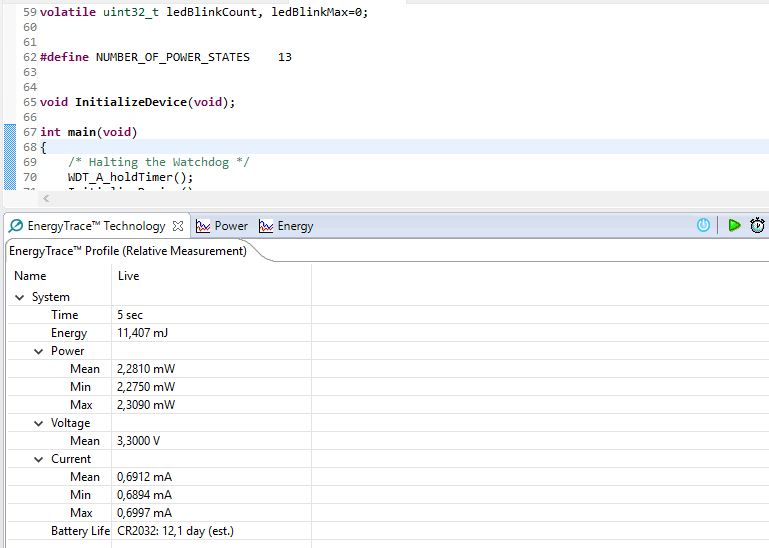
The CCS module is called EnergyTrace. It will sample the current that the MSP432 eats, and display it in some neat ways:

  • You can check how much time (or %) the processor spends in high and low power modes. You can trace watts consumed and energy spent.
  • You can give it a battery profile, and it'll show how your firmware's energy budget fits in the accu's capacities (see what I did there?).
  • And it will predict the battery life.
  • It can beak down your firmware, telling how much energy is burned in each funtion - based on runtime analysis.
image


The Testbed


I used the power mode example from the MSP430 Deep Dive tutorial as firmware.

You can load this MSPWare project from the CCS Resource Explorer (Menu: View -> Resource Explorer (examples)).

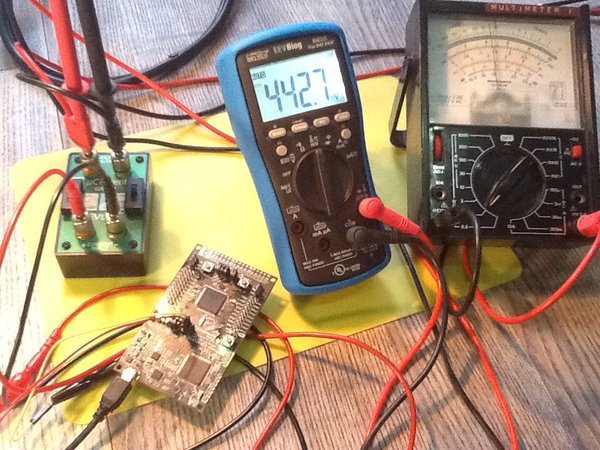
I wired a µCurrent in series with the 3.3 V supply to the controller - remove J3 and connect both pins to the current input of the µCurrent


image


The µCurrent is put in the 1 mV/µA range. The shunt resistor is 10Ω. The burden voltage never exceeded 8 mV. We can ignore that when the supply voltage is 3.3 V.

The firmware steps through a variety of power modes.

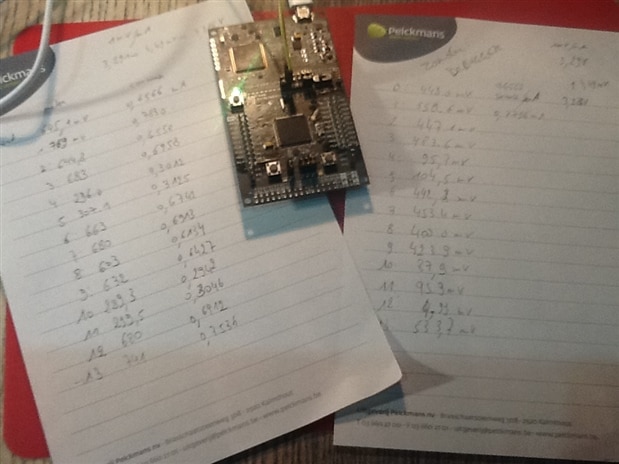
For each of the modes, I've written down the value measured on the µCurrent, and the mean value of 5 seconds sampling in EnergyTrace.
 

image


MSP430 profile without debugging


Let's start with a somewhat clean board.
When you run the MSP432 in debug mode, it automatically consumes more energy - current rises 200 µA (and power is constant at 3.3V).

My exercise here was not to make a profil of the MSP432, but I did it anyway image.

Here's the current consumption in the 14 different states of that Testbed, in µA:


µCurrent wo debugger
448
558,6
447,1
483,6
95,7
104,5
442,2
453,4
400
423,9
87,9
95,9
499
533,7


The table shows a mix of high and low power modes, some with clock slowed down. 88 µA (290 µW if you know that the supply is approx. 3.3V) was the lowest measurement.


This video is unavailable.
You don't have permission to edit metadata of this video.


Comparing EnergyTrace with Measured Values


Now let's see how the retrieved value compares with my measurements. These data points are taken with the debugger active.

You see that we draw 200 µA more current at each step.

But what we see in these samples is that the figures are close.

The EnergyTrace results are certainly good enough to investigate the controller's power profile in your design.

The values below are again in µA.


µCurrentEnergyTrace
645,1656,6
769783
644,8655
683695,8
296301,2
307,1312,5
663674,2
680691,3
603613,4
632642,7
289,3294,2
299,5304,6
680691,2
741753,6


This isn't bad, is it?  On a graph, you can see how close they are:

image


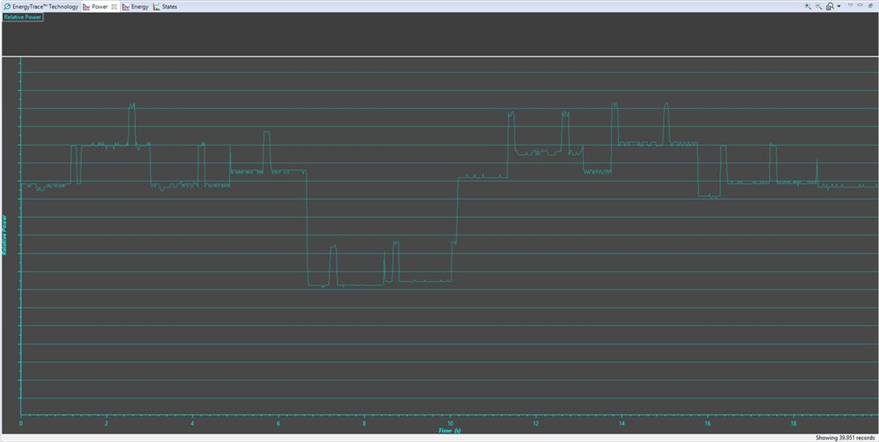
The EnergieTrace graph capture below is showing a multiple second sample exercise. Each peak is when I push the LaunchPad user button to switch to the next power mode.
image


*It's been a while since I used this word the last time - must be late 80's

  • Sign in to reply

Top Comments

  • shabaz
    shabaz over 9 years ago +1
    Hi Jan, Excellent post. Energytrace is great, isn't it : ) It is an extremely impressive feature with the TI development hardware - all software engineers effectively have accurate power measurement capability…
  • DAB
    DAB over 9 years ago +1
    Great post Jan. We tend to just take published specifications for granted, but it is nice to know that this device works as advertised. DAB
  • jw0752
    jw0752 over 9 years ago +1
    Hi Jan, Very nice presentation. It is always fun to run the empirical tests to see if the specification match. John
Parents
  • jw0752
    jw0752 over 9 years ago

    Hi Jan,

    Very nice presentation. It is always fun to run the empirical tests to see if the specification match.

    John

    • Cancel
    • Vote Up +1 Vote Down
    • Sign in to reply
    • More
    • Cancel
Comment
  • jw0752
    jw0752 over 9 years ago

    Hi Jan,

    Very nice presentation. It is always fun to run the empirical tests to see if the specification match.

    John

    • Cancel
    • Vote Up +1 Vote Down
    • Sign in to reply
    • More
    • Cancel
Children
No Data
element14 Community

element14 is the first online community specifically for engineers. Connect with your peers and get expert answers to your questions.

  • Members
  • Learn
  • Technologies
  • Challenges & Projects
  • Products
  • Store
  • About Us
  • Feedback & Support
  • FAQs
  • Terms of Use
  • Privacy Policy
  • Legal and Copyright Notices
  • Sitemap
  • Cookies

An Avnet Company © 2025 Premier Farnell Limited. All Rights Reserved.

Premier Farnell Ltd, registered in England and Wales (no 00876412), registered office: Farnell House, Forge Lane, Leeds LS12 2NE.

ICP 备案号 10220084.

Follow element14

  • X
  • Facebook
  • linkedin
  • YouTube