element14 Community
element14 Community
    Register Log In
  • Site
  • Search
  • Log In Register
  • Community Hub
    Community Hub
    • What's New on element14
    • Feedback and Support
    • Benefits of Membership
    • Personal Blogs
    • Members Area
    • Achievement Levels
  • Learn
    Learn
    • Ask an Expert
    • eBooks
    • element14 presents
    • Learning Center
    • Tech Spotlight
    • STEM Academy
    • Webinars, Training and Events
    • Learning Groups
  • Technologies
    Technologies
    • 3D Printing
    • FPGA
    • Industrial Automation
    • Internet of Things
    • Power & Energy
    • Sensors
    • Technology Groups
  • Challenges & Projects
    Challenges & Projects
    • Design Challenges
    • element14 presents Projects
    • Project14
    • Arduino Projects
    • Raspberry Pi Projects
    • Project Groups
  • Products
    Products
    • Arduino
    • Avnet & Tria Boards Community
    • Dev Tools
    • Manufacturers
    • Multicomp Pro
    • Product Groups
    • Raspberry Pi
    • RoadTests & Reviews
  • About Us
  • Store
    Store
    • Visit Your Store
    • Choose another store...
      • Europe
      •  Austria (German)
      •  Belgium (Dutch, French)
      •  Bulgaria (Bulgarian)
      •  Czech Republic (Czech)
      •  Denmark (Danish)
      •  Estonia (Estonian)
      •  Finland (Finnish)
      •  France (French)
      •  Germany (German)
      •  Hungary (Hungarian)
      •  Ireland
      •  Israel
      •  Italy (Italian)
      •  Latvia (Latvian)
      •  
      •  Lithuania (Lithuanian)
      •  Netherlands (Dutch)
      •  Norway (Norwegian)
      •  Poland (Polish)
      •  Portugal (Portuguese)
      •  Romania (Romanian)
      •  Russia (Russian)
      •  Slovakia (Slovak)
      •  Slovenia (Slovenian)
      •  Spain (Spanish)
      •  Sweden (Swedish)
      •  Switzerland(German, French)
      •  Turkey (Turkish)
      •  United Kingdom
      • Asia Pacific
      •  Australia
      •  China
      •  Hong Kong
      •  India
      • Japan
      •  Korea (Korean)
      •  Malaysia
      •  New Zealand
      •  Philippines
      •  Singapore
      •  Taiwan
      •  Thailand (Thai)
      • Vietnam
      • Americas
      •  Brazil (Portuguese)
      •  Canada
      •  Mexico (Spanish)
      •  United States
      Can't find the country/region you're looking for? Visit our export site or find a local distributor.
  • Translate
  • Profile
  • Settings
Personal Blogs
  • Community Hub
  • More
Personal Blogs
Legacy Personal Blogs My First Ever Crimping Experience
  • Blog
  • Documents
  • Mentions
  • Sub-Groups
  • Tags
  • More
  • Cancel
  • New
  • Share
  • More
  • Cancel
Group Actions
  • Group RSS
  • More
  • Cancel
Engagement
  • Author Author: dubbie
  • Date Created: 20 Nov 2020 2:54 PM Date Created
  • Views 5201 views
  • Likes 10 likes
  • Comments 34 comments
  • spade connections
  • crimping
Related
Recommended

My First Ever Crimping Experience

dubbie
dubbie
20 Nov 2020

For my Sand Based Cat Detector (Cat Detector Using Sand #2 : The Implementation ) I used a lead acid battery with spade connections. I have never properly used spade connections before (I usually use crocodile clips or solder directly) so I thought this would be a good time to start as I am working my way towards an outdoor mobile robot and robust and reliable connections are essential. Not really knowing much about making spade or crimping connections I decide that the best approach would be to buy some and just try it out. I have wanted to crimp for some time so rather than find out about it I just blundered in and bought something. I do not expect to do much crimping in the future so just looked online and bought the cheapest set I could find that seemed to do what I wanted.


You don't have permission to edit metadata of this video.
Edit media
x
image
Upload Preview
image


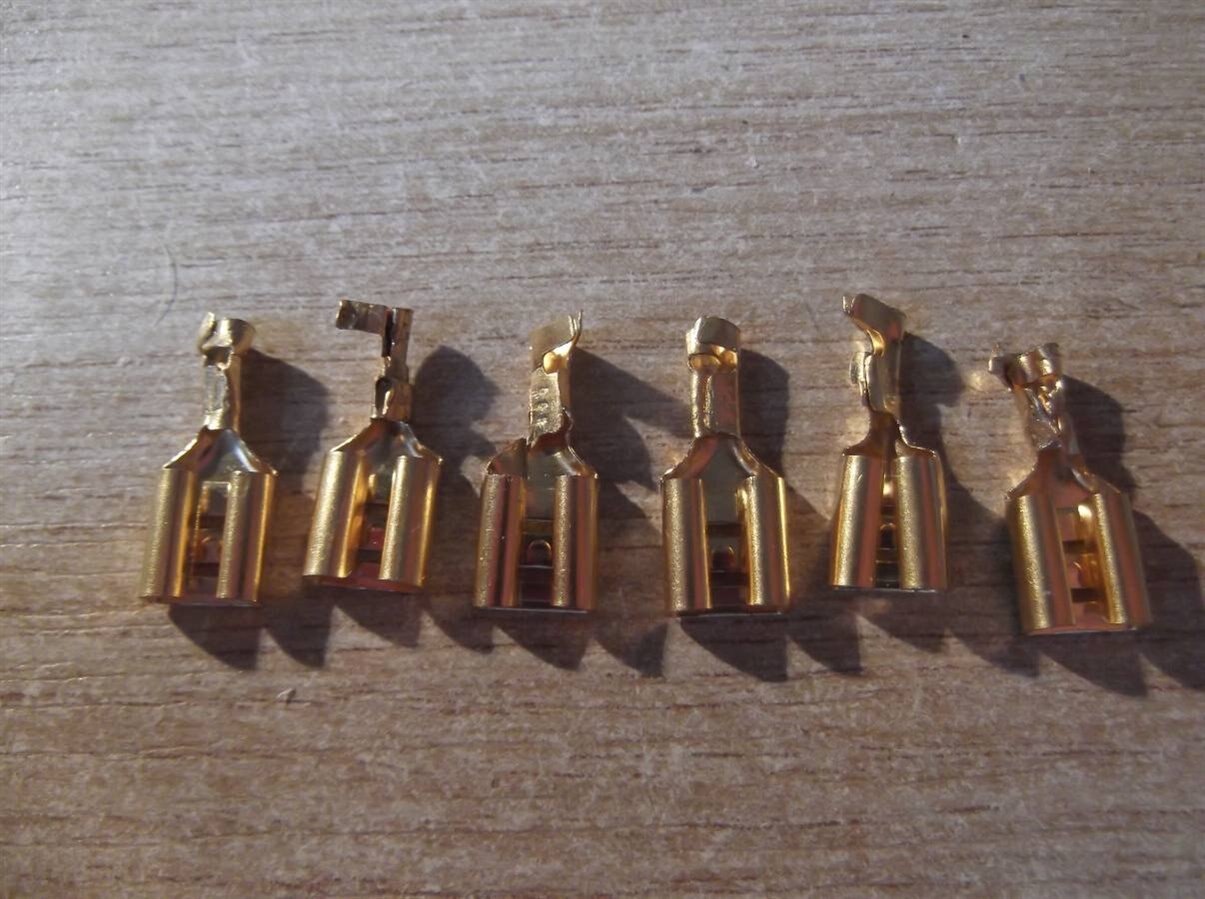
I used deep learning to update my natural neural networks in my head, basically I just stuck some wire inside the crimpets (or connectors) and tried to make good connections with the wire using the crimping tool. Initially there was little success as the tool I obtained did not come with any instructions what-so-ever. The crimpets would not stay on the wire while I attempted to use the crimping tool and several crimpets were harmed in this process.
 

image


It took me several attempts to work out that the tool I had purchased did not do any folding of the little tabs on the crimpets. Once I had worked this out and folded over the ;little tabs using some pin nosed pliers I was able to make some good crimped connections. I'm not sure if it uses cold-welding or just mechanical interference to make a good physical and electrical connection, but they seem to work, so all is good.


Dubbie

  • Sign in to reply

Top Comments

  • shabaz
    shabaz over 5 years ago in reply to ajcc +8
    Hi Adrian, Probably everyone has their own recommendations, I've been quite impressed with the Multicomp HT-xxx range, I have several of them, they are about $25 ballpark. The HT-230 crimp tool HT-230…
  • shabaz
    shabaz over 5 years ago +7
    Hi Dubbie, I do the same as Doug, i.e. add some solder (after crimping) if the specific crimp tool isn't suitable. However, I think maybe your tool might do both the bare wire crimping and the insulation…
  • dougw
    dougw over 5 years ago +5
    There is a lot of science behind good crimp connections. I suspect they rely on the wire bring more springy than the crimp terminal, so after a crimp there is always force on the joint Whenever I don't…
Parents
  • phoenixcomm
    phoenixcomm over 5 years ago

    dubbie 'good' crimpers can be very expensive. My old AMP crimps for DB-xx pins is just a pain in you know what. you have to have the terminal with wire and then crimp it. 50%  of the time if fails for one reason or another. and they used to cost 200+. Next comes my aircraft pin crimp. This is a never-fail crimper. This crimper works by squeezing the pin with 4 teeth. you need a body 300usd+ and then the turret which is for the pin itself, add another 100usd+ for each. by the time you are all through you could spend 500 - 1000 bucks. its made by DMC and you can find it sometimes on eBay. imageimage

    ~~Cris

    • Cancel
    • Vote Up +4 Vote Down
    • Sign in to reply
    • More
    • Cancel
  • shabaz
    shabaz over 5 years ago in reply to phoenixcomm

    Hi Cris,


    I was looking at identical crimpers last night : ) There's some used ones on ebay, and I wished to purchase one (actually two, but one is for an unusual scenario).

    I had a question: If no positioner is used, is it possible to eyeball it and still manage to crimp in approximately the correct depth? All the e-bay ones come with just a single positioner (if at all).

    Secondly, is that screw thing in your photo like an adjustable positioner? i.e. no need to use a fixed positioner if the adjustable one is good enough?

    In the end I did purchase one last night, a DMC one, but a non-standard model, which I'm hoping will work for extremely tiny (0.5mm or less) pins (for small coax connectors). It was a BT (British Telecom) variant, so I expect it was used for an unusual RF connector, but I'm hoping it will work for similar-ish sized normal coax connector pins.

    However, since I have not received it yet, I don't know if I can hack together a positioner, or use it without one, since the supplied one is designed for the specific BT pin, and it comes with no adjustable attachment (apart from the dial for the indentation travel).

    Since the tool is non-standard, it was only £15 used on ebay so I figured it's worth a try, and if I cannot position pins correctly then it's not a lot of money wasted.

    • Cancel
    • Vote Up +4 Vote Down
    • Sign in to reply
    • More
    • Cancel
  • phoenixcomm
    phoenixcomm over 5 years ago in reply to shabaz

    shabaz ouch, the DMC kit, are made for different pins, mine are mil-std so the positioner is required. as you have two things to worry about: pin dia., pin length, and required pressure to perform a good crimp.

    I have the AF8 with a turret.

    • Cancel
    • Vote Up +1 Vote Down
    • Sign in to reply
    • More
    • Cancel
  • shabaz
    shabaz over 5 years ago in reply to shabaz

    Good news, it looks like the cheap used custom-variant DMC tool can be handy for crimping the centre pins of small RF connectors.

    The particular tool is called 'DMC MH800' and it looks like it is made for a BT (British Telecom) specific connector. There appear to be dozens of these used MH800 tools on ebay, for £10 upward.

    I think the BT connector must have been SMA connector-sized or similar, and seems set up to approximately crimp well enough for ballpark RG316 centre conductor wire. However, the MH800 tool has the following issues:

    1. The positioner (which determines how far down the shaft of the pin to crimp at) is preset, and is not useful for anything other than the (unknown) BT connector

    2. The MH800 tool has no adjustment dial for crimp depth (how much the pin will be crimped), that part of this tool is blanked out with a sticker.


    The good thing is that the tool is very hackable. It was possible to disassemble it without any pieces flying off, all with a few Imperial hex keys. To resolve issue (1) it will be easy to make a custom positioner (either with some simple metal or plastic work, or could even be 3D printed).

    Issue (2) is a bit harder, but not insurmountable at all. I have an idea to find a circular piece of metal, and drill a hole slightly off-axis, and use a nut and bolt to make it act like a fixed cam almost. If that is done then it will work for pins even down to (say) approx 0.4mm outer diameter, at a guess. The normal adjustable DMC tool does a similar thing I think.. it has a dial control which is supposed to be lifted and rotated.


    I'll write up a blog post when I get it done (unlikely for at least a week or so) but in summary I think the tool will be useful for RF connectors of size SMA and smaller, once the two issues are resolved. The tool will not be useful for larger RF connectors, because of the shape of the four metal punches.. they are fairly pointy on this custom MH800 tool, and will just tear into larger pins (I tested with a BNC centre pin); I think it has to be for SMA or smaller connectors, RF or otherwise.

    • Cancel
    • Vote Up +1 Vote Down
    • Sign in to reply
    • More
    • Cancel
  • phoenixcomm
    phoenixcomm over 5 years ago in reply to shabaz

    shabaz Sounds cool. PLEASE POST PICTURES!!

    ~~~Cris

    As I dont want to rip apart my DMC AM8!!!

    • Cancel
    • Vote Up +1 Vote Down
    • Sign in to reply
    • More
    • Cancel
Comment
  • phoenixcomm
    phoenixcomm over 5 years ago in reply to shabaz

    shabaz Sounds cool. PLEASE POST PICTURES!!

    ~~~Cris

    As I dont want to rip apart my DMC AM8!!!

    • Cancel
    • Vote Up +1 Vote Down
    • Sign in to reply
    • More
    • Cancel
Children
  • shabaz
    shabaz over 5 years ago in reply to phoenixcomm

    Hi Cris,


    I'll take some photos today and share them : )

    • Cancel
    • Vote Up +1 Vote Down
    • Sign in to reply
    • More
    • Cancel
  • shabaz
    shabaz over 5 years ago in reply to phoenixcomm

    DMC tool teardown here! Daniels (DMC) Pin Crimping Tool Teardown

    • Cancel
    • Vote Up 0 Vote Down
    • Sign in to reply
    • More
    • Cancel
element14 Community

element14 is the first online community specifically for engineers. Connect with your peers and get expert answers to your questions.

  • Members
  • Learn
  • Technologies
  • Challenges & Projects
  • Products
  • Store
  • About Us
  • Feedback & Support
  • FAQs
  • Terms of Use
  • Privacy Policy
  • Legal and Copyright Notices
  • Sitemap
  • Cookies

An Avnet Company © 2026 Premier Farnell Limited. All Rights Reserved.

Premier Farnell Ltd, registered in England and Wales (no 00876412), registered office: Farnell House, Forge Lane, Leeds LS12 2NE.

ICP 备案号 10220084.

Follow element14

  • X
  • Facebook
  • linkedin
  • YouTube