element14 Community
element14 Community
    Register Log In
  • Site
  • Search
  • Log In Register
  • Community Hub
    Community Hub
    • What's New on element14
    • Feedback and Support
    • Benefits of Membership
    • Personal Blogs
    • Members Area
    • Achievement Levels
  • Learn
    Learn
    • Ask an Expert
    • eBooks
    • element14 presents
    • Learning Center
    • Tech Spotlight
    • STEM Academy
    • Webinars, Training and Events
    • Learning Groups
  • Technologies
    Technologies
    • 3D Printing
    • FPGA
    • Industrial Automation
    • Internet of Things
    • Power & Energy
    • Sensors
    • Technology Groups
  • Challenges & Projects
    Challenges & Projects
    • Design Challenges
    • element14 presents Projects
    • Project14
    • Arduino Projects
    • Raspberry Pi Projects
    • Project Groups
  • Products
    Products
    • Arduino
    • Avnet & Tria Boards Community
    • Dev Tools
    • Manufacturers
    • Multicomp Pro
    • Product Groups
    • Raspberry Pi
    • RoadTests & Reviews
  • About Us
  • Store
    Store
    • Visit Your Store
    • Choose another store...
      • Europe
      •  Austria (German)
      •  Belgium (Dutch, French)
      •  Bulgaria (Bulgarian)
      •  Czech Republic (Czech)
      •  Denmark (Danish)
      •  Estonia (Estonian)
      •  Finland (Finnish)
      •  France (French)
      •  Germany (German)
      •  Hungary (Hungarian)
      •  Ireland
      •  Israel
      •  Italy (Italian)
      •  Latvia (Latvian)
      •  
      •  Lithuania (Lithuanian)
      •  Netherlands (Dutch)
      •  Norway (Norwegian)
      •  Poland (Polish)
      •  Portugal (Portuguese)
      •  Romania (Romanian)
      •  Russia (Russian)
      •  Slovakia (Slovak)
      •  Slovenia (Slovenian)
      •  Spain (Spanish)
      •  Sweden (Swedish)
      •  Switzerland(German, French)
      •  Turkey (Turkish)
      •  United Kingdom
      • Asia Pacific
      •  Australia
      •  China
      •  Hong Kong
      •  India
      • Japan
      •  Korea (Korean)
      •  Malaysia
      •  New Zealand
      •  Philippines
      •  Singapore
      •  Taiwan
      •  Thailand (Thai)
      • Vietnam
      • Americas
      •  Brazil (Portuguese)
      •  Canada
      •  Mexico (Spanish)
      •  United States
      Can't find the country/region you're looking for? Visit our export site or find a local distributor.
  • Translate
  • Profile
  • Settings
Personal Blogs
  • Community Hub
  • More
Personal Blogs
John Wiltrout's Blog Back Up Battery failure inspires new test tools.
  • Blog
  • Documents
  • Mentions
  • Sub-Groups
  • Tags
  • More
  • Cancel
  • New
  • Share
  • More
  • Cancel
Group Actions
  • Group RSS
  • More
  • Cancel
Engagement
  • Author Author: jw0752
  • Date Created: 27 Nov 2018 5:07 AM Date Created
  • Views 1163 views
  • Likes 12 likes
  • Comments 13 comments
  • process duration timer
Related
Recommended

Back Up Battery failure inspires new test tools.

jw0752
jw0752
27 Nov 2018

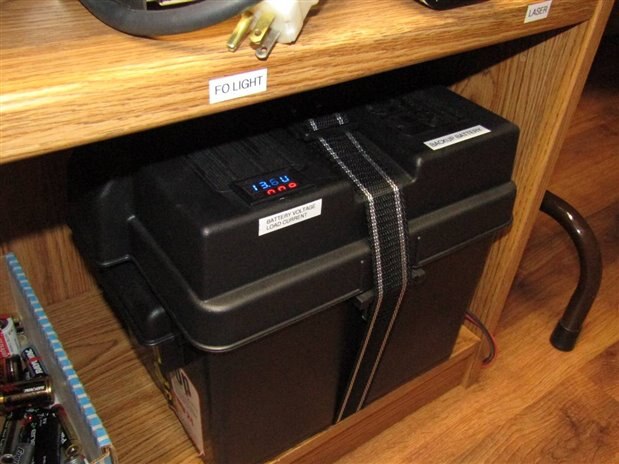
The computer in my lab is very important to me. This of course is very subjective as its contents and utilities are understood and utilized only be me and so someday, when I can no longer use it, it will go directly from my lab to the computer recycle facility. In the meantime I do everything in my power to keep it clean, backed up, and with a protected UPS power supply. The original battery of the 650 Watt UPS is long since failed and when it did I bought a car battery and rewired things so that I can monitor the voltage of the battery and the discharge rate when it is being used.
 

image

Here is the battery in its case with the volt/ammeter mounted in the cover. Every couple months I pull the mains electrical plug and let the system run for an hour or so. Two nights ago I performed this routine test but within 10 minutes the UPS was beeping frantically for power and before I could get to the mains plug it died.


I took the battery case and opened it to find that while I was checking everything else I had not been monitoring the water level of the battery and 3 years of constant float charging had finally dropped the fluid level to about an inch of the bottom. This is not a good situation and there was not much else to do except to replace the battery. This time I got a battery with ADM maintenance free technology and an 8 year warranty. We will see how that goes.


I am not one to give up too easily and my thoughts went to the possibility of resurrecting the old battery. Just to show how bad the water situation had gotten the battery took almost 3 liters of distilled water before it was full again. I put the battery on a small charger and left it to charge.


The next problem that caught my attention was how I was going to test and measure the health of the car battery. When I have this problem with small batteries I hook them up to the Process Duration Timer


https://www.element14.com/community/videos/22548/l/first-test-of-process-duration-timer?sr=search&searchId=f826766b-bfaf-4e39-bdc2-afd26ffc3843&searchIndex=4


Short video of the Process Duration Timer (PDT) unit in operation. You can also search on this site for the original 4 blog series if you want to know more about the Process Duration Timer build.


The size of this battery however seemed likely to strain my present test abilities. One thought that seemed to make sense was that I would use a spare UPS Backup unit with a 75 Watt incandescent bulb and use that for the load.  The next problem would be how to interface the PDT to the system so that I could time the draining of the battery until the shut off voltage (which I didn't know) of the UPS was reached.


This was the inspiration that I needed to build an Interface for the PDT. As it sits the Process Duration Timer (PDT) was designed to monitor and time a voltage level and respond by stopping the clock when the monitored voltage level drops below a given threshold.


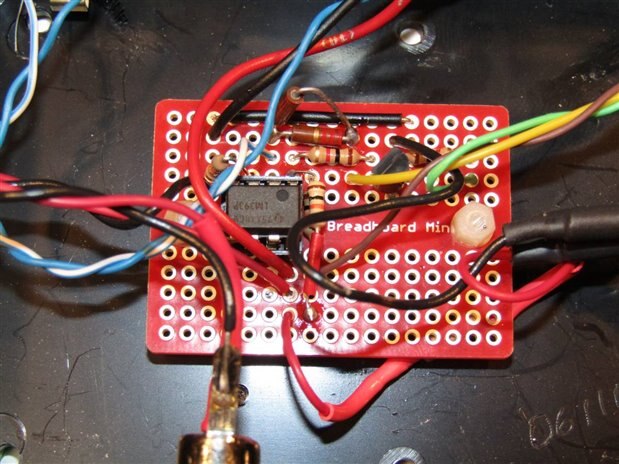
At its core the Interface is very simple with an LM393 comparitor, a MOSFET output and the required resistors and hardware needed to allow a sensor  to monitor a given process by watching other physical changes in the system and reporting back to the PDT with a High or Low voltage output which in turn is used to stop the timing of the process.


Here is a schematic for the Interface:


image

It was my plan to build the Interface and let its ability to monitor a light level watch the 75 Watt bulb on the output of the UPS that was being powered by the damaged battery. As long as the bulb was lit the interface would send 15 volts to the PDT and it would happily keep on timing the process of battery discharge. As soon as the battery level dropped below critical for the UPS operation however the bulb would go out and the interface would send a Low voltage signal to the PDT and the timer would stop and wait for me to return and read its output.


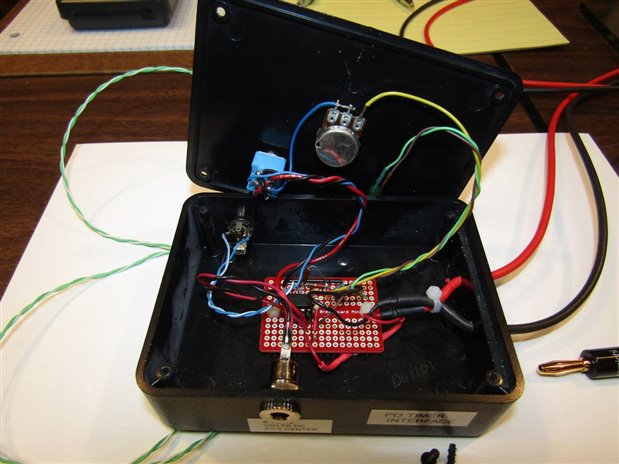
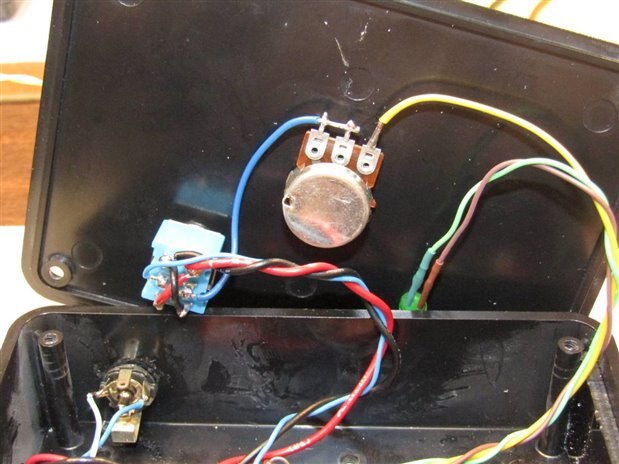
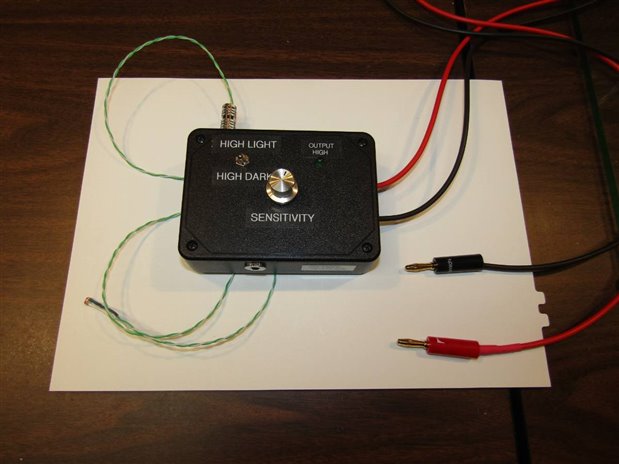
Before I get to the actual battery test however here are some picture of the Interface:
 

imageimage


imageimage


I am using a DPDT toggle switch on the unit to give me the flexibility to transition from High output to Low output on the Interface in either direction, Light to Dark, or Dark to Light. The LED tells the state of the output and the potentiometer allows the operator to adjust the sensitivity to fit local light conditions.


image


Here is a picture of the experiment set up. The battery has been charged for several hours and is showing all the signs that it is bad. The UPS is hooked to the battery and has a 75 Watt bulb plugged into one of its outlets. In a preparatory experiment I have measured the current demand on the battery to power the 75 Watt bulb. This turned out to be about 8.5 Amps. For some reason I don't understand right now the UPS's power demand is not stable but fluctuates +/- 1 amp while it is working. If anyone knows why please clue me in. The photo resistor sensor of the PDT Interface is pointed towards the 75 watt bulb. The Interface is set so that the output will transition from High output to Low output when the sensor no longer sees the light.


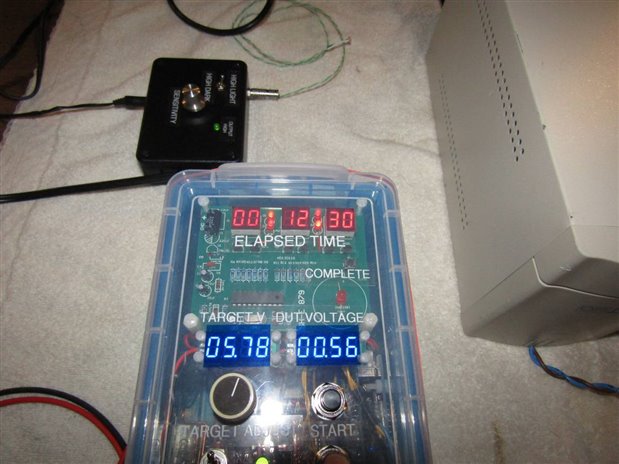
The PDT has been set to watch the Interface which should put out about 14.86 volts and continue timing the process until it sees less than 5.81 Volts.


image

The timer indicates that we are 1 minute 23 seconds into the test at this point.
 

image

We really did not have long to wait as 12 minutes and 30 seconds after the process started the battery gave up. If we do the math for 8.5 Amps over 12 minutes and 30 seconds we get about 1.7 Ah of power. For a battery that should have upwards of 45 Amp Hours this is a clear indication that the low fluid level has permanently damaged this battery beyond redemption.


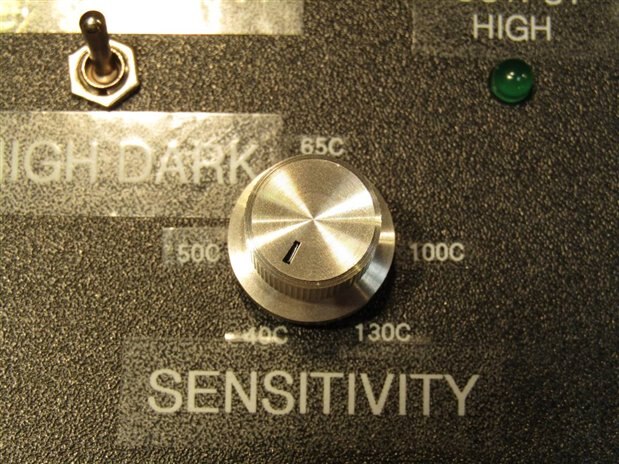
Since I was still in the mood to upgrade the Interface I also made a Thermistor Sensor for it. The thermistor was chosen to work with the Interface in the range of 40 C to 130 C as I guessed that this might be a range that would be usable for me. Now I will be able to monitor and time processes that involve things that gradually heat up or cool down.
 

image


The sensitivity control was labeled with approximate transition temperatures for future use of the thermistor sensor.


Overall I am pleased with the added flexibility of the PDT that the Interface has provided. It is the silver lining of the cloud that was the failure of the backup battery.


John


  • Sign in to reply

Top Comments

  • Gough Lui
    Gough Lui over 7 years ago +7
    Flooded lead acid cells are fairly bulletproof, but indeed, every three or so months, topping up is highly recommended. Unfortunately, once the plates are exposed to air, I believe they oxidise and the…
  • Gough Lui
    Gough Lui over 7 years ago in reply to jw0752 +5
    That actually reminds me of a funny moment where I thought I could beat the system and ended up making a fool of myself. I thought having a UPS meant I was invincible (for at least 10 minutes with a beefy…
  • jw0752
    jw0752 over 7 years ago +4
    I should probably start a new blog for this but you are all probably getting sick of my Process Duration Timer so I will add it to this stream. After I finished with the interface I saw another simple…
Parents
  • Gough Lui
    Gough Lui over 7 years ago

    Flooded lead acid cells are fairly bulletproof, but indeed, every three or so months, topping up is highly recommended. Unfortunately, once the plates are exposed to air, I believe they oxidise and the capacity can't reliably be recovered in any way. Or if you do manage to get the layer off, it settles in the bottom where it eventually shorts out the cell, manifesting itself as high self discharge. Generally speaking, deep-cycle batteries are best suited, with most automotive "starting lighting and ignition" batteries not suitable for cycle use as their plates disintegrate rapidly from just a few deep cycles.


    AGM cells or even gel cells can have a fairly decent float life but do watch the voltage. If the float voltage gets too high, the recombination catalysts in the cap may not handle the load and the cell may eventually dry up. Charge rates are important for gel as well, as sometimes I've heard of the batteries swelling due to trapped gas in the gel itself. But this is what most telecommunication facilities use nowadays, and it's actually much safer for use "in the home" as all that evaporated water would have meant hydrogen evolution into your workspace. Also of note is that the vented nature of flooded cells may also lead to corrosive vapours which can attack metal nearby - terminals, etc.


    Ironically, where I live, most of the time the consumer grade UPS fails before the power does - in a very similar way as you mentioned. During a self test, the battery would not be able to handle the high rate load, the voltage drops, the UPS complains and attempts a switch back to mains ... but not quickly enough (or a relay fails in an inopportune time, welds contacts, etc). Once that happens, I have to disconnect the load and replace or service the UPS. I got sick of this as I did run a number of experiments and servers where it would be nice to have no downtime operation, and without a bypass transfer switch to cut the UPS out of the loop for servicing, I basically had to shut everything down. Aside from that, I find that over longer periods, many of them also have a habit of overheating, many produce "modified" sine wave (or square wave with "dead" periods) which results in noisy power and those with AVR (automatic voltage regulation) basically cut in boost/buck coils at their whim when the mains drifts about 10% and these changes cause power line noise during the transfer time (i.e. 4-8ms with nothing on the line) which I find more stressful as some precision devices will not ride these out without consequences (e.g. multimeters which are "mains line synchronized" to reduce the influence of mains hum on measurements).


    And that's the story of how I learned to stop worrying about power outages, live with a simple but effective MOV based surge suppressor, and saved myself the hassle of maintaining a bank of batteries that would save my bacon less often than I would have to test/service it!


    - Gough

    • Cancel
    • Vote Up +7 Vote Down
    • Sign in to reply
    • More
    • Cancel
  • jw0752
    jw0752 over 7 years ago in reply to Gough Lui

    Hi Gough,


    Great insights. You are right but it is so much fun when the power does go out and I can sit and play on the computer and beat the system. Your explanation of the buck/boost coils checking in and out may explain the irregular current draw that I saw.


    John

    • Cancel
    • Vote Up +3 Vote Down
    • Sign in to reply
    • More
    • Cancel
  • Gough Lui
    Gough Lui over 7 years ago in reply to jw0752

    That actually reminds me of a funny moment where I thought I could beat the system and ended up making a fool of myself.


    I thought having a UPS meant I was invincible (for at least 10 minutes with a beefy UPS) when the power went out. First time it did, I thought my investment paid for itself. Instead, being the utter fool I was, I plugged my CRT monitor (yep, no LCD back then) into the UPS. Once the power went out, the UPS software decided to kick in and woke the monitor from sleep which (on that model) started a degauss cycle. The draw of the degauss coil promptly overloaded the UPS which shut down to protect itself.


    So much for being able to use the computer or ensure my data was saved ... lesson learned. Don't plug CRT monitors into UPSes ... (or laser printers, or anything else "high draw" and non-critical).


    - Gough

    • Cancel
    • Vote Up +5 Vote Down
    • Sign in to reply
    • More
    • Cancel
Comment
  • Gough Lui
    Gough Lui over 7 years ago in reply to jw0752

    That actually reminds me of a funny moment where I thought I could beat the system and ended up making a fool of myself.


    I thought having a UPS meant I was invincible (for at least 10 minutes with a beefy UPS) when the power went out. First time it did, I thought my investment paid for itself. Instead, being the utter fool I was, I plugged my CRT monitor (yep, no LCD back then) into the UPS. Once the power went out, the UPS software decided to kick in and woke the monitor from sleep which (on that model) started a degauss cycle. The draw of the degauss coil promptly overloaded the UPS which shut down to protect itself.


    So much for being able to use the computer or ensure my data was saved ... lesson learned. Don't plug CRT monitors into UPSes ... (or laser printers, or anything else "high draw" and non-critical).


    - Gough

    • Cancel
    • Vote Up +5 Vote Down
    • Sign in to reply
    • More
    • Cancel
Children
  • jw0752
    jw0752 over 7 years ago in reply to Gough Lui

    Hi Gough,


    You are right, the universe does seem to have a way of balancing the books on those of us who like to try to beat the system.


    John

    • Cancel
    • Vote Up +2 Vote Down
    • Sign in to reply
    • More
    • Cancel
element14 Community

element14 is the first online community specifically for engineers. Connect with your peers and get expert answers to your questions.

  • Members
  • Learn
  • Technologies
  • Challenges & Projects
  • Products
  • Store
  • About Us
  • Feedback & Support
  • FAQs
  • Terms of Use
  • Privacy Policy
  • Legal and Copyright Notices
  • Sitemap
  • Cookies

An Avnet Company © 2026 Premier Farnell Limited. All Rights Reserved.

Premier Farnell Ltd, registered in England and Wales (no 00876412), registered office: Farnell House, Forge Lane, Leeds LS12 2NE.

ICP 备案号 10220084.

Follow element14

  • X
  • Facebook
  • linkedin
  • YouTube