element14 Community
element14 Community
    Register Log In
  • Site
  • Search
  • Log In Register
  • Community Hub
    Community Hub
    • What's New on element14
    • Feedback and Support
    • Benefits of Membership
    • Personal Blogs
    • Members Area
    • Achievement Levels
  • Learn
    Learn
    • Ask an Expert
    • eBooks
    • element14 presents
    • Learning Center
    • Tech Spotlight
    • STEM Academy
    • Webinars, Training and Events
    • Learning Groups
  • Technologies
    Technologies
    • 3D Printing
    • FPGA
    • Industrial Automation
    • Internet of Things
    • Power & Energy
    • Sensors
    • Technology Groups
  • Challenges & Projects
    Challenges & Projects
    • Design Challenges
    • element14 presents Projects
    • Project14
    • Arduino Projects
    • Raspberry Pi Projects
    • Project Groups
  • Products
    Products
    • Arduino
    • Avnet & Tria Boards Community
    • Dev Tools
    • Manufacturers
    • Multicomp Pro
    • Product Groups
    • Raspberry Pi
    • RoadTests & Reviews
  • About Us
    About the element14 Community
  • Store
    Store
    • Visit Your Store
    • Choose another store...
      • Europe
      •  Austria (German)
      •  Belgium (Dutch, French)
      •  Bulgaria (Bulgarian)
      •  Czech Republic (Czech)
      •  Denmark (Danish)
      •  Estonia (Estonian)
      •  Finland (Finnish)
      •  France (French)
      •  Germany (German)
      •  Hungary (Hungarian)
      •  Ireland
      •  Israel
      •  Italy (Italian)
      •  Latvia (Latvian)
      •  
      •  Lithuania (Lithuanian)
      •  Netherlands (Dutch)
      •  Norway (Norwegian)
      •  Poland (Polish)
      •  Portugal (Portuguese)
      •  Romania (Romanian)
      •  Russia (Russian)
      •  Slovakia (Slovak)
      •  Slovenia (Slovenian)
      •  Spain (Spanish)
      •  Sweden (Swedish)
      •  Switzerland(German, French)
      •  Turkey (Turkish)
      •  United Kingdom
      • Asia Pacific
      •  Australia
      •  China
      •  Hong Kong
      •  India
      •  Japan
      •  Korea (Korean)
      •  Malaysia
      •  New Zealand
      •  Philippines
      •  Singapore
      •  Taiwan
      •  Thailand (Thai)
      •  Vietnam
      • Americas
      •  Brazil (Portuguese)
      •  Canada
      •  Mexico (Spanish)
      •  United States
      Can't find the country/region you're looking for? Visit our export site or find a local distributor.
  • Translate
  • Profile
  • Settings
Personal Blogs
  • Community Hub
  • More
Personal Blogs
John Wiltrout's Blog Incorporating the LT 4320 Ideal Bridge in the Linear Bench Supply
  • Blog
  • Documents
  • Mentions
  • Sub-Groups
  • Tags
  • More
  • Cancel
  • New
  • Share
  • More
  • Cancel
Group Actions
  • Group RSS
  • More
  • Cancel
Engagement
  • Author Author: jw0752
  • Date Created: 3 Mar 2017 7:46 AM Date Created
  • Views 3528 views
  • Likes 8 likes
  • Comments 14 comments
  • bench top power supply
  • lt4320
Related
Recommended

Incorporating the LT 4320 Ideal Bridge in the Linear Bench Supply

jw0752
jw0752
3 Mar 2017

A while back I explored the Ideal Bridge available using the LT 4320 Controller and 4 N Channel MOSFETs.


https://www.element14.com/community/people/jw0752/blog/2017/02/01/exploring-the-lt4320-ideal-diode-bridge-controller


I also built a two channel linear bench supply using some Chinese Kits.


https://www.element14.com/community/people/jw0752/blog/2017/02/11/oh-no-not-another-power-supply


In this blog I will explore the results when I built another module with the Chinese Power Supply Kit but this time instead of using the 1N5408 Diodes supplied I substituted the LT 4320 Controller with 4 MOSFETs. Here are some pictures of the completed Module.


image


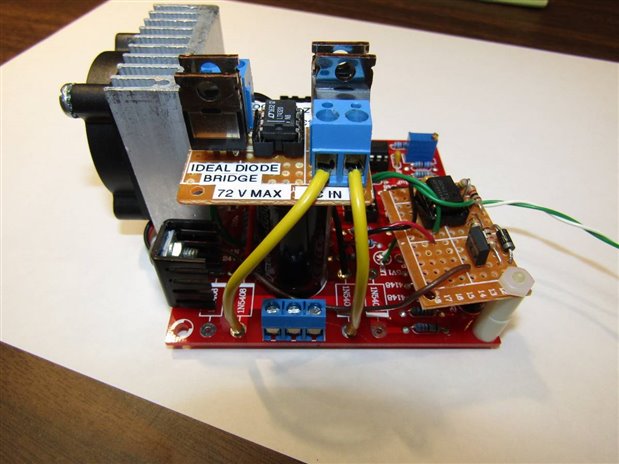
The small board in the upper left is the LT 4320 with the MOSFETs. The Yellow wires supply the AC voltage and the RED and Black are the rectified output back to the board. The small auxiliary board in the lower left is the fan controller which supplies about 11 volts to the 24 volt fan at room temperature and increases the voltage to the full 24 volts as the heat sink approaches 100 C.


image


The Red lead with the black coupler is the 12 volt supply to the meter circuitry.
 

image


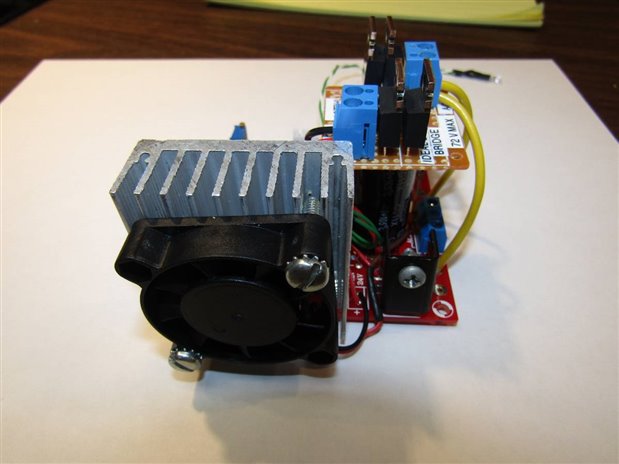
The nice Radio Shack CPU heat sink that I used on the first two modules was not available any more so I had to use this less impressive but still adequate sink. The fan for this sink came at 24 volts instead of the previous 12 volts so the fan control had to be modified to make the adjustment. Since 24 volts was so close to the max raw voltage from the unregulated supply I used it directly instead of placing a regulator in the circuit.
 

image


Here is the final side view of the module. The next step was to remove one of the Diode Modules from the Linear Supply and install the LT4320 version.


image


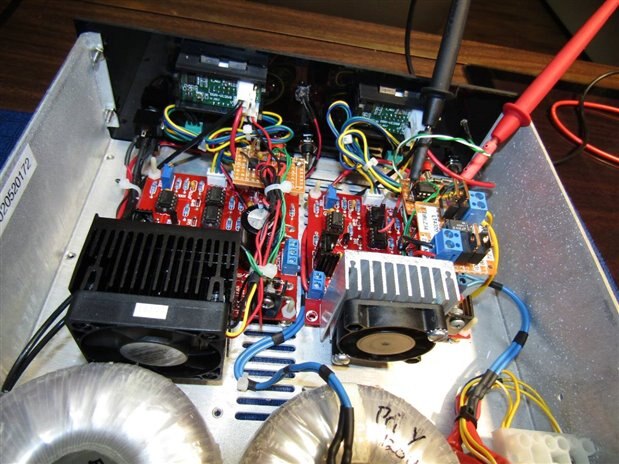
The meter probes are looking at the voltage to the fan as the heat sink rises in temperature under a 36 Watt dissipation.
 

image


This is just the view from the back.


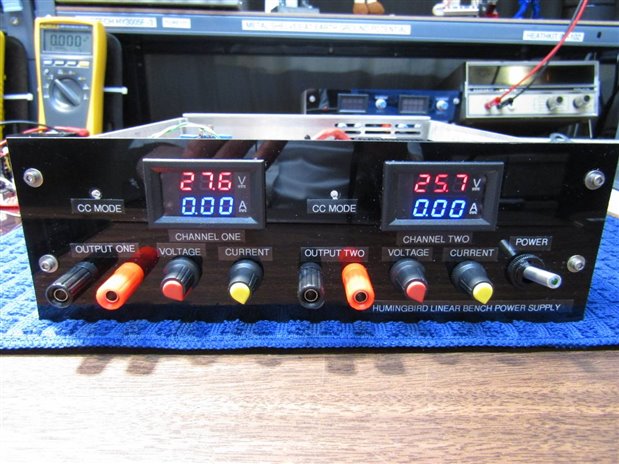
The goal of this experiment was to see what the difference would be between a channel using the LT4320 as opposed to the 1N5408 Diodes. Keep in mind the supply has identical Toroid Transformers and support controls for each channel. It turn out that the LT4320 side had a Max 27.6 Volts and the Diode side had 25.7 Volts. Besides this unloaded voltage difference at the top the load capability also showed the same differential. For example I turned both channels to their max output and then load each channel with a 2 amp load. The LT 4320 side dropped to 22 volts before it could support 2 amps. The Diode side dropped to 20.4 volts before it could support the 2 amp load. Even under a 3 amp load which is the max for this supply the MOSFETs ran very close to room temperature. While I like the LT4320 from a standpoint of improved efficiency and sophistication the improvement is probably not enough to justify its use in most cases.
 

image


Picture showing the no load difference between the two channels.


John

  • Sign in to reply

Top Comments

  • Gough Lui
    Gough Lui over 9 years ago in reply to mcb1 +5
    Hello guys (all the way from South Korea)! Interesting point in terms of mains "pollution" and it led me to scratch my head for a bit. Ideally, from my understanding anyhow, what you're probably most interested…
  • Jan Cumps
    Jan Cumps over 9 years ago +3
    Thanks God you had your clothes on. There's reflection in the last photo. Always dangerous...
  • jw0752
    jw0752 over 9 years ago in reply to Jan Cumps +2
    Ah yes Naked Electronics, Always an adventure.
  • Gough Lui
    Gough Lui over 9 years ago in reply to mcb1

    Hello guys (all the way from South Korea)!


    Interesting point in terms of mains "pollution" and it led me to scratch my head for a bit.


    Ideally, from my understanding anyhow, what you're probably most interested is in the current waveform on the mains side as that will be what will potentially create any "nasties" on the mains. If you have a power analyzer (like the PA1000 which I managed to snag from here), you can use its shunt to read out the harmonic distortion (Ithd) to get an idea of how "polluting" a particular load is. Of course, just looking at the current waveform and its shape/phase relative to the mains voltage will give you an idea about it as well. However, the *actual* resulting observed voltage effects are (likely, as I understand it) going to depend on the supply impedance and any other loads on the circuit/network which might interact with (e.g. resonate, non-linear effects) whatever harmonic components are in the current waveform.


    To that end, I'm not sure how an isolation transformer might separate the filtering effect of the mains side - the grid and house wiring have (usually) quite low impedances (say <=2 ohm), so it will take a lot of harmonic current to produce any noticeable effect on the voltage measured at the point of connection. An isolation transformer might add some impedance, but whether you're going to get anything useful out of such a measurement, I am not sure.


    Instead, my expectation is probably to use a shunt to observe the current from the mains. To do this safely and isolate yourself, it's probably best to use a very sensitive clamp/current transformer. It might be enough but that will depend on its bandwidth response and what magnitude/frequency of harmonics you're expecting to observe. Otherwise, a direct shunt connection used with an isolated input as per the power analyzers might be the next best way.


    But honestly, it's a little bit out of my depth, but at least that's my (primitive) understanding anyhow.


    - Gough

    • Cancel
    • Vote Up +5 Vote Down
    • Sign in to reply
    • More
    • Cancel
  • mcb1
    mcb1 over 9 years ago in reply to jw0752

    I am not sure how to do it on a mains feed

    CAREFULLY


    Others here will most likely have a good idea of how to look for ripple fed back to the mains.

    My first thought would be use an isolation transformer to seperate the filtering effect of the incoming, and then a scope across it should show 'irregularities' in the waveform.

    The supply connected and isolated gives a baseline for any existing noise ...

    You'll probably find that the switched mode version also introduces noise as well.


    It would make a very good blog post on how to safely do that check .. and sadly Gough Lui is on his adventure.


    Mark

    • Cancel
    • Vote Up +2 Vote Down
    • Sign in to reply
    • More
    • Cancel
  • mcb1
    mcb1 over 9 years ago in reply to Jan Cumps

    There's reflection in the last photo

    Haha

    I'm now concerned about the three arms on one side ...

    • Cancel
    • Vote Up 0 Vote Down
    • Sign in to reply
    • More
    • Cancel
  • jw0752
    jw0752 over 9 years ago in reply to Jan Cumps

    Ah yes Naked Electronics, Always an adventure.

    • Cancel
    • Vote Up +2 Vote Down
    • Sign in to reply
    • More
    • Cancel
  • jw0752
    jw0752 over 9 years ago in reply to DAB

    Hi DAB,

    I will look at using the idea of PWM in a future design. I have recently explored some voltage controlled PWM circuits that could probably be incorporated with the existing Op Amp circuit I am using.

    John

    • Cancel
    • Vote Up +1 Vote Down
    • Sign in to reply
    • More
    • Cancel
<>
element14 Community

element14 is the first online community specifically for engineers. Connect with your peers and get expert answers to your questions.

  • Members
  • Learn
  • Technologies
  • Challenges & Projects
  • Products
  • Store
  • About Us
  • Feedback & Support
  • FAQs
  • Terms of Use
  • Privacy Policy
  • Legal and Copyright Notices
  • Sitemap
  • Cookies

An Avnet Company © 2026 Premier Farnell Limited. All Rights Reserved.

Premier Farnell Ltd, registered in England and Wales (no 00876412), registered office: Farnell House, Forge Lane, Leeds LS12 2NE.

ICP 备案号 10220084.

Follow element14

  • X
  • Facebook
  • linkedin
  • YouTube