element14 Community
element14 Community
    Register Log In
  • Site
  • Search
  • Log In Register
  • Community Hub
    Community Hub
    • What's New on element14
    • Feedback and Support
    • Benefits of Membership
    • Personal Blogs
    • Members Area
    • Achievement Levels
  • Learn
    Learn
    • Ask an Expert
    • eBooks
    • element14 presents
    • Learning Center
    • Tech Spotlight
    • STEM Academy
    • Webinars, Training and Events
    • Learning Groups
  • Technologies
    Technologies
    • 3D Printing
    • FPGA
    • Industrial Automation
    • Internet of Things
    • Power & Energy
    • Sensors
    • Technology Groups
  • Challenges & Projects
    Challenges & Projects
    • Design Challenges
    • element14 presents Projects
    • Project14
    • Arduino Projects
    • Raspberry Pi Projects
    • Project Groups
  • Products
    Products
    • Arduino
    • Avnet & Tria Boards Community
    • Dev Tools
    • Manufacturers
    • Multicomp Pro
    • Product Groups
    • Raspberry Pi
    • RoadTests & Reviews
  • About Us
  • Store
    Store
    • Visit Your Store
    • Choose another store...
      • Europe
      •  Austria (German)
      •  Belgium (Dutch, French)
      •  Bulgaria (Bulgarian)
      •  Czech Republic (Czech)
      •  Denmark (Danish)
      •  Estonia (Estonian)
      •  Finland (Finnish)
      •  France (French)
      •  Germany (German)
      •  Hungary (Hungarian)
      •  Ireland
      •  Israel
      •  Italy (Italian)
      •  Latvia (Latvian)
      •  
      •  Lithuania (Lithuanian)
      •  Netherlands (Dutch)
      •  Norway (Norwegian)
      •  Poland (Polish)
      •  Portugal (Portuguese)
      •  Romania (Romanian)
      •  Russia (Russian)
      •  Slovakia (Slovak)
      •  Slovenia (Slovenian)
      •  Spain (Spanish)
      •  Sweden (Swedish)
      •  Switzerland(German, French)
      •  Turkey (Turkish)
      •  United Kingdom
      • Asia Pacific
      •  Australia
      •  China
      •  Hong Kong
      •  India
      • Japan
      •  Korea (Korean)
      •  Malaysia
      •  New Zealand
      •  Philippines
      •  Singapore
      •  Taiwan
      •  Thailand (Thai)
      • Vietnam
      • Americas
      •  Brazil (Portuguese)
      •  Canada
      •  Mexico (Spanish)
      •  United States
      Can't find the country/region you're looking for? Visit our export site or find a local distributor.
  • Translate
  • Profile
  • Settings
Personal Blogs
  • Community Hub
  • More
Personal Blogs
John Wiltrout's Blog Power Straw
  • Blog
  • Documents
  • Mentions
  • Sub-Groups
  • Tags
  • More
  • Cancel
  • New
  • Share
  • More
  • Cancel
Group Actions
  • Group RSS
  • More
  • Cancel
Engagement
  • Author Author: jw0752
  • Date Created: 31 Oct 2016 7:23 PM Date Created
  • Views 3045 views
  • Likes 9 likes
  • Comments 39 comments
  • medical devices
  • handicapped assist
Related
Recommended

Power Straw

jw0752
jw0752
31 Oct 2016

For several years my Mom has been in a Nursing Home with Parkinson's disease. As she has lost function of her muscles I have attempted to use technology to assist her. I have posted a couple of my attempts to assist her in my Blog on E-14.


https://www.element14.com/community/people/jw0752/blog/2015/07/07/hacking-a-lift-chair


https://www.element14.com/community/people/jw0752/blog/2016/01/15/building-an-led-amplifier-for-mom


Recently on her bad days she has been too weak to draw the thickened water she has to drink up a straw. This causes her to become dehydrated and quickly affects her health. She is very stubborn and will not allow herself to be fed by other than by herself. To help her in the days that she is too weak to drink through a straw  I have constructed this little device to assist her. I call it a Power Straw. It is very light on electronics so perhaps it does not have much application to our electronics site but since I had published previous projects I though a few of the guys would be interested.


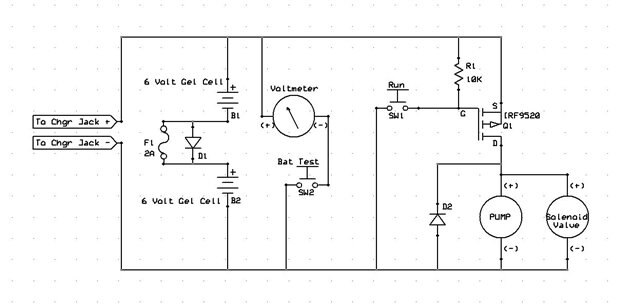
Here is a schematic of the project:
 

image


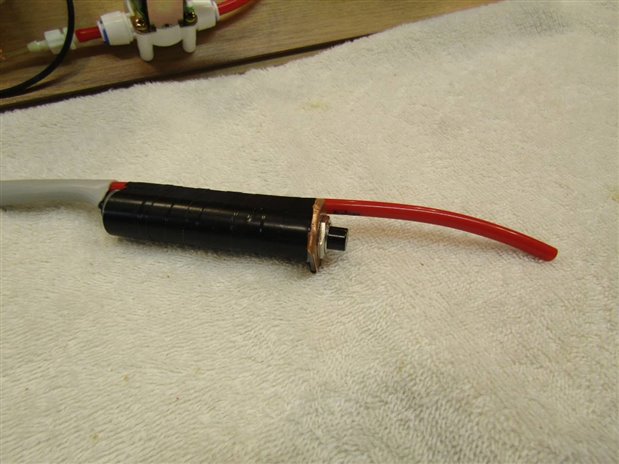
I began the project by collecting a variety of potential components. My Goal was to draw her thickened water from a reservoir and pump it up a line and into her mouth. She is accustomed to using a push button call switch when she needs help from an attendant so I decided to use a very similar switch to actuate the pump.


The water line would run axially with the switch and its wiring. The switch could be held in her hand and the water feed line would continue past the switch by about 4 inches.
 

image

Picture of Hand Switch


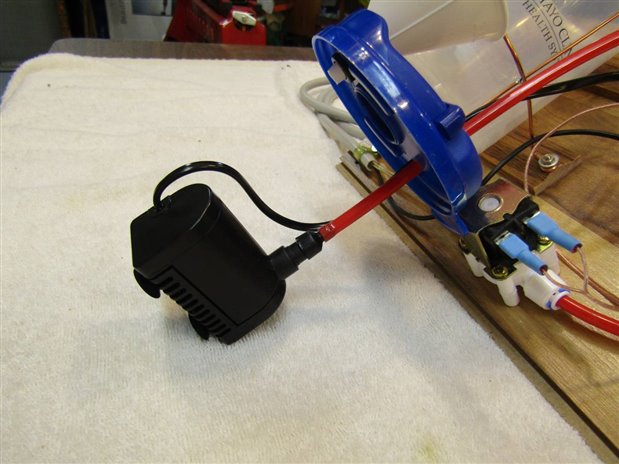
I decided to try a small 12 volt water pump, that is usually used in small fountains, to pump the water from the reservoir.
 

image

Picture of Pump in the Reservoir


My first prototype did not include an in line solenoid. This created a problem if the cord accidentally fell to the floor as gravity would siphon the water from the reservoir and create a big mess on the floor. My final prototype needed a solenoid.


image

Solenoid Picture


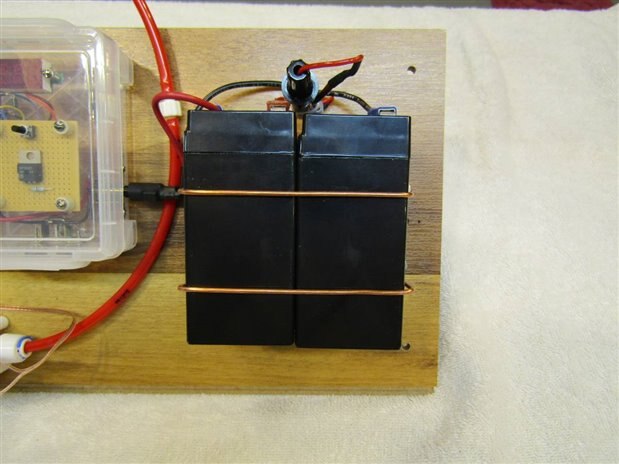
Since space and weight were not a particular problem I decided to use two 6 volt 4.5 Ahr Lead Acid Gel Cells for the batteries.
 

image

Battery Picture


A small Volt Meter circuit was incorporated in the control box so I could check the level of the battery and recharge it when needed.
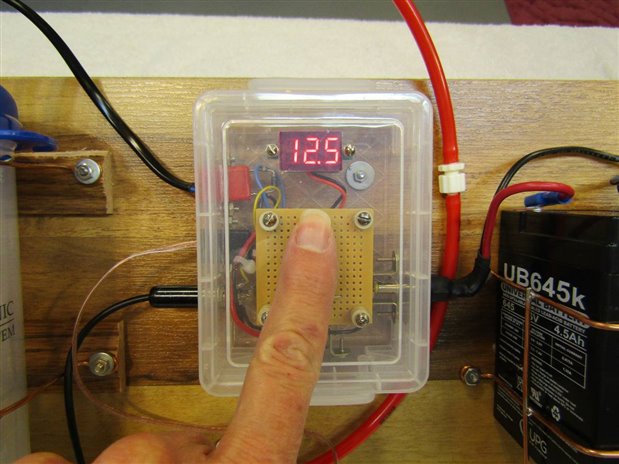
 

image

Control Box Picture


The control box is very simple with the Volt Meter and a momentary switch to activate it, a single P Channel MOSFET, Jacks for: Batteries, Charger, Pump, Solenoid, and actuation switch.

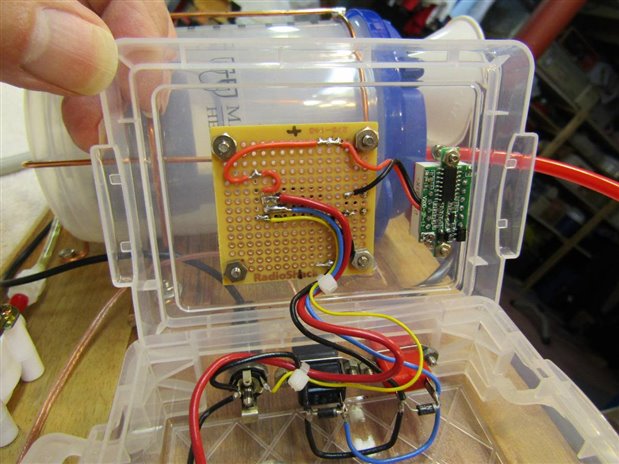
 

    imageimage

Pictures on inside the Control Box


The Reservoir is an lightly insulated hospital drinking cup that I brought home after a past overnight adventure.
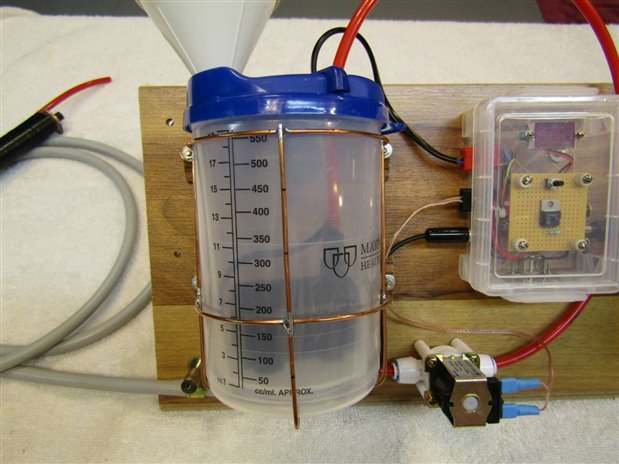
 

image

Picture of the Reservoir.


Here is a picture of the finished project before I took it to Mom's room and nylon strapped it to the back of her wheel chair.
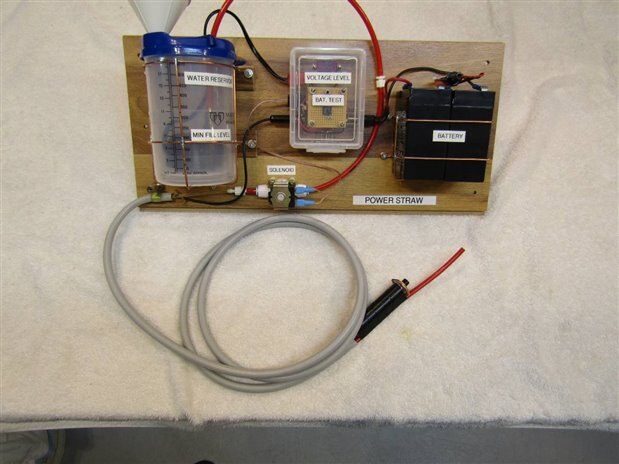
 

image

Picture of completed assembly


I can see room for many improvements. The parts that I ordered and received did not meet my imagined specifications. For example the pump could have a little more power and the solenoid draws too much current. While the batteries will be heavy enough to deal with the present solenoid, ideally, I should be able to find one that uses 200 mA or less instead of the current 400+ mA. I have made the reservoir and hand cord easy to disassemble for cleaning but improvements can be made. The plugs that were used on the pump and the solenoid were not polarized. While this will not affect the solenoid it is important the the pump spin in the correct direction for maximum efficiency. I have marked the non-polarized plugs but someone other than me might miss this detail. For the time being however Mom is happy and after the newness wears off she too will have some good suggestions for her sonny boy on how he can make it better.

  • Sign in to reply

Top Comments

  • dougw
    dougw over 9 years ago +6
    They say need is the mother of invention, mothers are also the mothers of invention. Very nicely done John. If you are looking for improvement ideas, you might consider using a peristaltic pump - the liquid…
  • jw0752
    jw0752 over 9 years ago +6
    Here is the next iteration of the prototype using a peristaltic pump. The first thing to note is that the reservoir holder has been changed so that it will accommodate the standard drinking cup that is…
  • jw0752
    jw0752 over 9 years ago +5
    ERRATA : I have discovered that I made a mistake and published incorrect information reference the mA draw of the peristaltic pump. If one looks closely at the picture of the Fluke Meter in my last post…
Parents
  • jw0752
    jw0752 over 9 years ago

    Here is the next iteration of the prototype using a peristaltic pump.


    image

    The first thing to note is that the reservoir holder has been changed so that it will accommodate the standard drinking cup that is used in Mom's nursing home. Rather than messing with pouring the thickened water that she has to drink into a separate reservoir all the staff has to do is replace one cup with another and insert the red hose into the straw hole. I mentioned thickened water. I never realized this but if one is not able to swallow properly water of regular consistency can pose a greater danger of choking. For this reason they give Mom a special thickened water that is easier to swallow.


    Here is a detail picture of the cup holder:


    image


    The red hose from the cup goes to the inlet of the peristaltic pump. The pump itself is controlled by a variable pulse width modulation generator in the control box. I was very pleased with the small peristaltic pump as it is capable of moving 75 milliliter of the thickened water per minute when the pump is running at 12 volts. Since the control box (See Red Capped Knob on top of the control) allows me to control the PWM 0% to 100% I can reduce the output of the pump as needed so as not to over run Mom's ability to swallow. Here is a detail of the peristaltic pump and the manifold that I built to interface with the feed from the cup and the line to drinking tube.


    image


    image


    One of the very pleasant surprises was that the peristaltic pump only drew 32  mA at the full 100 % PMW level. This is more than a magnitude reduction from the 500 mA + current needed for the first prototype. Current calculations suggest that the battery should be able to run the unit for a couple weeks at a time without recharging.  Since the Peristaltic pump pinches the line continuously there is also no need for a solenoid to prevent siphoning. Check out the ammeter reading for the pump.


    image


    For the fun of it I made a video of the pump in action. Check it out.


    You don't have permission to edit metadata of this video.
    Edit media
    x
    image
    Upload Preview
    image


    The unit is now back attached to Mom's wheel chair and she has been using it for a day. We will be watching for other problems and opportunities to improve it in the coming days.


    John

    • Cancel
    • Vote Up +6 Vote Down
    • Sign in to reply
    • More
    • Cancel
Comment
  • jw0752
    jw0752 over 9 years ago

    Here is the next iteration of the prototype using a peristaltic pump.


    image

    The first thing to note is that the reservoir holder has been changed so that it will accommodate the standard drinking cup that is used in Mom's nursing home. Rather than messing with pouring the thickened water that she has to drink into a separate reservoir all the staff has to do is replace one cup with another and insert the red hose into the straw hole. I mentioned thickened water. I never realized this but if one is not able to swallow properly water of regular consistency can pose a greater danger of choking. For this reason they give Mom a special thickened water that is easier to swallow.


    Here is a detail picture of the cup holder:


    image


    The red hose from the cup goes to the inlet of the peristaltic pump. The pump itself is controlled by a variable pulse width modulation generator in the control box. I was very pleased with the small peristaltic pump as it is capable of moving 75 milliliter of the thickened water per minute when the pump is running at 12 volts. Since the control box (See Red Capped Knob on top of the control) allows me to control the PWM 0% to 100% I can reduce the output of the pump as needed so as not to over run Mom's ability to swallow. Here is a detail of the peristaltic pump and the manifold that I built to interface with the feed from the cup and the line to drinking tube.


    image


    image


    One of the very pleasant surprises was that the peristaltic pump only drew 32  mA at the full 100 % PMW level. This is more than a magnitude reduction from the 500 mA + current needed for the first prototype. Current calculations suggest that the battery should be able to run the unit for a couple weeks at a time without recharging.  Since the Peristaltic pump pinches the line continuously there is also no need for a solenoid to prevent siphoning. Check out the ammeter reading for the pump.


    image


    For the fun of it I made a video of the pump in action. Check it out.


    You don't have permission to edit metadata of this video.
    Edit media
    x
    image
    Upload Preview
    image


    The unit is now back attached to Mom's wheel chair and she has been using it for a day. We will be watching for other problems and opportunities to improve it in the coming days.


    John

    • Cancel
    • Vote Up +6 Vote Down
    • Sign in to reply
    • More
    • Cancel
Children
  • mcb1
    mcb1 over 9 years ago in reply to jw0752

    Brilliant.

    Glad the pump worked out.


    It's certainly got great potential.


    Do you think the nursing staff are going to be careful with the cup holder, or are you envisaging a slightly more robust version.??


    Mark

    • Cancel
    • Vote Up +3 Vote Down
    • Sign in to reply
    • More
    • Cancel
  • dougw
    dougw over 9 years ago in reply to jw0752

    This build is absolutely inspirational.

    • Cancel
    • Vote Up +2 Vote Down
    • Sign in to reply
    • More
    • Cancel
  • Jan Cumps
    Jan Cumps over 9 years ago in reply to jw0752

    Perfect fit for purpose, and well engineered.


    two possible points for future improvement:

    • Make the piece of hose that goes into the cup easily replaceable. Just like Mark mentioned, staff may knack that part of the device when frequently changing cups
    • maybe a small plastic cup filled with damping material mounted over the pump, to soften the motor noise.
    • Cancel
    • Vote Up +3 Vote Down
    • Sign in to reply
    • More
    • Cancel
  • shabaz
    shabaz over 9 years ago in reply to jw0752

    Hi John,


    That is a remarkable piece of equipment! Truly fantastic. It looks very effective.


    One way of removing that tubing from the top of the container might be to find a capsule type

    coffee maker, they have a water reservoir that clips on the back, and when fitted

    it somehow opens and mates in a leak-free manner (I've not examined how they do that,

    presumably it is a split rubber bung style thing).

    So maybe ex-coffee-machines could be a good source of bits too. However maybe the

    nurses prefer using the same standard-issue container as you've used, rather than a coffee

    machine reservoir.


    Also, very cool that this can function on batteries for a long period of time!!

    • Cancel
    • Vote Up +3 Vote Down
    • Sign in to reply
    • More
    • Cancel
  • jw0752
    jw0752 over 9 years ago in reply to mcb1

    Hi Mark,

    Thanks for your ideas. I have made the cup holder out of 12 gauge copper wire and at these lengths it is really quite sturdy. I find that wire of this size is perfect for my level of tooling as I can straighten it by twisting it in a drill and then bend it to any shape needed and solder the pieces together. As far as how carefully the staff will be, the jury is still out on that question but so far they have been open to my little gadgets and usually come and gather around when they see me coming with something new.

    John

    • Cancel
    • Vote Up +4 Vote Down
    • Sign in to reply
    • More
    • Cancel
element14 Community

element14 is the first online community specifically for engineers. Connect with your peers and get expert answers to your questions.

  • Members
  • Learn
  • Technologies
  • Challenges & Projects
  • Products
  • Store
  • About Us
  • Feedback & Support
  • FAQs
  • Terms of Use
  • Privacy Policy
  • Legal and Copyright Notices
  • Sitemap
  • Cookies

An Avnet Company © 2025 Premier Farnell Limited. All Rights Reserved.

Premier Farnell Ltd, registered in England and Wales (no 00876412), registered office: Farnell House, Forge Lane, Leeds LS12 2NE.

ICP 备案号 10220084.

Follow element14

  • X
  • Facebook
  • linkedin
  • YouTube