element14 Community
element14 Community
    Register Log In
  • Site
  • Search
  • Log In Register
  • Community Hub
    Community Hub
    • What's New on element14
    • Feedback and Support
    • Benefits of Membership
    • Personal Blogs
    • Members Area
    • Achievement Levels
  • Learn
    Learn
    • Ask an Expert
    • eBooks
    • element14 presents
    • Learning Center
    • Tech Spotlight
    • STEM Academy
    • Webinars, Training and Events
    • Learning Groups
  • Technologies
    Technologies
    • 3D Printing
    • FPGA
    • Industrial Automation
    • Internet of Things
    • Power & Energy
    • Sensors
    • Technology Groups
  • Challenges & Projects
    Challenges & Projects
    • Design Challenges
    • element14 presents Projects
    • Project14
    • Arduino Projects
    • Raspberry Pi Projects
    • Project Groups
  • Products
    Products
    • Arduino
    • Avnet & Tria Boards Community
    • Dev Tools
    • Manufacturers
    • Multicomp Pro
    • Product Groups
    • Raspberry Pi
    • RoadTests & Reviews
  • About Us
  • Store
    Store
    • Visit Your Store
    • Choose another store...
      • Europe
      •  Austria (German)
      •  Belgium (Dutch, French)
      •  Bulgaria (Bulgarian)
      •  Czech Republic (Czech)
      •  Denmark (Danish)
      •  Estonia (Estonian)
      •  Finland (Finnish)
      •  France (French)
      •  Germany (German)
      •  Hungary (Hungarian)
      •  Ireland
      •  Israel
      •  Italy (Italian)
      •  Latvia (Latvian)
      •  
      •  Lithuania (Lithuanian)
      •  Netherlands (Dutch)
      •  Norway (Norwegian)
      •  Poland (Polish)
      •  Portugal (Portuguese)
      •  Romania (Romanian)
      •  Russia (Russian)
      •  Slovakia (Slovak)
      •  Slovenia (Slovenian)
      •  Spain (Spanish)
      •  Sweden (Swedish)
      •  Switzerland(German, French)
      •  Turkey (Turkish)
      •  United Kingdom
      • Asia Pacific
      •  Australia
      •  China
      •  Hong Kong
      •  India
      • Japan
      •  Korea (Korean)
      •  Malaysia
      •  New Zealand
      •  Philippines
      •  Singapore
      •  Taiwan
      •  Thailand (Thai)
      • Vietnam
      • Americas
      •  Brazil (Portuguese)
      •  Canada
      •  Mexico (Spanish)
      •  United States
      Can't find the country/region you're looking for? Visit our export site or find a local distributor.
  • Translate
  • Profile
  • Settings
Arduino
  • Products
  • More
Arduino
Blog What would be your bare minimum on a Nano project PCB?
  • Blog
  • Forum
  • Documents
  • Quiz
  • Events
  • Polls
  • Files
  • Members
  • Mentions
  • Sub-Groups
  • Tags
  • More
  • Cancel
  • New
Join Arduino to participate - click to join for free!
  • Share
  • More
  • Cancel
Group Actions
  • Group RSS
  • More
  • Cancel
Engagement
  • Author Author: colporteur
  • Date Created: 8 May 2023 8:29 PM Date Created
  • Views 2438 views
  • Likes 13 likes
  • Comments 12 comments
  • arduino_development
  • arduino
Related
Recommended

What would be your bare minimum on a Nano project PCB?

colporteur
colporteur
8 May 2023

image

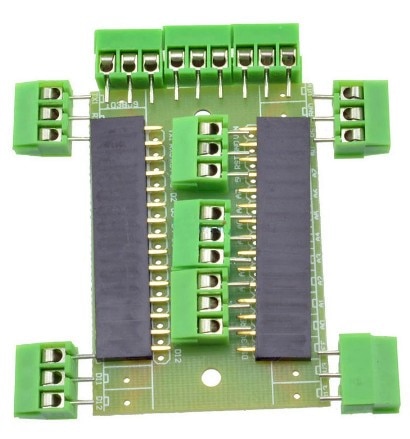
I’ve purchased the Arduino Nano holders above in the past for projects.

image

I have gone one step further and created PCB’s to hold a Nano and a JQ6500 sound module. I can share the KiCAD files if someone is interested. I reluctant to post them until I can improve the quality.

The ellipses shown on the boards proves that just because you can find a KiCAD footprints doesn't mean it is right. The ellipses on the left shows bow-legged pins because the footprint was wider than the actual module. The foot print dimension for the ellipse on the right were also off by 2.54mm. Live and learn.

After baring witness to Shabaz PCB design, I thought what would the E14 Community put as the bare minimum on a project board. I agree "it depends on what you want to do on the board." But I'm thinking there would be some general support even before the project starts. Things like power, protection, options.......

In the above project example. There is power I/P. I included a diode to prevent computer power feeding back into the power supply. I'm thinking maybe a 5V power supply. My design has the JQ6500 being supplied by the Nano. The example above uses 12VDC I/P. The 5V PS used in Shabaz design would be great on this board. Note my design doesn't have any filter capacitors that are see on other PCB's.

I'm currently working on a single Nano multi-function animation PCB. The board would have option to support light, sound and motion. The light would be LED's, the sound is the JQ6500 module and the motion would be some type of motor control. I'm currently thinking 5V servo but that is expanding. The board above supports a MOSFET module to drive a 12V load. There is a input to trigger the Nano with a button and speaker pins. 

I'm trying to get the model railroad community I play in, interested in microcontroller animation. If there was a small inexpensive PCB that allowed them to dabble in Arduino code to create simple animations, Lights coming on in a building. a car horn honking or a door opening on a building (i.e. light, sound and motion) maybe it would generate some interest. 

I'm curious what are your bare minimums for a Arduino project type board?

  • Sign in to reply
  • shabaz
    shabaz over 2 years ago in reply to colporteur

    Circuit related:

    2. The transistor has a lot of gain, it will be fine with the resistor and the 1.6V input. See this link:

    https://tinyurl.com/2qwoufb8

    You'll see the circuit with 1.5V input, and you can control it by clicking on the switch lever, and monitoring the voltmeter connected to the output.

    image

    3. The 47uF capacitor can be near the JQ6500 VCC pin. 

    PCB related:

    2: I find the easiest way is to do it once on any board, and then for any subsequent board you can go to File->Board Setup and click on Import Settings from Another Board as shown here:

    image

    I select a few things from the list usually, as shown above. Then click Import Settings.

    5. In the schematic, press A to add a component, and type 'hole' and you'll see it, double-click it to put it in the schematic:

    image

    Then, once it is in your schematic, press F to select the footprint, and you can again type hole, and then scroll down to M3 and double-click it:

    image

    6/7: It's easy, here are the steps:

    Firstly, delete any GND traces back to yellow lines:

    image

    Next, take a look at the traces which are on the side of the board with the least traces. The blue side in this example. See if you can replace with traces on the red side. In the example below, I made all the blue traces red, apart from two remaining traces which are not as easy, so I left them alone (optionally, I rerouted one to be closer to the other one):

    image

    Next, click on the blue Add a Filled Zone icon, and then click just inside any corner of the board. A window will pop up, and select both top and bottom layers and select the GND net, as shown in the screenshot below. Then click on OK.

    image

    Now continue to click on the remaining corners of the board, as shown below:

    image

    Finally, when you click back on the first corner to complete the shape, you'll see a hatched pattern appear on the path that was drawn as shown here:

    image

    You're done! Press B to perform the fill calculation operation, and hit escape if any net is selected, and you'll see the following:

    image

    If you subsequently move any traces, you'll have to press the B key again to re-calculate the ground plane.

    You can confirm that the ground plane is very good, by seeing the other side using the 3D viewer:

    image

    The screenshot above shows that nearly the entire copper is ground plane, very little is broken. This is fine.

    Now, you can add a few vias to join the top and bottom ground planes (it is not essential for this board, but nice to do so). To do that, first set the grid to 5mm or larger, and then click on the round via icon, and place vias in empty parts of the board, avoiding traces and silkscreen. 

    image

    10. I mean right angles coming off pads. Once the trace is beyond the pad, then it would be 45 degrees. There's no electrical reason, it's personal preference.

    For instance in the last screenshot above, the 5V trace at the bottom is at 45 degrees into the pad on the Nano. I would change it to:

    image

    I hope this helps! Many of these things are minor or cosmetic, but I figured it is good to mention them anyway.


    • Cancel
    • Vote Up 0 Vote Down
    • Sign in to reply
    • More
    • Cancel
  • colporteur
    colporteur over 2 years ago in reply to shabaz

    I have a few questions. I identify them according to number.

    Circuit Related:

    2. The busy pin from the JQ6500 is 1.6V when active. It appears to drive an LED. When it is hooked to the transistor the LED fails to light. Will moving the resistor from emitter to base be impacted by the low base input voltage?

    3. I'm not sure location of the 47uf decouple cap, close to JQ6500?

    6. A consideration I have on the drawing board.

    6a. The JQ6500 has five pins if grounded play an associated file. I'm pinning those so the JQ6500 can play random files or play a file if one of the external pins are triggered

    PCB Related:

    2. Is there a place to change defaults to be used all times. I make changes every time I use the software. I haven't figured out set defaults.

    4. I've seen it used and like.

    5. Need to learn how to do this.

    6/7. I have posted questions on this in the community. I have been unable to gain confidence to use it.

    8. Will do

    10. I read somewhere right angles in traces is frowned upon.

    11. Good point. I've fixed it sometime and others I haven't. I need to be more consistent.

    12. Good point. I haven't started putting things in enclosures but make sense.

    13. Again that inconsistent thing.

    14. I try to get them where I can see them. I forget this stuff and need reminders.

    Send me the link to your favourite coffee shop, I owe you a few cups in return.

    • Cancel
    • Vote Up 0 Vote Down
    • Sign in to reply
    • More
    • Cancel
  • shabaz
    shabaz over 2 years ago in reply to shabaz

    One more point:

    15: I find it a struggle to create PCBs with many through-hole components. I'd definitely recommend slowly getting into surface-mount. For instance, for a first PCB, you could replace the resistors with surface-mount ones (0805 size is great). You'll see that they are easy to solder because they are as large as small through-hole parts. There are lots of suggestions on tweezers, soldering iron shape and solder thickness etc on various blogs, and it will all end up feeling a lot simpler than through-hole parts. For a second board, you could consider replacing any transistors with surface-mount ones in SOT-23 package, which again is large and easy-to-solder.

    • Cancel
    • Vote Up 0 Vote Down
    • Sign in to reply
    • More
    • Cancel
  • colporteur
    colporteur over 2 years ago in reply to scottiebabe

    Cool resource! I have only discovered Apply External Vin Power Backwards lets the smoke out.

    • Cancel
    • Vote Up 0 Vote Down
    • Sign in to reply
    • More
    • Cancel
  • shabaz
    shabaz over 2 years ago in reply to shabaz

    (Can't edit)

    I got the link wrong, it should be:

    https://www.youtube.com/watch?v=5Be7XOMmPQE&t=933s

    • Cancel
    • Vote Up 0 Vote Down
    • Sign in to reply
    • More
    • Cancel
<>
element14 Community

element14 is the first online community specifically for engineers. Connect with your peers and get expert answers to your questions.

  • Members
  • Learn
  • Technologies
  • Challenges & Projects
  • Products
  • Store
  • About Us
  • Feedback & Support
  • FAQs
  • Terms of Use
  • Privacy Policy
  • Legal and Copyright Notices
  • Sitemap
  • Cookies

An Avnet Company © 2026 Premier Farnell Limited. All Rights Reserved.

Premier Farnell Ltd, registered in England and Wales (no 00876412), registered office: Farnell House, Forge Lane, Leeds LS12 2NE.

ICP 备案号 10220084.

Follow element14

  • X
  • Facebook
  • linkedin
  • YouTube