element14 Community
element14 Community
    Register Log In
  • Site
  • Search
  • Log In Register
  • Community Hub
    Community Hub
    • What's New on element14
    • Feedback and Support
    • Benefits of Membership
    • Personal Blogs
    • Members Area
    • Achievement Levels
  • Learn
    Learn
    • Ask an Expert
    • eBooks
    • element14 presents
    • Learning Center
    • Tech Spotlight
    • STEM Academy
    • Webinars, Training and Events
    • Learning Groups
  • Technologies
    Technologies
    • 3D Printing
    • FPGA
    • Industrial Automation
    • Internet of Things
    • Power & Energy
    • Sensors
    • Technology Groups
  • Challenges & Projects
    Challenges & Projects
    • Design Challenges
    • element14 presents Projects
    • Project14
    • Arduino Projects
    • Raspberry Pi Projects
    • Project Groups
  • Products
    Products
    • Arduino
    • Avnet & Tria Boards Community
    • Dev Tools
    • Manufacturers
    • Multicomp Pro
    • Product Groups
    • Raspberry Pi
    • RoadTests & Reviews
  • About Us
  • Store
    Store
    • Visit Your Store
    • Choose another store...
      • Europe
      •  Austria (German)
      •  Belgium (Dutch, French)
      •  Bulgaria (Bulgarian)
      •  Czech Republic (Czech)
      •  Denmark (Danish)
      •  Estonia (Estonian)
      •  Finland (Finnish)
      •  France (French)
      •  Germany (German)
      •  Hungary (Hungarian)
      •  Ireland
      •  Israel
      •  Italy (Italian)
      •  Latvia (Latvian)
      •  
      •  Lithuania (Lithuanian)
      •  Netherlands (Dutch)
      •  Norway (Norwegian)
      •  Poland (Polish)
      •  Portugal (Portuguese)
      •  Romania (Romanian)
      •  Russia (Russian)
      •  Slovakia (Slovak)
      •  Slovenia (Slovenian)
      •  Spain (Spanish)
      •  Sweden (Swedish)
      •  Switzerland(German, French)
      •  Turkey (Turkish)
      •  United Kingdom
      • Asia Pacific
      •  Australia
      •  China
      •  Hong Kong
      •  India
      • Japan
      •  Korea (Korean)
      •  Malaysia
      •  New Zealand
      •  Philippines
      •  Singapore
      •  Taiwan
      •  Thailand (Thai)
      • Vietnam
      • Americas
      •  Brazil (Portuguese)
      •  Canada
      •  Mexico (Spanish)
      •  United States
      Can't find the country/region you're looking for? Visit our export site or find a local distributor.
  • Translate
  • Profile
  • Settings
Arduino
  • Products
  • More
Arduino
Arduino Forum Transistor as an analog input
  • Blog
  • Forum
  • Documents
  • Quiz
  • Events
  • Polls
  • Files
  • Members
  • Mentions
  • Sub-Groups
  • Tags
  • More
  • Cancel
  • New
Join Arduino to participate - click to join for free!
Actions
  • Share
  • More
  • Cancel
Forum Thread Details
  • State Verified Answer
  • Replies 19 replies
  • Answers 2 answers
  • Subscribers 404 subscribers
  • Views 2966 views
  • Users 0 members are here
  • transistor
  • input
  • arduino
  • analog
Related

Transistor as an analog input

dirtdiver
dirtdiver over 13 years ago

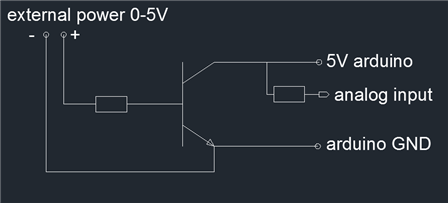
If i were to use a transtor as an analog input device is that the proper way to connect it to the arduino?image

Thanks!

  • Sign in to reply
  • Cancel
Parents
  • Former Member
    0 Former Member over 13 years ago

    I think that setup will always read 5V on the analog input. That setup will adjust the current.

    • Cancel
    • Vote Up 0 Vote Down
    • Sign in to reply
    • Verify Answer
    • Cancel
  • dirtdiver
    0 dirtdiver over 13 years ago in reply to Former Member

    I found that in a forum where everyone knew everything image Thats why i like to doublecheck stuff.

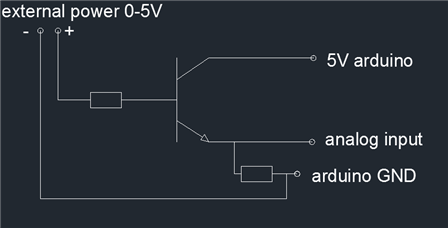
    So what if i wire it like its a button , but instead of connecting it to a Digital pin i use an analog one?


    image

    • Cancel
    • Vote Up 0 Vote Down
    • Sign in to reply
    • Verify Answer
    • Cancel
  • michaelkellett
    0 michaelkellett over 13 years ago in reply to dirtdiver

    This latest circuit is a badly implemented common base amplifier - it will have  a low input impedance and very unpredictable gain because the collector load is undefined.


    Tell me what your input signal is and I'll try to help you properly.


    Michael Kellett.

    • Cancel
    • Vote Up 0 Vote Down
    • Sign in to reply
    • Verify Answer
    • Cancel
  • dirtdiver
    0 dirtdiver over 13 years ago in reply to michaelkellett

    Well all im trying  to do is to have an rc receiver comunicate to the arduino.I think the best way is to use a transistor (the receiver is intended to drive a servo so im going to use the signal wire and the ground wire to drive the transistor)

    if thats not an option i guess i can use optocouplers or something similar

    • Cancel
    • Vote Up 0 Vote Down
    • Sign in to reply
    • Verify Answer
    • Cancel
  • michaelkellett
    0 michaelkellett over 13 years ago in reply to dirtdiver

    If it's a standard RC type receiver with a pulse width modulated output you don't need to do it like this - you canuse a digital input and measure the poulse widths. Can you tell me the type and spec of the receiver.


    (BTW there is a lot of info available re. RC controler -> Arduino - try http://rcarduino.blogspot.co.uk/2012/01/how-to-read-rc-receiver-with.html


    Michael Kellett

    • Cancel
    • Vote Up 0 Vote Down
    • Sign in to reply
    • Verify Answer
    • Cancel
  • dirtdiver
    0 dirtdiver over 13 years ago in reply to michaelkellett

    its a 4 in 1 esky receiver.

    I have two servo "channels" so Digital read for these /or pilsein?

    and two motor connectors (i need a couple of transistors for them couse my 4th channel is actually speeding one up and slowing the other)and with code i can use that difference as a regular channel and have it doing something i want-which wont be possible without the arduino

    • Cancel
    • Vote Up 0 Vote Down
    • Sign in to reply
    • Verify Answer
    • Cancel
  • YT2095
    0 YT2095 over 13 years ago in reply to dirtdiver

    if you`re really concerned, you could use a 74125 hex Buffer IC image

    • Cancel
    • Vote Up 0 Vote Down
    • Sign in to reply
    • Verify Answer
    • Cancel
  • dirtdiver
    0 dirtdiver over 13 years ago in reply to YT2095

    Im trying to keep it as simple as possible , thats why i wanted to do it with transistors, but as a last resort i could look into something like this

    • Cancel
    • Vote Up 0 Vote Down
    • Sign in to reply
    • Verify Answer
    • Cancel
  • YT2095
    0 YT2095 over 13 years ago in reply to dirtdiver

    it`s a Quad buffer btw, my mistake, I was thinking of the Hex version.

    eitherway, it`s going to be just as easy as transistors, and there`s 4 of them on the chip (so you could do 4 inputs if you wanted), you simply give the IC 5 volts, then you have signal in and signal out.

    that`s it really, just make sure the buffer is enabled and you`re all done.

    the other way would be a simple Voltage follower using an op-amp, again no other external parts needed, and if you used a C1458, you have 2 of them on a little 8 pin chip image

    no harder than using Opto couplers etc...

    • Cancel
    • Vote Up 0 Vote Down
    • Sign in to reply
    • Verify Answer
    • Cancel
  • dirtdiver
    0 dirtdiver over 13 years ago in reply to YT2095

    Oh, now that i think about it you are right! I will deffeenetly look into this , so i just put the signal wire(or the +) in and the signal out goes to analog input?

    • Cancel
    • Vote Up 0 Vote Down
    • Sign in to reply
    • Verify Answer
    • Cancel
Reply
  • dirtdiver
    0 dirtdiver over 13 years ago in reply to YT2095

    Oh, now that i think about it you are right! I will deffeenetly look into this , so i just put the signal wire(or the +) in and the signal out goes to analog input?

    • Cancel
    • Vote Up 0 Vote Down
    • Sign in to reply
    • Verify Answer
    • Cancel
Children
No Data
element14 Community

element14 is the first online community specifically for engineers. Connect with your peers and get expert answers to your questions.

  • Members
  • Learn
  • Technologies
  • Challenges & Projects
  • Products
  • Store
  • About Us
  • Feedback & Support
  • FAQs
  • Terms of Use
  • Privacy Policy
  • Legal and Copyright Notices
  • Sitemap
  • Cookies

An Avnet Company © 2025 Premier Farnell Limited. All Rights Reserved.

Premier Farnell Ltd, registered in England and Wales (no 00876412), registered office: Farnell House, Forge Lane, Leeds LS12 2NE.

ICP 备案号 10220084.

Follow element14

  • X
  • Facebook
  • linkedin
  • YouTube