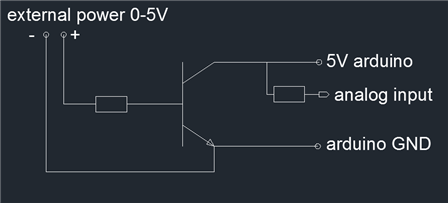
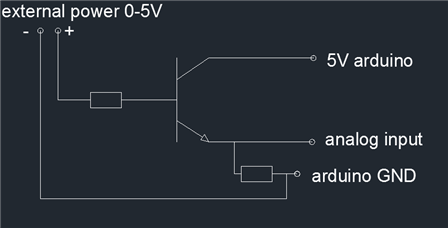
This latest circuit is a badly implemented common base amplifier - it will have a low input impedance and very unpredictable gain because the collector load is undefined.
Tell me what your input signal is and I'll try to help you properly.
Well all im trying to do is to have an rc receiver comunicate to the arduino.I think the best way is to use a transistor (the receiver is intended to drive a servo so im going to use the signal wire and the ground wire to drive the transistor)
if thats not an option i guess i can use optocouplers or something similar
If it's a standard RC type receiver with a pulse width modulated output you don't need to do it like this - you canuse a digital input and measure the poulse widths. Can you tell me the type and spec of the receiver.
I have two servo "channels" so Digital read for these /or pilsein?
and two motor connectors (i need a couple of transistors for them couse my 4th channel is actually speeding one up and slowing the other)and with code i can use that difference as a regular channel and have it doing something i want-which wont be possible without the arduino
it`s a Quad buffer btw, my mistake, I was thinking of the Hex version.
eitherway, it`s going to be just as easy as transistors, and there`s 4 of them on the chip (so you could do 4 inputs if you wanted), you simply give the IC 5 volts, then you have signal in and signal out.
that`s it really, just make sure the buffer is enabled and you`re all done.
the other way would be a simple Voltage follower using an op-amp, again no other external parts needed, and if you used a C1458, you have 2 of them on a little 8 pin chip
Oh, now that i think about it you are right! I will deffeenetly look into this , so i just put the signal wire(or the +) in and the signal out goes to analog input?